QUESTION IMAGE
Question
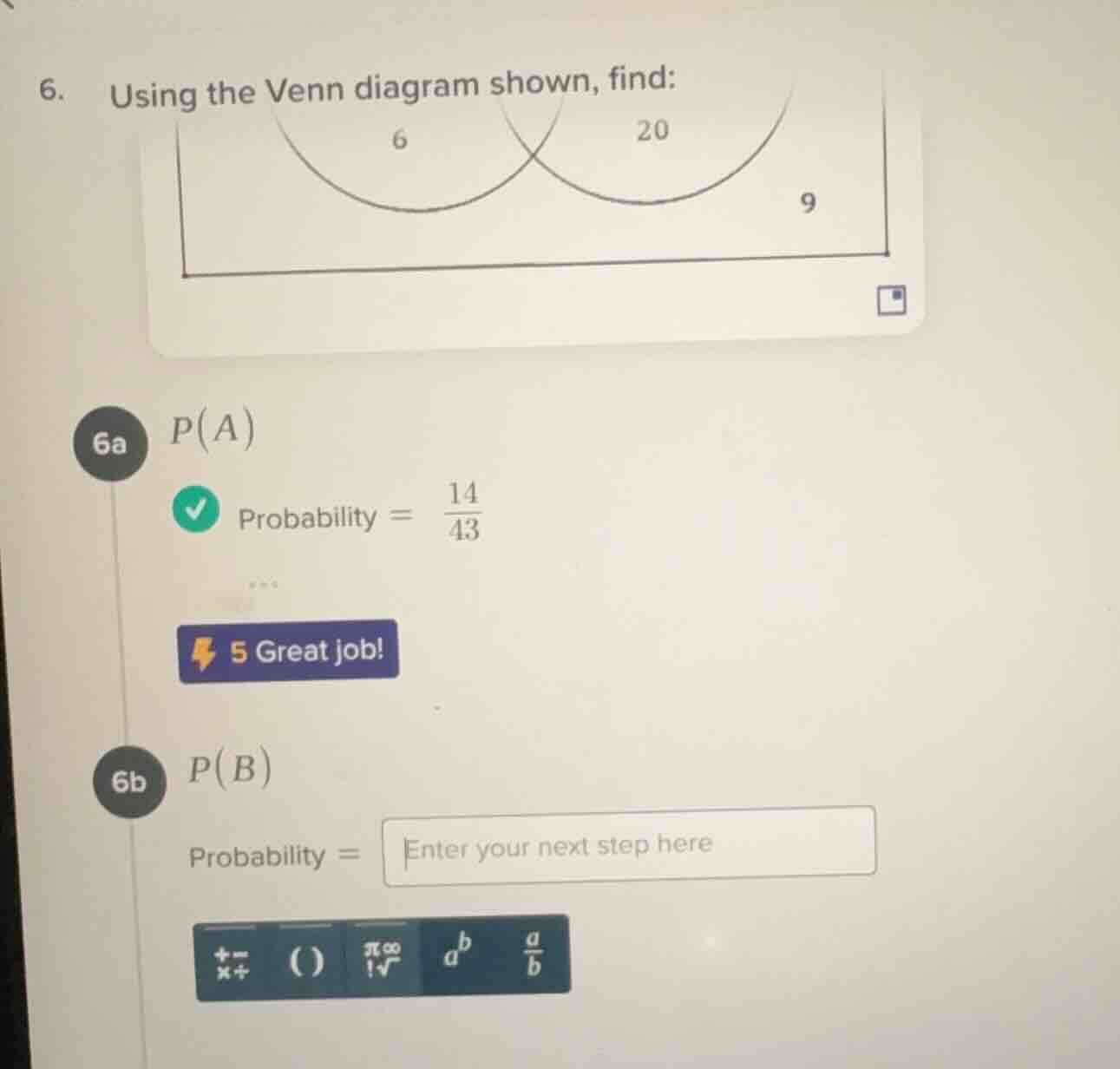
- using the venn diagram shown, find:
6a ( p(a) )
probability ( = \frac{14}{43} )
6b ( p(b) )
probability = enter your next step here
Step1: Find total number of elements
From 6a, we know the total is \( 6 + 20 + 8 + 9 \)? Wait, no, from 6a, \( P(A)=\frac{14}{43} \), so total \( N = 6 + 20 + 8 + 9 \)? Wait, no, let's see: For \( P(A) \), the number of elements in A is \( 6 + 8 \) (assuming the overlapping part is 8? Wait, no, in 6a, \( P(A)=\frac{14}{43} \), so number of elements in A is 14, total is 43. Now for \( P(B) \), the number of elements in B is \( 20 + 8 \)? Wait, no, let's re-express. Wait, the Venn diagram has two circles, A and B, with A having 6 (only A), B having 20 (only B), overlapping part (both A and B) let's say x, and outside both is 9. From 6a, \( P(A)=\frac{6 + x}{6 + x + 20 + 9}=\frac{14}{43} \), so \( 6 + x = 14 \), so x = 8. Then number of elements in B is \( 20 + 8 = 28 \). Total is 43. So \( P(B)=\frac{28}{43} \).
Wait, let's check: Total elements \( N = 6 + 8 + 20 + 9 = 43 \). Number of elements in B: only B (20) + both (8) = 28. So \( P(B)=\frac{28}{43} \).
Step2: Calculate \( P(B) \)
Number of elements in B: \( 20 + 8 = 28 \) (since 6 + 8 = 14 for A, so 8 is the overlap). Total elements: 43. So \( P(B)=\frac{28}{43} \).

Snap & solve any problem in the app
Get step-by-step solutions on Sovi AI
Photo-based solutions with guided steps
Explore more problems and detailed explanations
\(\frac{28}{43}\)