QUESTION IMAGE
Question
venice, the sinking city
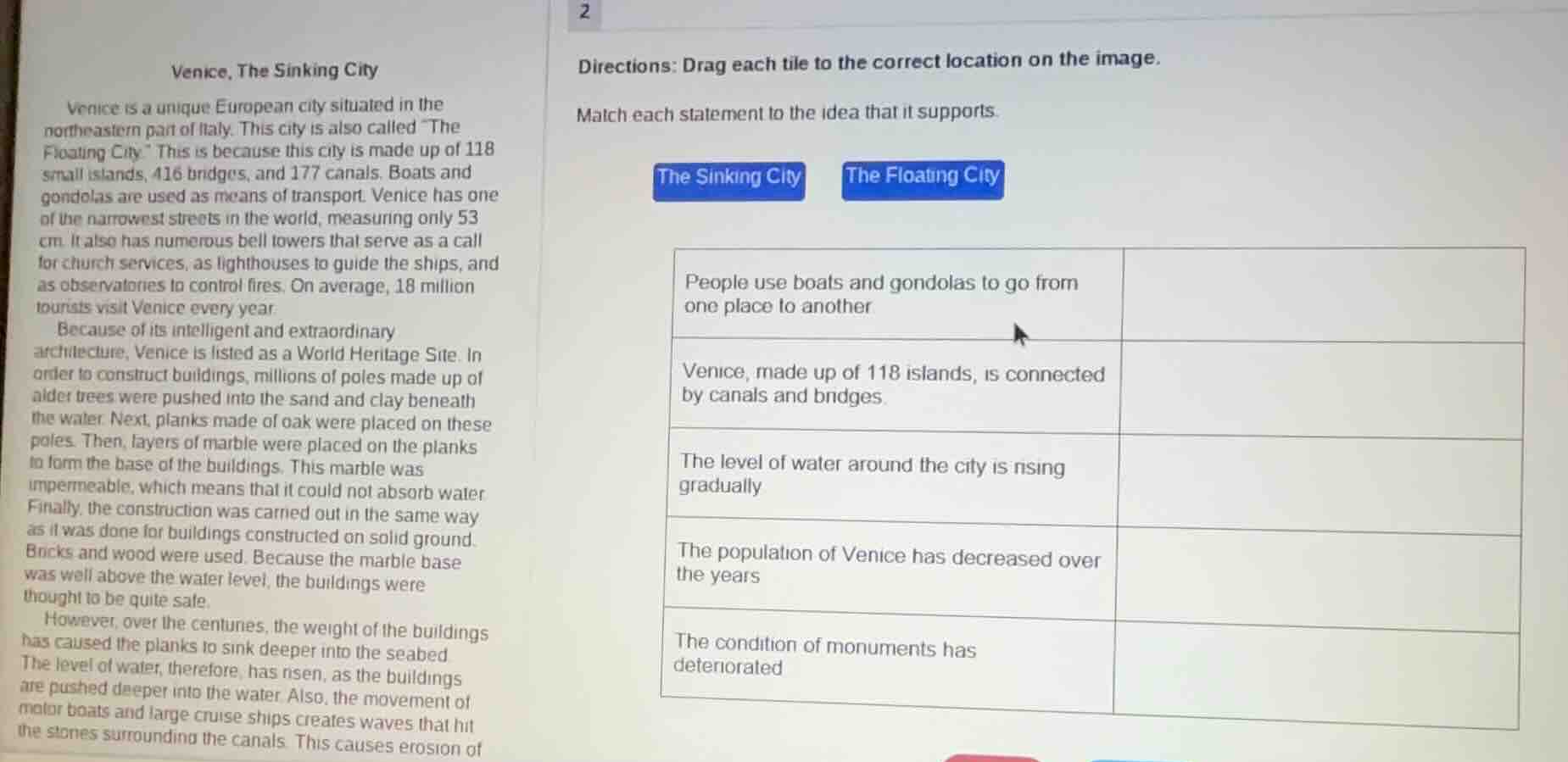
venice is a unique european city situated in the northeastern part of italy. this city is also called \the floating city.\ this is because this city is made up of 118 small islands, 416 bridges, and 177 canals. boats and gondolas are used as means of transport. venice has one of the narrowest streets in the world, measuring only 53 cm. it also has numerous bell towers that serve as a call for church services, as lighthouses to guide the ships, and as observatories to control fires. on average, 18 million tourists visit venice every year.
because of its intelligent and extraordinary architecture, venice is listed as a world heritage site. in order to construct buildings, millions of poles made up of alder trees were pushed into the sand and clay beneath the water. next, planks made of oak were placed on these poles. then, layers of marble were placed on the planks to form the base of the buildings. this marble was impermeable, which means that it could not absorb water. finally, the construction was carried out in the same way as it was done for buildings constructed on solid ground. bricks and wood were used. because the marble base was well above the water level, the buildings were thought to be quite safe.
however, over the centuries, the weight of the buildings has caused the planks to sink deeper into the seabed. the level of water, therefore, has risen, as the buildings are pushed deeper into the water. also, the movement of motor boats and large cruise ships creates waves that hit the stones surrounding the canals. this causes erosion of
2
directions: drag each tile to the correct location on the image.
match each statement to the idea that it supports.
the sinking city the floating city
people use boats and gondolas to go from one place to another
venice, made up of 118 islands, is connected by canals and bridges.
the level of water around the city is rising gradually
the population of venice has decreased over the years
the condition of monuments has deteriorated
- Boat/gondola transport and the island/canal/bridge structure directly describe Venice's identity as a "Floating City" (a city built on water with water-based transit).
- Rising water levels are explicitly linked to Venice sinking in the text.
- A declining population and deteriorated monuments are logical consequences of a sinking city (unlivable conditions, structural damage to historic sites).

Snap & solve any problem in the app
Get step-by-step solutions on Sovi AI
Photo-based solutions with guided steps
Explore more problems and detailed explanations
- The Floating City: People use boats and gondolas to go from one place to another
- The Floating City: Venice, made up of 118 islands, is connected by canals and bridges
- The Sinking City: The level of water around the city is rising gradually
- The Sinking City: The population of Venice has decreased over the years
- The Sinking City: The condition of monuments has deteriorated