QUESTION IMAGE
Question
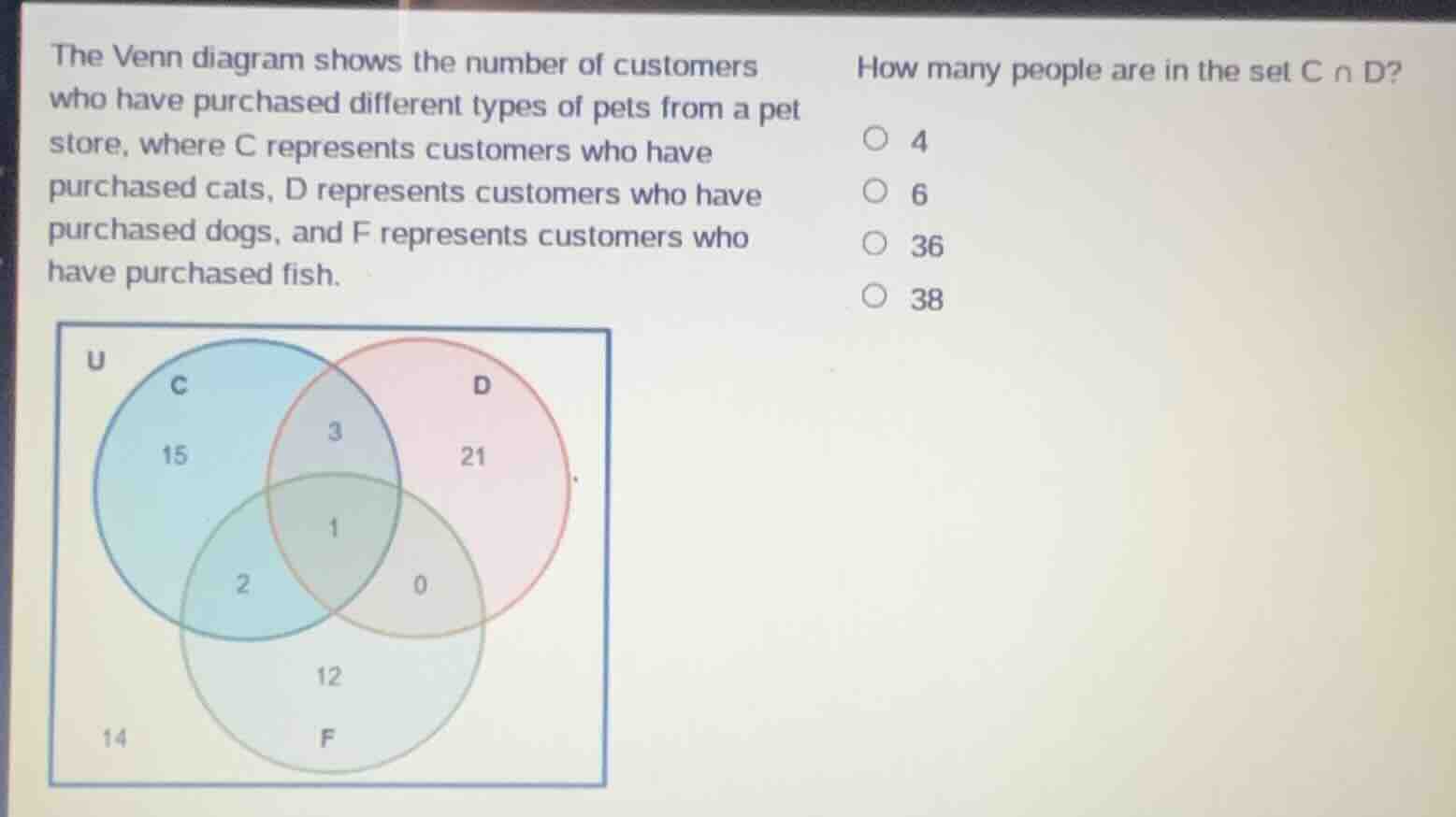
the venn diagram shows the number of customers who have purchased different types of pets from a pet store, where c represents customers who have purchased cats, d represents customers who have purchased dogs, and f represents customers who have purchased fish. how many people are in the set ( c cap d )? 4 6 36 38
Step1: Understand the intersection
The set \( C \cap D \) represents the customers who have purchased both cats and dogs. In a Venn diagram, this is the region that is common to both circles \( C \) and \( D \).
Step2: Identify the numbers in \( C \cap D \)
Looking at the Venn diagram, the region common to \( C \) and \( D \) has two parts: the part only in \( C \cap D \) (not including the intersection with \( F \)) and the part that is in \( C \cap D \cap F \). Wait, no—actually, the notation \( C \cap D \) includes all elements that are in both \( C \) and \( D \), regardless of \( F \). Wait, no, actually, in set theory, \( C \cap D \) is the set of elements that are in both \( C \) and \( D \), so it includes the elements that are in \( C \), \( D \), and also maybe \( F \)? Wait, no, \( C \cap D \) is the intersection of \( C \) and \( D \), so it's all elements that are in both \( C \) and \( D \), regardless of \( F \). Wait, but in the Venn diagram, the overlapping region between \( C \) and \( D \) has two numbers: 3 (the part that's only \( C \cap D \), not including \( F \)) and 1 (the part that's \( C \cap D \cap F \)). Wait, no—wait, the Venn diagram: the circle \( C \) has 15 (only \( C \)), 2 (only \( C \cap F \)), 3 (only \( C \cap D \)), and 1 (all three). The circle \( D \) has 21 (only \( D \)), 0 (only \( D \cap F \)), 3 (only \( C \cap D \)), and 1 (all three). The circle \( F \) has 12 (only \( F \)), 2 (only \( C \cap F \)), 0 (only \( D \cap F \)), and 1 (all three). So the intersection \( C \cap D \) is the set of elements in both \( C \) and \( D \), so that's the 3 (only \( C \cap D \)) plus the 1 (all three, since they are also in \( F \), but still in \( C \) and \( D \)). Wait, no—actually, \( C \cap D \) is the union of the regions that are in both \( C \) and \( D \), so that's the region with 3 (only \( C \) and \( D \), not \( F \)) and the region with 1 ( \( C \), \( D \), and \( F \) ). So we need to add those two numbers: 3 + 1 = 4? Wait, no, wait the options include 4. Wait, let's check again. The problem is asking for \( C \cap D \), which is the number of customers who have purchased both cats and dogs (regardless of fish). So in the Venn diagram, the overlapping area between \( C \) and \( D \) includes the 3 (only cats and dogs) and the 1 (cats, dogs, and fish). So 3 + 1 = 4? Wait, but let's look at the options. The options are 4, 6, 36, 38. Wait, maybe I made a mistake. Wait, maybe \( C \cap D \) is just the part that's in both \( C \) and \( D \) but not including \( F \)? No, set intersection \( C \cap D \) includes all elements in both \( C \) and \( D \), so including those who also have fish. Wait, but let's check the numbers. The circle \( C \) has 15 (only \( C \)), 2 ( \( C \) and \( F \) only), 3 ( \( C \) and \( D \) only), and 1 (all three). The circle \( D \) has 21 (only \( D \)), 0 ( \( D \) and \( F \) only), 3 ( \( C \) and \( D \) only), and 1 (all three). So the number of customers in \( C \cap D \) is the number of customers who are in both \( C \) and \( D \), which is the 3 (only \( C \) and \( D \)) plus the 1 (all three). So 3 + 1 = 4. So the answer should be 4.

Snap & solve any problem in the app
Get step-by-step solutions on Sovi AI
Photo-based solutions with guided steps
Explore more problems and detailed explanations
4