QUESTION IMAGE
Question
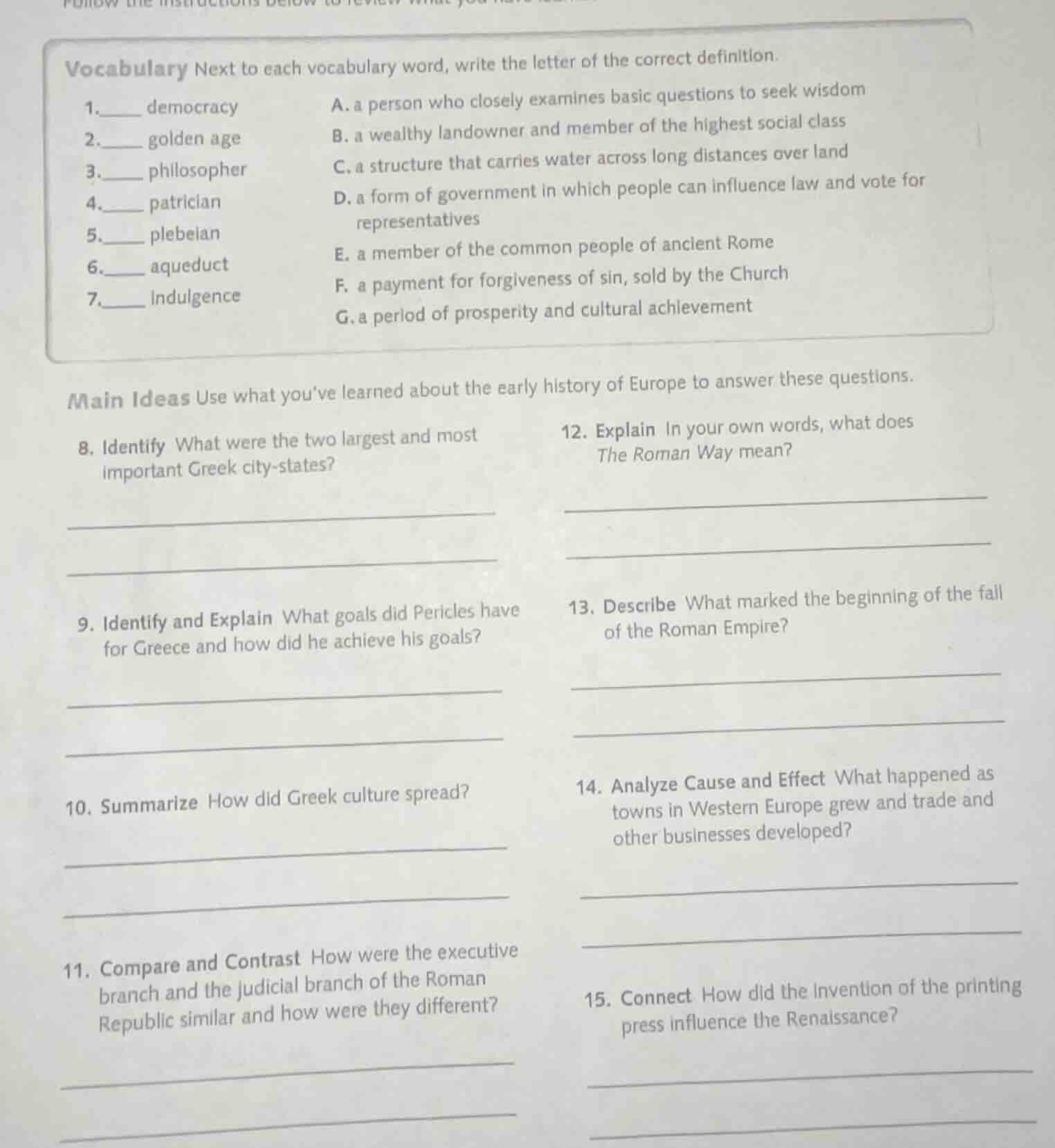
vocabulary next to each vocabulary word, write the letter of the correct definition.
1.____ democracy
2.____ golden age
3.____ philosopher
4.____ patrician
5.____ plebeian
6.____ aqueduct
7.____ indulgence
a. a person who closely examines basic questions to seek wisdom
b. a wealthy landowner and member of the highest social class
c. a structure that carries water across long distances over land
d. a form of government in which people can influence law and vote for representatives
e. a member of the common people of ancient rome
f. a payment for forgiveness of sin, sold by the church
g. a period of prosperity and cultural achievement
main ideas use what youve learned about the early history of europe to answer these questions.
- identify what were the two largest and most important greek city-states?
- identify and explain what goals did pericles have for greece and how did he achieve his goals?
- summarize how did greek culture spread?
- compare and contrast how were the executive branch and the judicial branch of the roman republic similar and how were they different?
- explain in your own words, what does the roman way mean?
- describe what marked the beginning of the fall of the roman empire?
- analyze cause and effect what happened as towns in western europe grew and trade and other businesses developed?
- connect how did the invention of the printing press influence the renaissance?
Vocabulary Matching
Each term is paired with its standard historical definition:
- Democracy is a government where people vote for representatives.
- A golden age is a prosperous, culturally rich period.
- A philosopher seeks wisdom via basic question examination.
- Patricians were Rome's wealthy, elite landowners.
- Plebeians were ancient Rome's common people.
- Aqueducts are structures for long-distance water transport.
- Indulgences were Church sin-forgiveness payments.
Main Ideas
- The two most prominent Greek city-states are widely documented in ancient history.
- Pericles aimed to strengthen Athens' democracy and empire, using Delian League funds for infrastructure and cultural projects.
- Greek culture spread via Alexander the Great's conquests, trade, and Roman adoption of Greek ideas.
- Both Roman branches served the republic; executives (consuls) led militarily/politically, while judges oversaw law and justice.
- "The Roman Way" refers to Rome's values of duty, discipline, loyalty to the state, and adherence to law.
- The fall of Rome began with external invasions, internal political instability, and economic decline.
- Growing Western European towns led to the rise of a merchant class, decline of feudalism, and growth of urban self-governance.
- The printing press made books affordable, spreading Renaissance ideas, increasing literacy, and weakening the Church's monopoly on information.

Snap & solve any problem in the app
Get step-by-step solutions on Sovi AI
Photo-based solutions with guided steps
Explore more problems and detailed explanations
Vocabulary
- D. a form of government in which people can influence law and vote for representatives
- G. a period of prosperity and cultural achievement
- A. a person who closely examines basic questions to seek wisdom
- B. a wealthy landowner and member of the highest social class
- E. a member of the common people of ancient Rome
- C. a structure that carries water across long distances over land
- F. a payment for forgiveness of sin, sold by the Church
Main Ideas
- Athens and Sparta
- Goals: Expand Athenian democracy, make Athens the leading power in Greece, and promote cultural achievement. He achieved this by paying citizens to participate in government, using Delian League funds to rebuild Athens and fund arts, and strengthening the Athenian navy.
- Greek culture spread primarily through Alexander the Great's military conquests (which created a vast empire where Greek language and ideas were adopted), trade networks across the Mediterranean, and later, the Roman Empire's absorption and spread of Greek philosophy, art, and science.
- Similarity: Both branches were part of the Roman Republic's system of checks and balances, and members were drawn from the elite class.
Difference: The executive branch (led by two consuls) was responsible for military command, governing the state, and proposing laws. The judicial branch (led by praetors) was responsible for interpreting laws, overseeing courts, and settling legal disputes.
- "The Roman Way" refers to the set of values and practices that defined Roman society, including loyalty to the state, respect for law and authority, discipline, duty, and a focus on practicality and military virtue.
- The beginning of the fall of the Roman Empire is marked by a combination of external invasions (by groups like the Visigoths and Vandals), political instability (frequent changes in emperors, corruption), economic decline (inflation, over-reliance on slave labor), and weakening military forces.
- As towns grew and trade developed, a new merchant and middle class emerged, which challenged the traditional feudal social order. Towns gained more self-governance, guilds were formed to protect workers' rights, and the shift from a land-based economy to a money-based economy weakened feudalism.
- The printing press allowed for the mass production of books, making Renaissance ideas (humanism, art, science) accessible to a much wider audience beyond the wealthy and clergy. It increased literacy rates, spread critical thinking, and helped challenge the Catholic Church's monopoly on information, accelerating the spread of Renaissance and Reformation ideas across Europe.