QUESTION IMAGE
Question
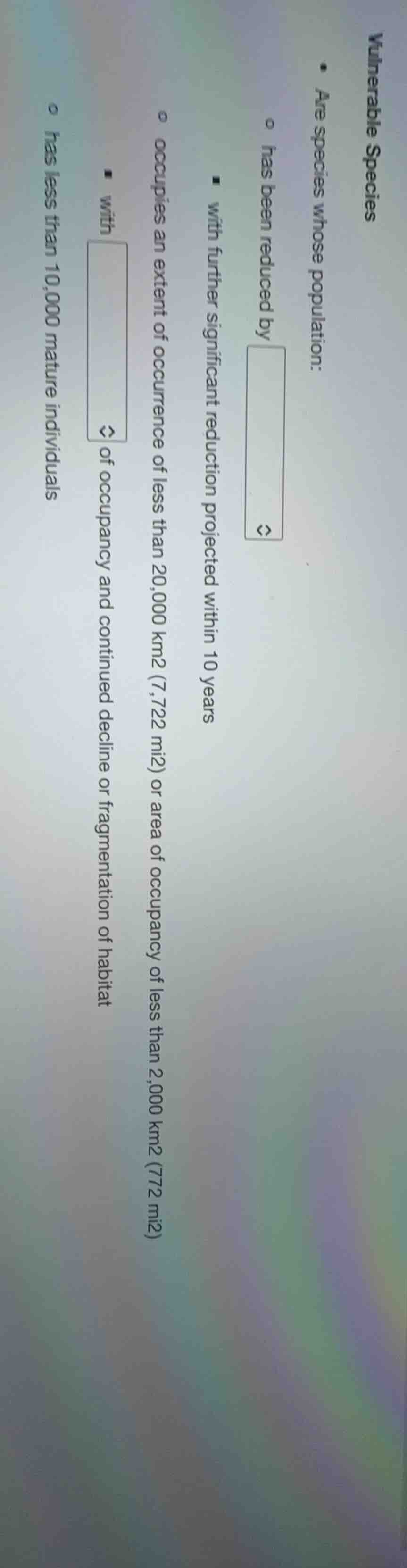
vulnerable species - are species whose population: - has been reduced by <> - with further significant reduction projected within 10 years - occupies an extent of occurrence of less than 20,000 km2 (7,722 mi2) or area of occupancy of less than 2,000 km2 (772 mi2) - with <> of occupancy and continued decline or fragmentation of habitat - has less than 10,000 mature individuals
To fill in the blanks for the definition of vulnerable species, we refer to the IUCN Red List criteria for vulnerable species:
First Blank (Population Reduction):
Vulnerable species are those whose population has been reduced by ≥ 30% (this is a key criterion from IUCN: a population reduction of at least 30% over the last 10 years or three generations, whichever is longer, or with a projected reduction of ≥ 30% in the next 10 years/three generations). So the first blank should be filled with a value like "30% or more" (or "≥ 30%").
Second Blank (Extent/Area of Occupancy):
For the area of occupancy/extent of occurrence, vulnerable species often have an extent of occurrence < 20,000 km² with a continuing decline (or similar phrasing about ongoing reduction) in occupancy/habitat. The second blank relates to the trend of the habitat/occupancy, so terms like "continuing decline", "ongoing reduction", or "further decrease" fit here (aligning with the IUCN criteria of continuing decline in area, extent, or quality of habitat).
Final Filled Definitions (Example):
- “has been reduced by $\boldsymbol{30\%}$ or more” (with further significant reduction projected within 10 years)
- “occupies an extent of occurrence of less than 20,000 km² (7,722 mi²) or area of occupancy of less than 2,000 km² (772 mi²) with $\boldsymbol{continuing\ decline}$ of occupancy and continued decline or fragmentation of habitat”
These values align with the International Union for Conservation of Nature (IUCN) Red List criteria for classifying a species as “Vulnerable.”

Snap & solve any problem in the app
Get step-by-step solutions on Sovi AI
Photo-based solutions with guided steps
Explore more problems and detailed explanations
To fill in the blanks for the definition of vulnerable species, we refer to the IUCN Red List criteria for vulnerable species:
First Blank (Population Reduction):
Vulnerable species are those whose population has been reduced by ≥ 30% (this is a key criterion from IUCN: a population reduction of at least 30% over the last 10 years or three generations, whichever is longer, or with a projected reduction of ≥ 30% in the next 10 years/three generations). So the first blank should be filled with a value like "30% or more" (or "≥ 30%").
Second Blank (Extent/Area of Occupancy):
For the area of occupancy/extent of occurrence, vulnerable species often have an extent of occurrence < 20,000 km² with a continuing decline (or similar phrasing about ongoing reduction) in occupancy/habitat. The second blank relates to the trend of the habitat/occupancy, so terms like "continuing decline", "ongoing reduction", or "further decrease" fit here (aligning with the IUCN criteria of continuing decline in area, extent, or quality of habitat).
Final Filled Definitions (Example):
- “has been reduced by $\boldsymbol{30\%}$ or more” (with further significant reduction projected within 10 years)
- “occupies an extent of occurrence of less than 20,000 km² (7,722 mi²) or area of occupancy of less than 2,000 km² (772 mi²) with $\boldsymbol{continuing\ decline}$ of occupancy and continued decline or fragmentation of habitat”
These values align with the International Union for Conservation of Nature (IUCN) Red List criteria for classifying a species as “Vulnerable.”