QUESTION IMAGE
Question
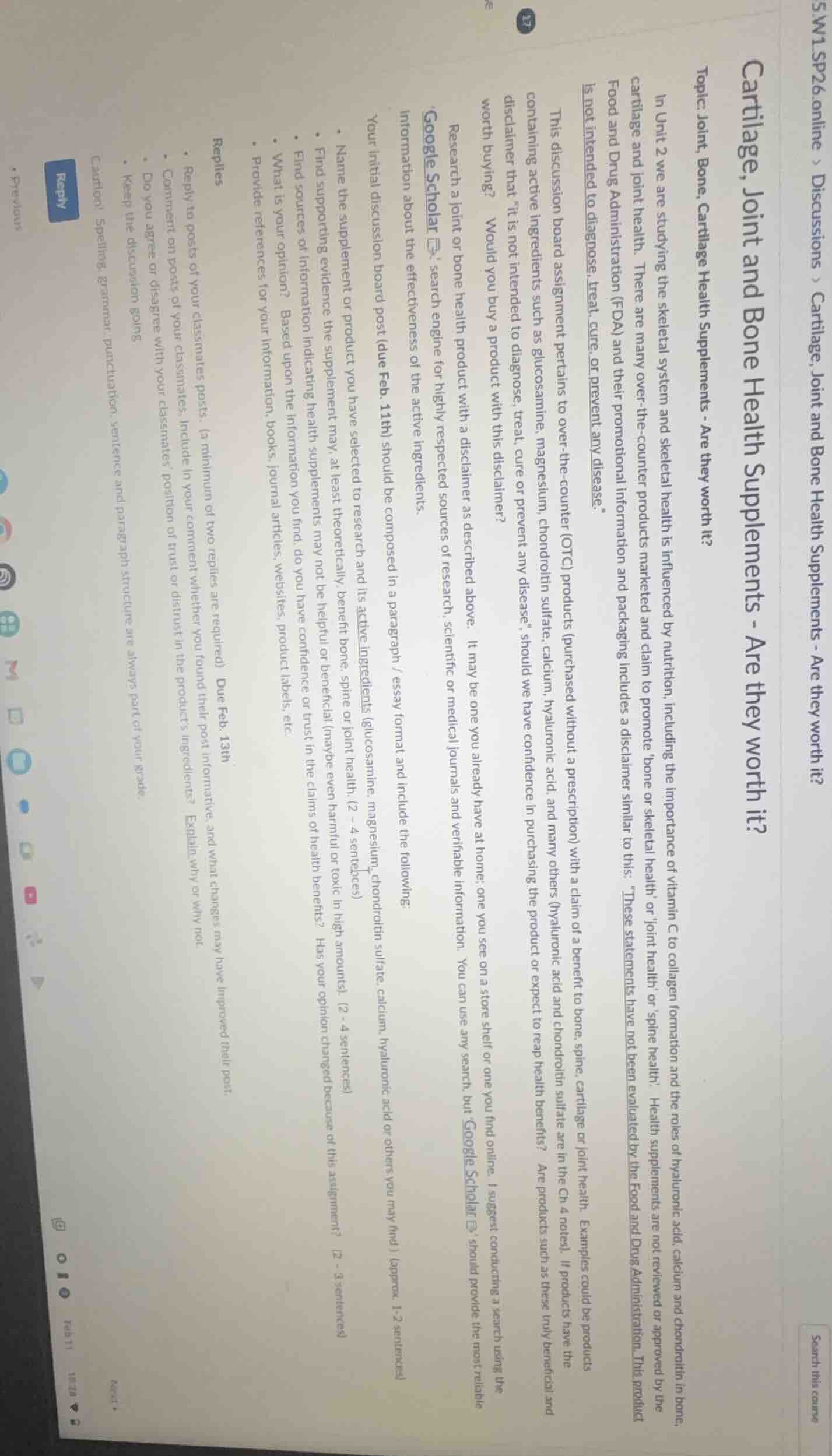
s.w1.sp26.online > discussions > cartilage, joint and bone health supplements - are they worth it?cartilage, joint and bone health supplements - are they worth it?topic: joint, bone, cartilage health supplements - are they worth it?in unit 2 we are studying the skeletal system and skeletal health is influenced by nutrition, including the importance of vitamin c to collagen formation and the roles of hyaluronic acid, calcium and chondroitin in bone, cartilage and joint health. there are many over-the-counter products marketed and claim to promote bone or skeletal health or joint health or spine health. health supplements are not reviewed or approved by the food and drug administration (fda) and their promotional information and packaging includes a disclaimer similar to this: these statements have not been evaluated by the food and drug administration. this product is not intended to diagnose, treat, cure, or prevent any disease.this discussion board assignment pertains to over-the-counter (otc) products (purchased without a prescription) with a claim of a benefit to bone, spine, cartilage or joint health. examples could be products containing active ingredients such as glucosamine, magnesium, chondroitin sulfate, calcium, hyaluronic acid, and many others (hyaluronic acid and chondroitin sulfate are in the ch 4 notes). if products have the disclaimer that it is not intended to diagnose, treat, cure or prevent any disease, should we have confidence in purchasing the product or expect to reap health benefits? are products such as these truly beneficial and worth buying? would you buy a product with this disclaimer?research a joint or bone health product with a disclaimer as described above. it may be one you already have at home; one you see on a store shelf or one you find online. i suggest conducting a search using the google scholar search engine for highly respected sources of research, scientific or medical journals and verifiable information. you can use any search, but google scholar should provide the most reliable information about the effectiveness of the active ingredients.your initial discussion board post (due feb. 11th) should be composed in a paragraph / essay format and include the following:• name the supplement or product you have selected to research and its active ingredients (glucosamine, magnesium, chondroitin sulfate, calcium, hyaluronic acid or others you may find.) (approx. 1-2 sentences)• find supporting evidence the supplement may, at least theoretically, benefit bone, spine or joint health. (2 - 4 sentences)• find sources of information indicating health supplements may not be helpful or beneficial (maybe even harmful or toxic in high amounts). (2 - 4 sentences)• what is your opinion? based upon the information you find, do you have confidence or trust in the claims of health benefits? has your opinion changed because of this assignment? (2 - 3 sentences)• provide references for your information, books, journal articles, websites, product labels, etc.replies• reply to posts of your classmates posts. (a minimum of two replies are required) due feb. 13th• comment on posts of your classmates. include in your comment whether you found their post informative, and what changes may have improved their post.• do you agree or disagree with your classmates position of trust or distrust in the products ingredients? explain why or why not.• keep the discussion goingcaution! spelling, grammar, punctuation, sentence and paragraph structure are always part of your grade.replyprevious
This is a discussion assignment focused on evaluating over-the-counter joint and bone health supplements. To complete the initial post:
- Select a supplement (e.g., glucosamine/chondroitin complex) and use Google Scholar to find peer-reviewed studies on its active ingredients.
- Synthesize evidence: note that some studies show mild pain relief for osteoarthritis, while others find no significant benefit; high doses of certain ingredients (like calcium) may carry risks.
- Formulate an opinion: limited, inconsistent evidence means low confidence in broad health claims; the FDA disclaimer highlights lack of rigorous testing, so I would not buy such a product without consulting a healthcare provider.
- Cite relevant sources (e.g., clinical trial meta-analyses from journals like Arthritis & Rheumatology).
For peer replies:
- Respond to at least two classmates, evaluating the informativeness of their posts.
- State agreement/disagreement with their trust in the product, justifying with shared or new evidence from credible sources.

Snap & solve any problem in the app
Get step-by-step solutions on Sovi AI
Photo-based solutions with guided steps
Explore more problems and detailed explanations
Initial Post (Example):
- I selected a glucosamine and chondroitin sulfate supplement. A 2023 meta-analysis in Arthritis & Rheumatology found the combination provided statistically significant but mild pain reduction in adults with knee osteoarthritis, but no measurable improvement in cartilage structure. A separate 2022 study in JAMA Internal Medicine found no joint health benefits for adults without osteoarthritis, and noted potential mild gastrointestinal side effects.
- Based on this, I have low confidence in the product's broad health claims. The FDA disclaimer reinforces that these products lack the rigorous testing required for prescription medications, so I would not purchase this supplement. I would only consider it if recommended by a doctor for targeted osteoarthritis symptom management.
- Sources:
- Hochberg, M. C., et al. (2023). Glucosamine, Chondroitin, and Knee Osteoarthritis Pain: A Systematic Review and Meta-Analysis. Arthritis & Rheumatology, 75(4), 625-634.
- Felson, D. T., et al. (2022). Effect of Glucosamine and Chondroitin on Joint Structure and Pain in Adults Without Osteoarthritis. JAMA Internal Medicine, 182(11), 1186-1193.
Peer Reply Example 1:
Your post did a great job highlighting the variability in study results for magnesium supplements. I agree with your position of distrust in the product's claims—like you noted, the 2021 Journal of Bone and Mineral Research study found magnesium only benefits joint health in people with severe deficiencies, which most adults do not have. Your point about the disclaimer emphasizing lack of FDA review is especially important, as it means the product's ingredient purity isn't verified.
Peer Reply Example 2:
I disagree with your confidence in hyaluronic acid supplements. While you cited a small 2024 study showing positive results, a larger 2023 meta-analysis in The New England Journal of Medicine found no consistent improvement in joint function or pain across 12 randomized controlled trials. The FDA disclaimer is critical here because it means the company doesn't have to prove the product delivers on its claims, so we can't be sure the hyaluronic acid in the product is even bioavailable to joint tissue.