QUESTION IMAGE
Question
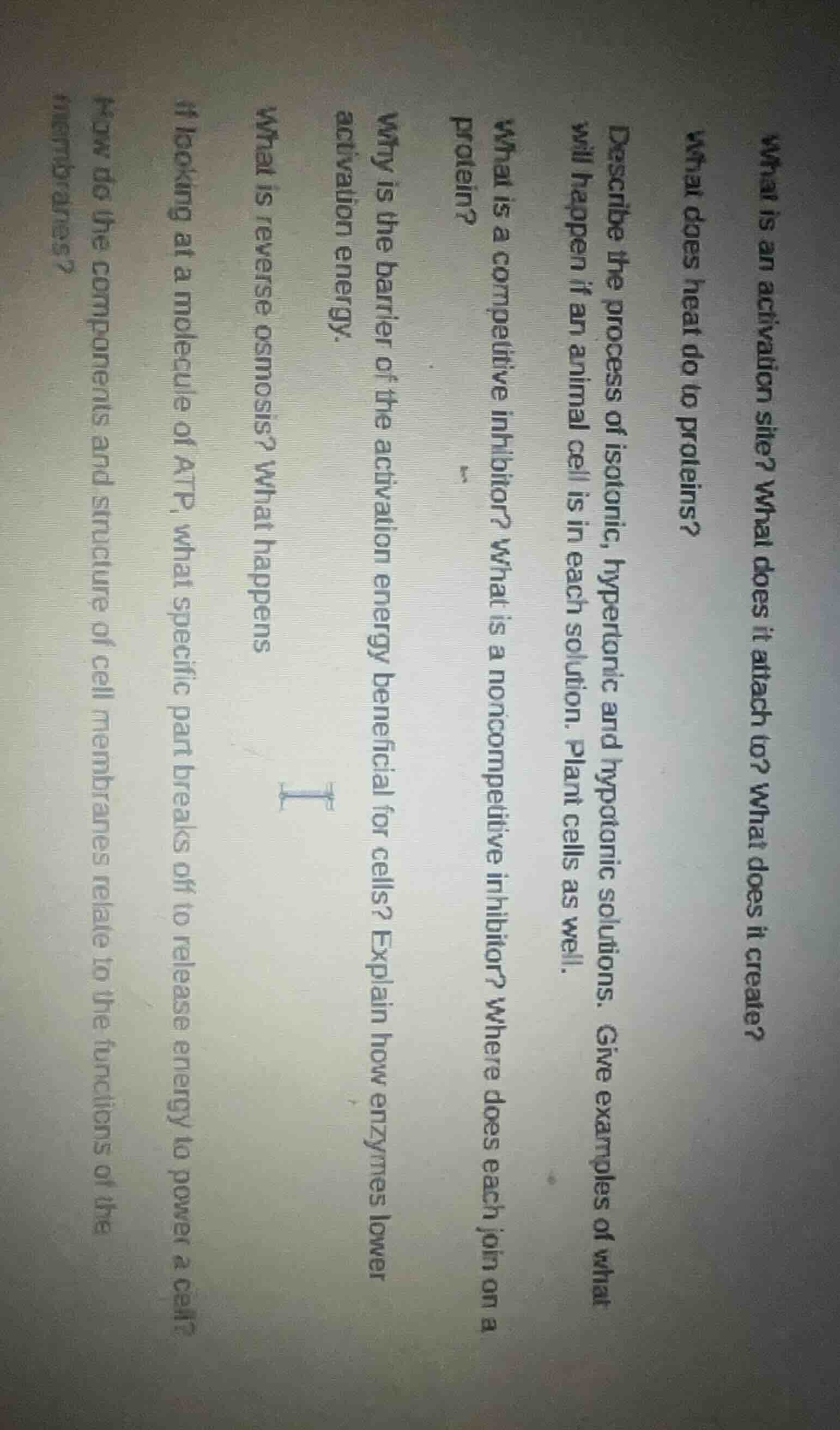
what is an activation site? what does it attach to? what does it create?
what does heat do to proteins?
describe the process of isotonic, hypertonic and hypotonic solutions. give examples of what will happen if an animal cell is in each solution. plant cells as well.
what is a competitive inhibitor? what is a noncompetitive inhibitor? where does each join on a protein?
why is the barrier of the activation energy beneficial for cells? explain how enzymes lower activation energy.
what is reverse osmosis? what happens
if looking at a molecule of atp, what specific part breaks off to release energy to power a cell?
how do the components and structure of cell membranes relate to the functions of the membranes?
Since there are multiple sub - questions related to biological concepts (such as cell membranes, osmosis, enzymes, protein inhibitors, etc.), we will use the Answer - Explanation Format for each sub - question:
Sub - question 1: What is an activation site? What does it attach to? What does it create?
An activation site (more accurately, an active site) is a region on an enzyme where the substrate binds. The substrate (the reactant molecule in an enzyme - catalyzed reaction) attaches to the active site. When the substrate binds to the active site, an enzyme - substrate complex is formed. This complex then undergoes a reaction to form the product(s) of the reaction, and the enzyme is released to catalyze another reaction.
Heat can cause proteins to denature. Denaturation involves the disruption of the protein's specific three - dimensional structure, including the secondary, tertiary, and in some cases, quaternary structures. This disruption is often due to the breaking of weak bonds (like hydrogen bonds, hydrophobic interactions, etc.) that maintain the protein's structure. As a result, the protein loses its specific biological activity (such as the catalytic activity of an enzyme or the binding ability of a receptor).
- Isotonic solution: The concentration of solutes is the same inside and outside the cell.
- For animal cells: There is no net movement of water across the cell membrane. The cell maintains its normal shape and size. For example, if a red blood cell is in an isotonic saline solution (like 0.9% NaCl solution), it will look normal.
- For plant cells: The cell also has no net water movement. The turgor pressure is maintained at a normal level, and the plant cell remains firm. For example, a plant cell in a solution with the same solute concentration as the cell sap.
- Hypertonic solution: The concentration of solutes is higher outside the cell than inside.
- For animal cells: Water moves out of the cell (osmosis) as water moves from an area of lower solute concentration (inside the cell) to an area of higher solute concentration (outside the cell). The cell shrinks (crenation in the case of red blood cells). For example, if a red blood cell is placed in a very concentrated salt solution, it will shrink.
- For plant cells: Water moves out of the cell, and the protoplast (the living part of the cell inside the cell wall) shrinks and pulls away from the cell wall (plasmolysis). For example, a plant cell in a concentrated sucrose solution.
- Hypotonic solution: The concentration of solutes is lower outside the cell than inside.
- For animal cells: Water moves into the cell (osmosis) as water moves from an area of lower solute concentration (outside the cell) to an area of higher solute concentration (inside the cell). The cell swells and may even burst (lysis) because animal cells do not have a rigid cell wall to prevent excessive swelling. For example, if a red blood cell is placed in pure water, it will swell and burst.
- For plant cells: Water moves into the cell, and the cell becomes turgid (swells). The rigid cell wall prevents the cell from bursting. For example, a plant cell in pure water will become turgid.

Snap & solve any problem in the app
Get step-by-step solutions on Sovi AI
Photo-based solutions with guided steps
Explore more problems and detailed explanations
An active site (commonly mis - termed as activation site) is a region on an enzyme. It attaches to the substrate (reactant molecule). It creates an enzyme - substrate complex, which then leads to the formation of the reaction product(s).