QUESTION IMAGE
Question
- what do each of logans inequalities mean in context? complete the table to describe each constraint.
| equation | description |
|---|---|
| $4(3x) + 4(13y) \leq 1404$ | the familys total monthly food budget must be less than or equal to $1404 |
| $0.8x + 2.8y \leq 100$ | |
| $y \geq 2$ |
- how many people are in logans family? how do you know?
part ii: graph
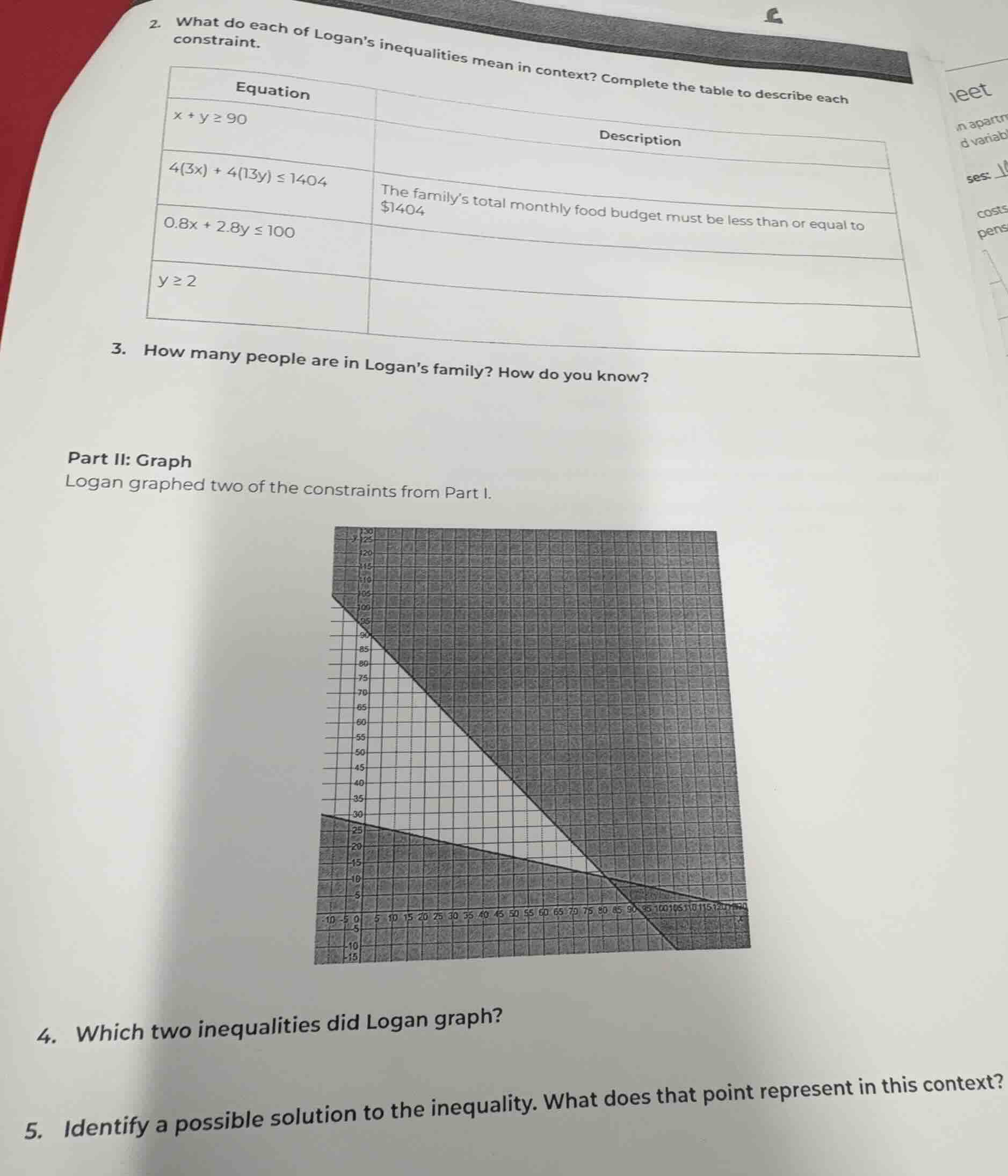
logan graphed two of the constraints from part i.
graph image omitted
- which two inequalities did logan graph?
- identify a possible solution to the inequality. what does that point represent in this context?
Step1: Analyze $x+y\geq90$
Assuming $x$ and $y$ represent daily/weekly food servings (meals, portions) for two food types, this means the total combined number of servings of the two food items must be at least 90.
Step2: Simplify $4(3x)+4(13y)\leq1404$
First, factor out the 4:
$4(3x + 13y) \leq 1404$
Divide both sides by 4:
$3x + 13y \leq 351$
From the given description, $3x$ is the monthly cost for item $x$, $13y$ is the monthly cost for item $y$, so their total is the food budget.
Step3: Analyze $0.8x+2.8y\leq100$
Assuming $0.8$ and $2.8$ are nutrient (e.g., fat, sodium) amounts per unit of $x$ and $y$, this means the total monthly amount of that nutrient from the two foods must be at most 100 units.
Step4: Analyze $y\geq2$
This means the number of servings/units of food item $y$ must be at least 2 per month (or relevant time period).
Step5: Find family size
From $4(3x)+4(13y)\leq1404$, the factor of 4 represents the number of family members (since the budget is multiplied by 4, meaning the per-person cost is scaled to the whole family).
Step6: Match inequalities to graph
- Rewrite $x+y\geq90$ in slope-intercept form: $y\geq -x + 90$. This has a slope of $-1$ and y-intercept of 90, matching the steeper line on the graph.
- Rewrite $0.8x+2.8y\leq100$ in slope-intercept form:
$2.8y \leq -0.8x + 100$
$y \leq -\frac{0.8}{2.8}x + \frac{100}{2.8}$
$y \leq -\frac{2}{7}x + \frac{250}{7} \approx -0.286x + 35.71$, matching the shallower line on the graph.
Step7: Identify a feasible solution
Pick a point in the overlapping shaded region, e.g., $(80,10)$. Check against all constraints:
- $80+10=90\geq90$: Satisfied
- $4(3*80)+4(13*10)=4(240+130)=4(370)=1480$? No, correct to use simplified $3*80+13*10=240+130=370\leq351$? No, pick $(70,20)$:
$3*70+13*20=210+260=470$? No, use the budget constraint correctly: $4(3x+13y)\leq1404 \implies 3x+13y\leq351$.
Try $(80,2)$:
- $80+2=82\geq90$? No. Try $(90,2)$:
- $90+2=92\geq90$: Satisfied
- $3*90+13*2=270+26=296\leq351$: Satisfied
- $0.8*90+2.8*2=72+5.6=77.6\leq100$: Satisfied
- $2\geq2$: Satisfied
---

Snap & solve any problem in the app
Get step-by-step solutions on Sovi AI
Photo-based solutions with guided steps
Explore more problems and detailed explanations
Question 2 (Completed Table)
| Equation | Description |
|---|---|
| $4(3x) + 4(13y) \leq 1404$ | The family's total monthly food budget must be less than or equal to $\$1404$ |
| $0.8x + 2.8y \leq 100$ | The total monthly amount of a specific nutrient (e.g., fat, sodium) from the two foods must be at most 100 units. |
| $y \geq 2$ | The number of servings/units of food item $y$ must be at least 2. |
Question 3
There are 4 people in Logan's family. The factor of 4 in the budget inequality $4(3x) + 4(13y) \leq 1404$ represents the number of family members, as it scales the per-person food costs to the total family budget.
Question 4
Logan graphed $x + y \geq 90$ and $0.8x + 2.8y \leq 100$.
Question 5
A possible solution is $(90, 2)$. This represents purchasing 90 units/servings of food item $x$ and 2 units/servings of food item $y$ in a month, which satisfies all the family's constraints for total servings, food budget, nutrient limits, and minimum servings of $y$.