QUESTION IMAGE
Question
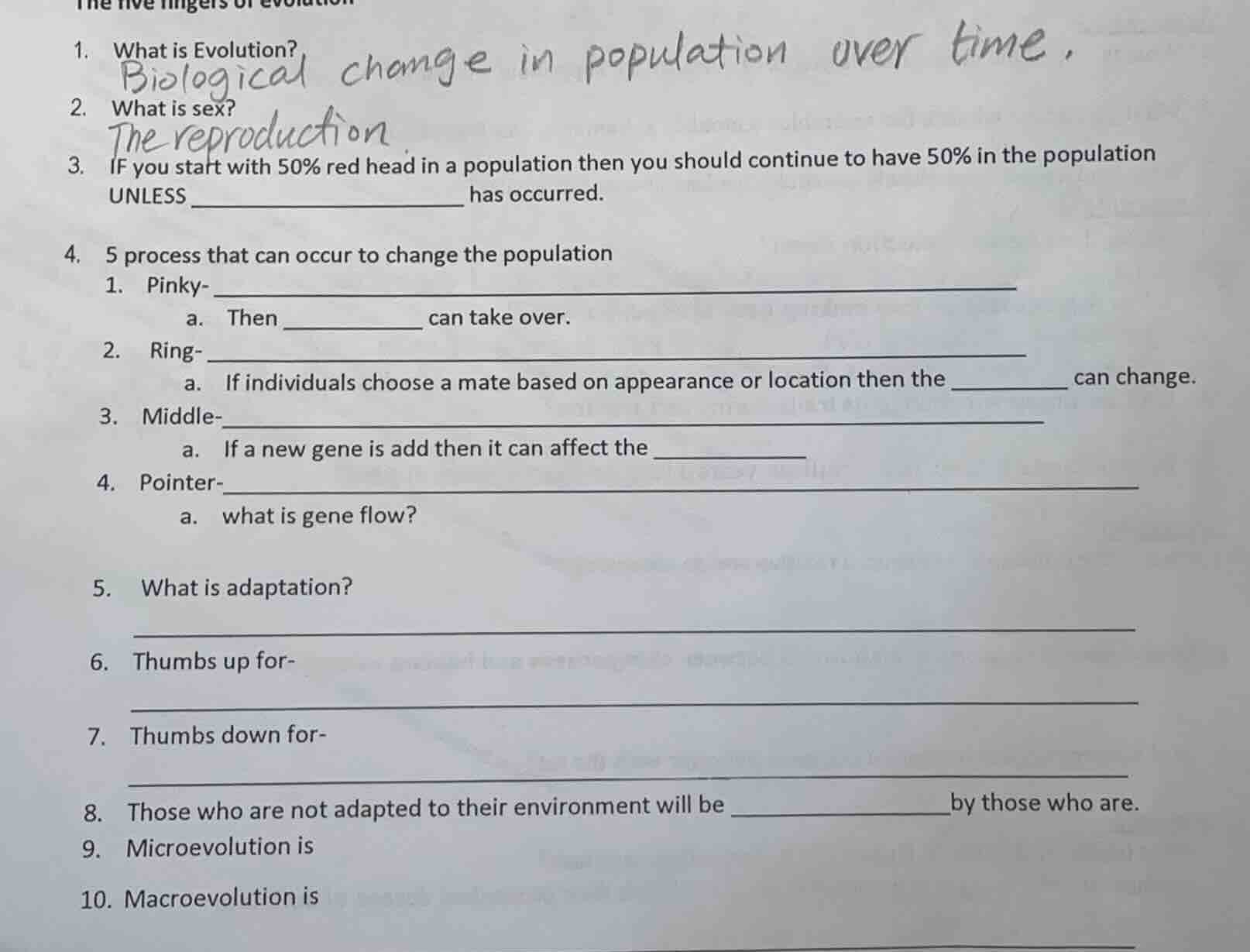
- what is evolution?
biological change in population over time,
- what is sex?
the reproduction
- if you start with 50% red head in a population then you should continue to have 50% in the population unless ______________ has occurred.
- 5 process that can occur to change the population
- pinky- _____________________________________
a. then _________ can take over.
- ring- ______________________________________
a. if individuals choose a mate based on appearance or location then the _______ can change.
- middle-_____________________________________
a. if a new gene is add then it can affect the _______
- pointer-_____________________________________
a. what is gene flow?
- what is adaptation?
_____________________________________
- thumbs up for-
_____________________________________
- thumbs down for-
_____________________________________
- those who are not adapted to their environment will be ____________ by those who are.
- microevolution is
- macroevolution is
Question 3
In population genetics, the Hardy - Weinberg principle states that allele frequencies in a population will remain constant from generation to generation in the absence of evolutionary influences. If the frequency of a trait (like red - headedness) changes, it means that one of the evolutionary mechanisms (such as genetic drift, natural selection, mutation, gene flow, or non - random mating) has occurred. In the context of a deviation from the expected 50% frequency, a common mechanism that can cause such a change is evolution (or more specifically, one of the evolutionary processes like genetic drift).
The "five fingers of evolution" is a mnemonic. The pinky finger is associated with genetic drift. Genetic drift is the change in the frequency of an existing gene variant (allele) in a population due to random sampling of organisms. When genetic drift occurs, sometimes a trait can become fixed (take over) in the population, meaning that all individuals in the population have that trait.
The ring finger in the "five fingers of evolution" mnemonic is associated with non - random mating (also called assortative mating). When individuals choose a mate based on appearance or location (which is non - random mating), it can change the gene pool (the set of all genes in a population) of the population because certain alleles will be more likely to be passed on to the next generation.

Snap & solve any problem in the app
Get step-by-step solutions on Sovi AI
Photo-based solutions with guided steps
Explore more problems and detailed explanations
evolution (or a specific evolutionary process like genetic drift)