QUESTION IMAGE
Question
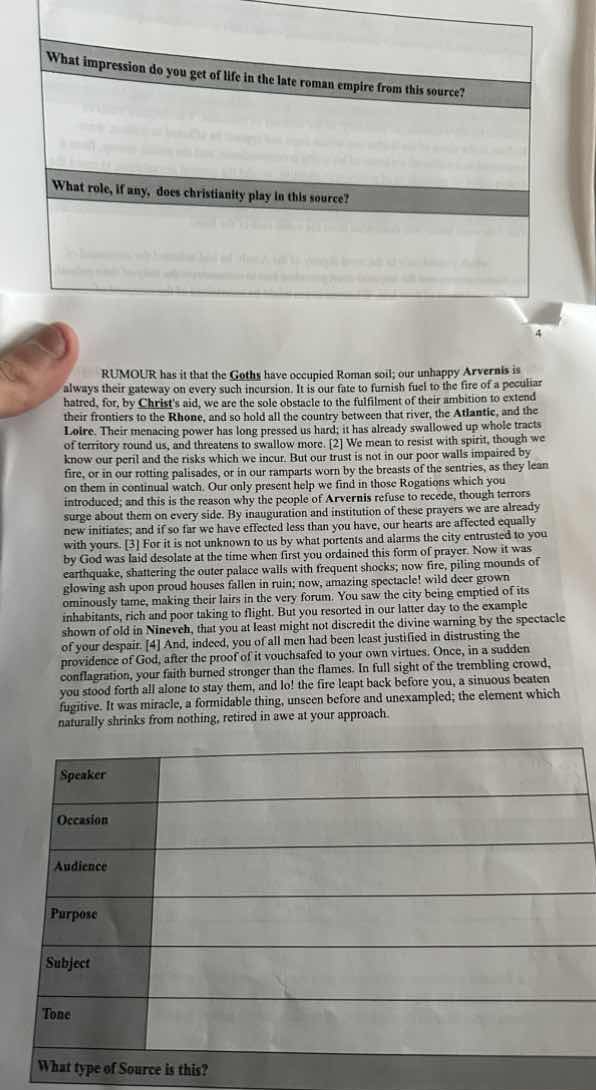
what impression do you get of life in the late roman empire from this source?
what role, if any, does christianity play in this source?
rumour has it that the goths have occupied roman soil; our unhappy arverais is
always their gateway on every such incursion. it is our fate to furnish fuel to the fire of a peculiar
hated, for, by christ’s aid, we are the sole obstacle to the fulfillment of their ambition to extend
their frontiers to the rhone, and so hold all the country between that river, the atlantic, and the
loire. their menacing power has long pressed us hard; it has already swallowed up whole tracts
of territory round us, and threatens to swallow more. 2 we mean to resist with spirit, though we
know our peril and the risks which we incur. but our trust is not in our poor walls impaired by
fire, or in our rotting palisades, or in our ramparts worn by the breasts of the sentries, as they lean
on them in continual watch. our only present help we find in those rogations which you
introduced; and this is the reason why the people of arvernis refuse to recede, though terrors
surge about them on every side. by inauguration and institution of these prayers we are already
new initiates; and if so far we have effected less than you have, our hearts are affected equally
with yours. 3 for it is not unknown to us by what portents and alarms the city entrusted to you
by god was laid desolate at the time when first you ordained this form of prayer. now it was
earthquake, shattering the palace walls with frequent shocks; now fire, piling mounds of
glowing ash upon proud houses fallen in ruin; now, amazing spectacle! wild deer grown
ominously tame, making the outer palace in now; now, amazing spectacle! wild deer grown
ominously tame, making taking to flight. but you resorted in our later day to the example
shown of old in nineveh, that you at least might not discredit the divine warning by the spectacle
of your despair. 4 and, indeed, you of all men had been least justified in distrusting the
providence of god, after the proof of it vouchsafed to your own virtues. once, in a sudden
conflagration, your faith burned stronger than the flames. in full sight of the trembling crowd,
you stood forth all alone to stay them, and lo! the fire leapt back before you, a sinuous beaten
fugitive. it was miracle, a formidable thing, unseen before and unexampled; the element which
naturally shrinks from nothing, retired in awe at your approach.
speaker
occasion
audience
purpose
subject
tone
what type of source is this?
For "What impression do you get of life in the late roman empire from this source?":
The text reveals constant external threat from the Goths, who occupy Roman territory and expand aggressively. The city of Arvernais faces destruction—ruined fortifications, collapsed houses, and inhabitants fleeing. There is a sense of fear and vulnerability, but also reliance on religious practices for comfort and resistance.
For "What role, if any, does christianity play in this source?":
Christianity serves as a source of resilience: the people frame themselves as God's chosen obstacle to the Goths, use Rogations (Christian prayer rituals) to cope with terror, and reference biblical examples (Nineveh) to justify their faith. It also shapes their view of suffering as a test of divine providence, and a miracle involving fire reinforces their trust in God's protection.
For the speaker/occasion/audience/purpose/subject/tone and source type:
- Speaker: A religious or civic leader of Arvernais, addressing a religious authority (who ordained the Rogations prayer).
- Occasion: A crisis of Gothic invasion, when the city is under threat and residents are fleeing.
- Audience: A high-ranking Christian cleric or authority who established the Rogations prayer practice.
- Purpose: To explain the city's resolve to resist, request continued spiritual support via the Rogations, and affirm their faith in God's protection amid invasion.
- Subject: The Gothic threat to Arvernais, the city's suffering, and the role of Christian prayer/faith in their resistance.
- Tone: Desperate yet devout; urgent, pleading, and reverent.
- What type of Source is this?: A rhetorical, religiously framed civic petition or address, likely a contemporary (Late Roman) prose text, possibly a letter or sermon, documenting a crisis and religious response.

Snap & solve any problem in the app
Get step-by-step solutions on Sovi AI
Photo-based solutions with guided steps
Explore more problems and detailed explanations
- Impression of Late Roman Empire life: Life was marked by constant violent external invasion, widespread destruction of cities, fear and displacement of residents, and a heavy reliance on religious faith to cope with existential threat.
- Role of Christianity: It is a core pillar of resilience, framing the community as God's chosen defenders, providing ritual (Rogations) to manage terror, justifying faith through biblical parallels, and reinforcing trust in divine protection via perceived miracles.
- Source breakdown:
- Speaker: Religious/civic leader of Arvernais
- Occasion: Gothic invasion crisis of Arvernais
- Audience: High-ranking Christian religious authority
- Purpose: Urge continued spiritual support, affirm faith-driven resistance
- Subject: Gothic threat and Christian faith in Arvernais' survival
- Tone: Desperate, devout, urgent
- Source type: Late Roman religious-civic address/petition (prose document)