QUESTION IMAGE
Question
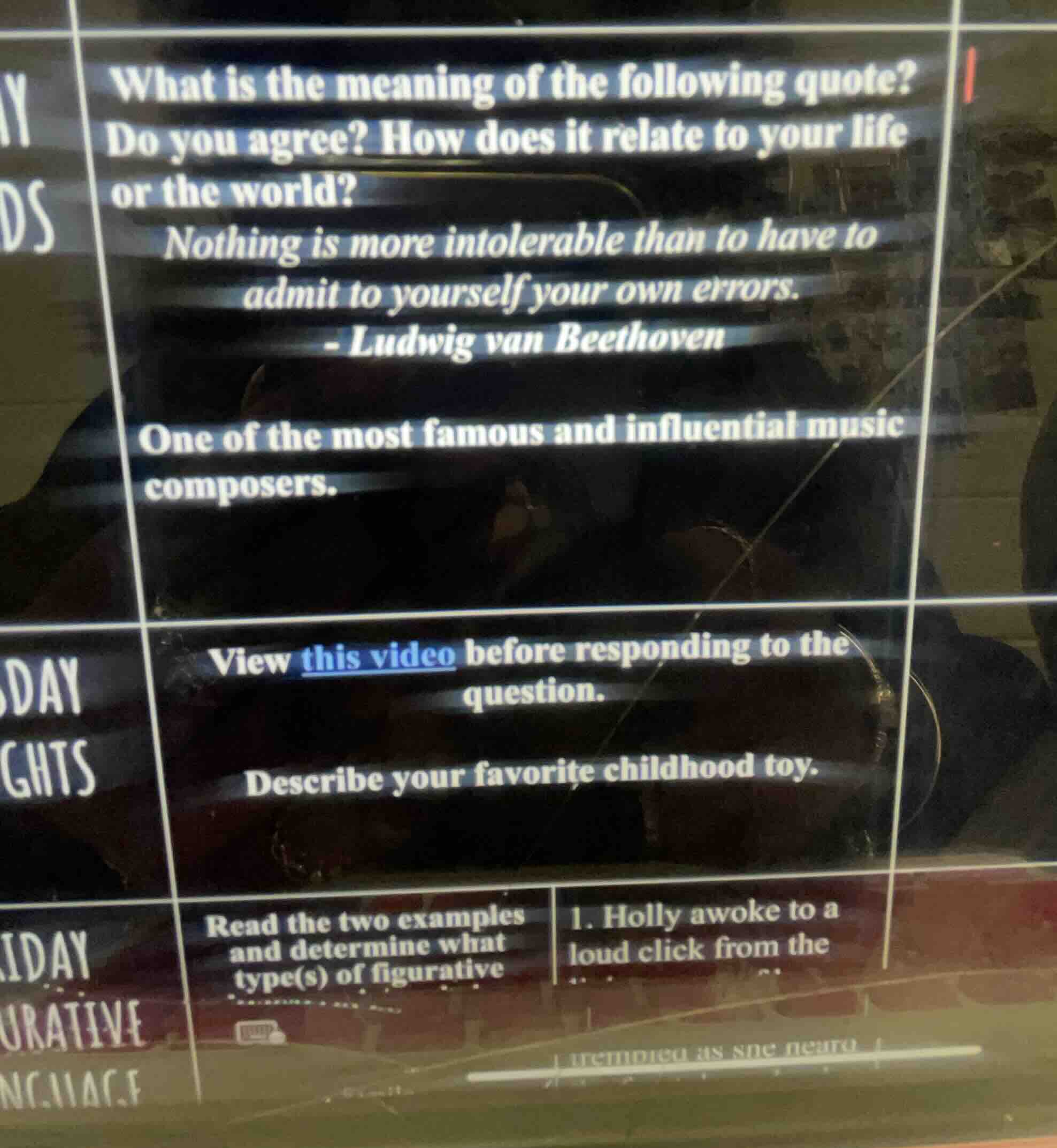
what is the meaning of the following quote? do you agree? how does it relate to your life or the world? nothing is more intolerable than to have to admit to yourself your own errors. - ludwig van beethoven one of the most famous and influential music composers. view this video before responding to the question. describe your favorite childhood toy. read the two examples and determine what type(s) of figurative
For the Beethoven quote:
- Meaning: The quote captures the psychological discomfort of acknowledging one's own mistakes; it refers to the ego's resistance to accepting fallibility, as this can threaten one's self-image of competence or correctness.
- Agreement & Real-World Link: This aligns with psychological ideas about cognitive dissonance, where people avoid conflicting information about their own flaws. In daily life, people often deflect blame or ignore their errors to preserve self-esteem—for example, a student refusing to admit they didn't study for a failed test, or a leader avoiding accountability for a bad decision. On a global scale, this can hinder progress: governments denying policy failures or corporations ignoring environmental harm rather than acknowledging and correcting mistakes.
For the childhood toy description:
(Example response) My favorite childhood toy was a tattered stuffed rabbit named Thumper. He had floppy gray ears with a white patch on one, and his left paw was missing a button eye I lost at the park. I brought him everywhere: he sat next to me at dinner, slept under my pillow, and was the "referee" for all my imaginary games. He felt like a safe, constant presence during big changes like starting school, and he taught me about care and empathy when I had to stitch his ear back together with help from my mom.
For the figurative language task:
(Note: Since only the start of the first example is provided, a general framework applies) To identify figurative language, first check for comparisons (simile/metaphor), exaggeration (hyperbole), non-human traits (personification), or wordplay (pun). Analyze phrases like "loud click"—if the click is used to represent a larger, unstated threat (e.g., a broken fire alarm), it could be synecdoche; if the click is described with emotional language, it might be personification. Compare to the second example to confirm shared or unique figurative types.

Snap & solve any problem in the app
Get step-by-step solutions on Sovi AI
Photo-based solutions with guided steps
Explore more problems and detailed explanations
Beethoven Quote Response:
- Meaning: Acknowledging personal errors is deeply psychologically painful, as it challenges one's self-perception of being right or capable.
- Agreement & Connection: I agree. This relates to cognitive dissonance, where people avoid accepting their mistakes to protect self-esteem. In daily life, this looks like deflecting blame for a missed deadline instead of admitting poor time management. Globally, it can slow progress: governments refusing to reverse harmful policies they championed, rather than acknowledging error to fix systemic issues.
Childhood Toy Description:
My favorite childhood toy was a worn stuffed rabbit named Thumper. He had floppy gray ears, a missing button eye, and a stitched-up ear I helped repair. He was my constant companion through starting school and family moves, acting as a safe, comforting presence and teaching me small lessons in care and empathy.
Figurative Language Task (Framework):
- Identify key phrases in each example.
- Match phrases to figurative language types (simile, metaphor, personification, hyperbole, etc.).
- Cross-reference between the two examples to list shared or distinct types.
(Full analysis requires the complete text of both examples.)