QUESTION IMAGE
Question
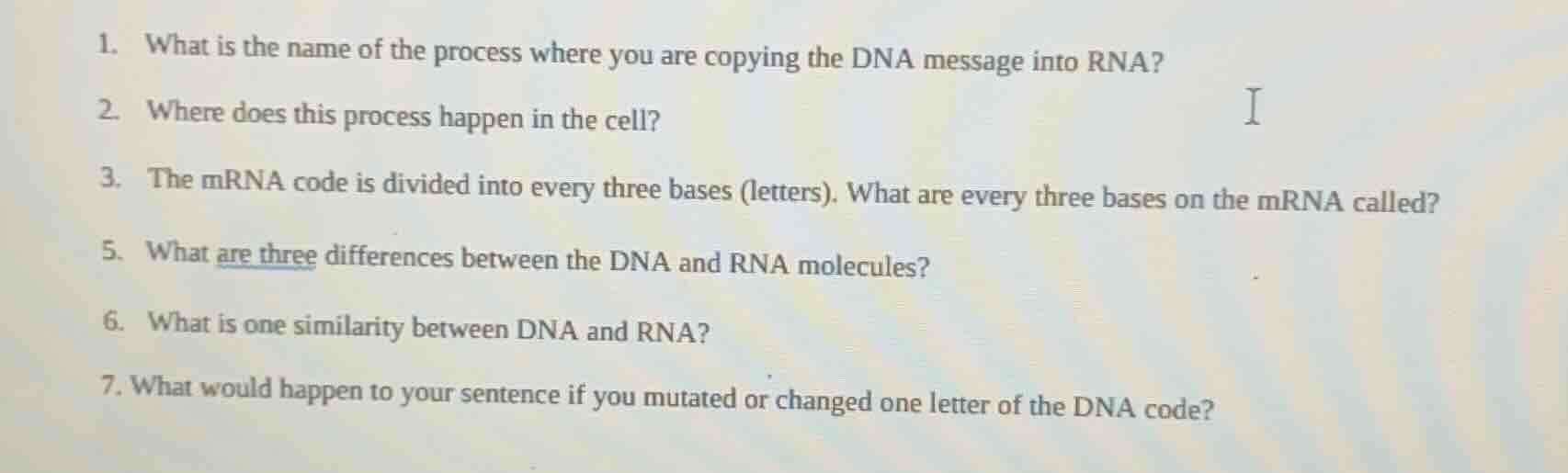
- what is the name of the process where you are copying the dna message into rna?
- where does this process happen in the cell?
- the mrna code is divided into every three bases (letters). what are every three bases on the mrna called?
- what are three differences between the dna and rna molecules?
- what is one similarity between dna and rna?
- what would happen to your sentence if you mutated or changed one letter of the dna code?
Brief Explanations
- Identifies the core genetic transcription process.
- States the cellular location of this DNA-to-RNA process.
- Names the 3-base mRNA coding units.
- Lists key structural/chemical differences between DNA and RNA.
- Notes a shared fundamental feature of DNA and RNA.
- Explains the impact of a single DNA base mutation on the resulting "sentence" (protein/product).

Snap & solve any problem in the app
Get step-by-step solutions on Sovi AI
Photo-based solutions with guided steps
Explore more problems and detailed explanations
- Transcription
- In the nucleus (of eukaryotic cells; in the cytoplasm of prokaryotic cells)
- Codons
- Three differences:
- DNA has deoxyribose sugar, RNA has ribose sugar
- DNA uses thymine (T) as a base, RNA uses uracil (U) instead
- DNA is typically double-stranded, RNA is typically single-stranded
- Both are nucleic acids made up of nucleotide subunits, and both use adenine (A), cytosine (C), and guanine (G) as bases.
- Changing one "letter" (base) could alter the corresponding codon, which might change the amino acid coded for, potentially altering the final protein (or "sentence") structure and function; in some cases, it could have no effect (silent mutation) or lead to a premature stop signal.