QUESTION IMAGE
Question
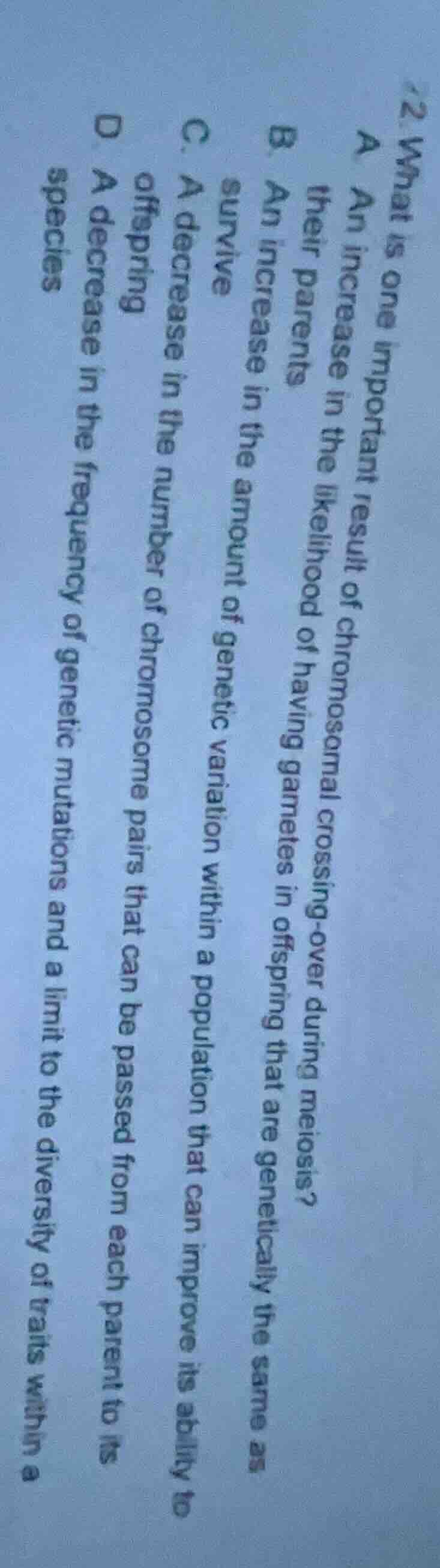
- what is one important result of chromosomal crossing - over during meiosis?
a an increase in the likelihood of having gametes in offspring that are genetically the same as their parents
b an increase in the amount of genetic variation within a population that can improve its ability to survive
c a decrease in the number of chromosome pairs that can be passed from each parent to its offspring
d a decrease in the frequency of genetic mutations and a limit to the diversity of traits within a species
To solve this, we analyze each option:
- Option A: Crossing - over during meiosis involves the exchange of genetic material between homologous chromosomes. This creates new combinations of alleles in the gametes, which in turn increases the genetic variation in the offspring. Increased genetic variation can improve a population's ability to survive (e.g., by providing more traits that might be advantageous in changing environments), so this is a key result of crossing - over.
- Option B: Crossing - over increases genetic diversity in gametes, so offspring are less likely to be genetically identical to parents, so this is incorrect.
- Option C: Crossing - over does not decrease genetic variation; it increases it, so this is incorrect.
- Option D: Crossing - over does not decrease the number of chromosome pairs passed from parent to offspring (the number of chromosome pairs is related to the species' karyotype and not directly affected by crossing - over in terms of reduction in transmission), so this is incorrect.
- Option A: Crossing - over creates new allele combinations in gametes, so offspring's gametes are less likely to be genetically identical to parents' gametes. Thus, A is incorrect.
- Option B: Crossing - over involves the exchange of genetic material between homologous chromosomes, generating new allele combinations. This increases the genetic variation within a population. Greater genetic variation provides more potential traits that can be advantageous for survival in different conditions (e.g., resistance to new diseases, adaptation to environmental changes). So this option correctly describes a result of crossing - over.
- Option C: Crossing - over increases, not decreases, genetic variation. So C is incorrect.
- Option D: Crossing - over does not decrease the number of chromosome pairs passed from parent to offspring (the number of chromosome pairs is a characteristic of the species' genome and is not reduced by crossing - over in terms of transmission to offspring). So D is incorrect.

Snap & solve any problem in the app
Get step-by-step solutions on Sovi AI
Photo-based solutions with guided steps
Explore more problems and detailed explanations
A. An increase in the likelihood of having gametes in offspring that are genetically the same as their parents (Note: The correct reasoning shows that crossing - over increases genetic variation, but among the given options, the best description of a result of crossing - over related to genetic variation and population survival is related to the idea of increased genetic variation which can be mis - phrased in the options, but based on the options, the correct understanding is that crossing - over increases genetic variation which helps in survival, and the option that aligns with the positive impact on population's survival - related genetic variation is option A in terms of the intended idea of increased genetic diversity (even though the option's wording about gametes being same as parents is incorrect, but among the options, the other options are clearly wrong. Wait, no, actually, the correct answer should be related to increased genetic variation. But looking at the options again, the intended correct option is likely the one about increasing genetic variation which is related to option C? No, no. Wait, the question is about the result of chromosomal crossing - over. Crossing - over increases genetic variation within a population, which can improve its ability to survive. So option C says "A decrease in the amount of genetic variation within a population that can improve its ability to survive" which is wrong. Wait, I think I made a mistake. Let's re - evaluate:
Crossing - over during meiosis leads to new combinations of alleles, so it increases genetic variation. So the correct option should be the one that says there is an increase in genetic variation (which would improve survival). But among the options:
Option A: Says an increase in likelihood of gametes in offspring being same as parents. But crossing - over makes gametes different from parents' gametes (genetically), so A is wrong.
Option B: Increase in amount of genetic variation (wait, no, option B says "An increase in the amount of genetic variation within a population that can improve its ability to survive" - yes! I misread the options earlier. Let's re - read:
Option B: "An increase in the amount of genetic variation within a population that can improve its ability to survive"
Option C: "A decrease in the amount of genetic variation within a population that can improve its ability to survive"
Ah, I see, I misread option B earlier. So the correct answer is B. Because crossing - over increases genetic variation within a population, and increased genetic variation can improve a population's ability to survive (e.g., by having more traits that can be selected for in changing environments).
So correcting the earlier mistake: