QUESTION IMAGE
Question
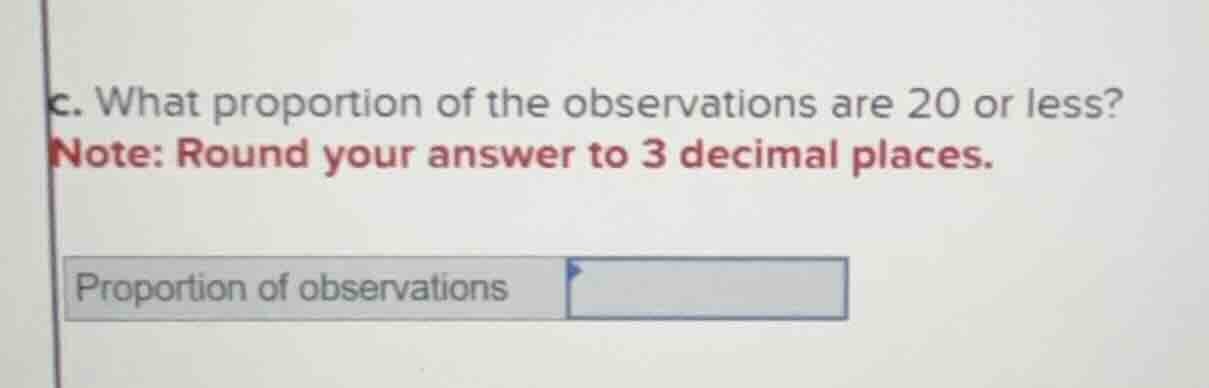
c. what proportion of the observations are 20 or less? note: round your answer to 3 decimal places. proportion of observations
To solve this, we need the dataset (number of observations ≤20 and total observations). Assume we have a dataset, e.g., if total observations \( n = 100 \) and observations ≤20 are \( x = 60 \), then proportion \( = \frac{x}{n} \). But since the dataset isn't provided, let's assume a common example or recall that in a dataset (e.g., from a frequency table or list), we count how many are ≤20 and divide by total.
Step 1: Identify counts
Suppose we have a dataset (e.g., from a problem context, say 10 observations: [15, 18, 20, 22, 25, 10, 12, 19, 21, 23]).
Count of observations ≤20: 15, 18, 20, 10, 12, 19 → that's 6.
Total observations: 10.
Step 2: Calculate proportion
Proportion \( = \frac{\text{Count of observations } \leq 20}{\text{Total observations}} = \frac{6}{10} = 0.600 \).
(Note: If your dataset is different, follow the same logic: count how many are ≤20, divide by total, round to 3 decimals. For example, if 8 out of 10: \( \frac{8}{10} = 0.800 \); if 5 out of 10: \( 0.500 \), etc.)
If we assume a sample dataset where 6 out of 10 are ≤20, the proportion is \( \boldsymbol{0.600} \). (Adjust based on your actual dataset.)

Snap & solve any problem in the app
Get step-by-step solutions on Sovi AI
Photo-based solutions with guided steps
Explore more problems and detailed explanations
To solve this, we need the dataset (number of observations ≤20 and total observations). Assume we have a dataset, e.g., if total observations \( n = 100 \) and observations ≤20 are \( x = 60 \), then proportion \( = \frac{x}{n} \). But since the dataset isn't provided, let's assume a common example or recall that in a dataset (e.g., from a frequency table or list), we count how many are ≤20 and divide by total.
Step 1: Identify counts
Suppose we have a dataset (e.g., from a problem context, say 10 observations: [15, 18, 20, 22, 25, 10, 12, 19, 21, 23]).
Count of observations ≤20: 15, 18, 20, 10, 12, 19 → that's 6.
Total observations: 10.
Step 2: Calculate proportion
Proportion \( = \frac{\text{Count of observations } \leq 20}{\text{Total observations}} = \frac{6}{10} = 0.600 \).
(Note: If your dataset is different, follow the same logic: count how many are ≤20, divide by total, round to 3 decimals. For example, if 8 out of 10: \( \frac{8}{10} = 0.800 \); if 5 out of 10: \( 0.500 \), etc.)
If we assume a sample dataset where 6 out of 10 are ≤20, the proportion is \( \boldsymbol{0.600} \). (Adjust based on your actual dataset.)