QUESTION IMAGE
Question
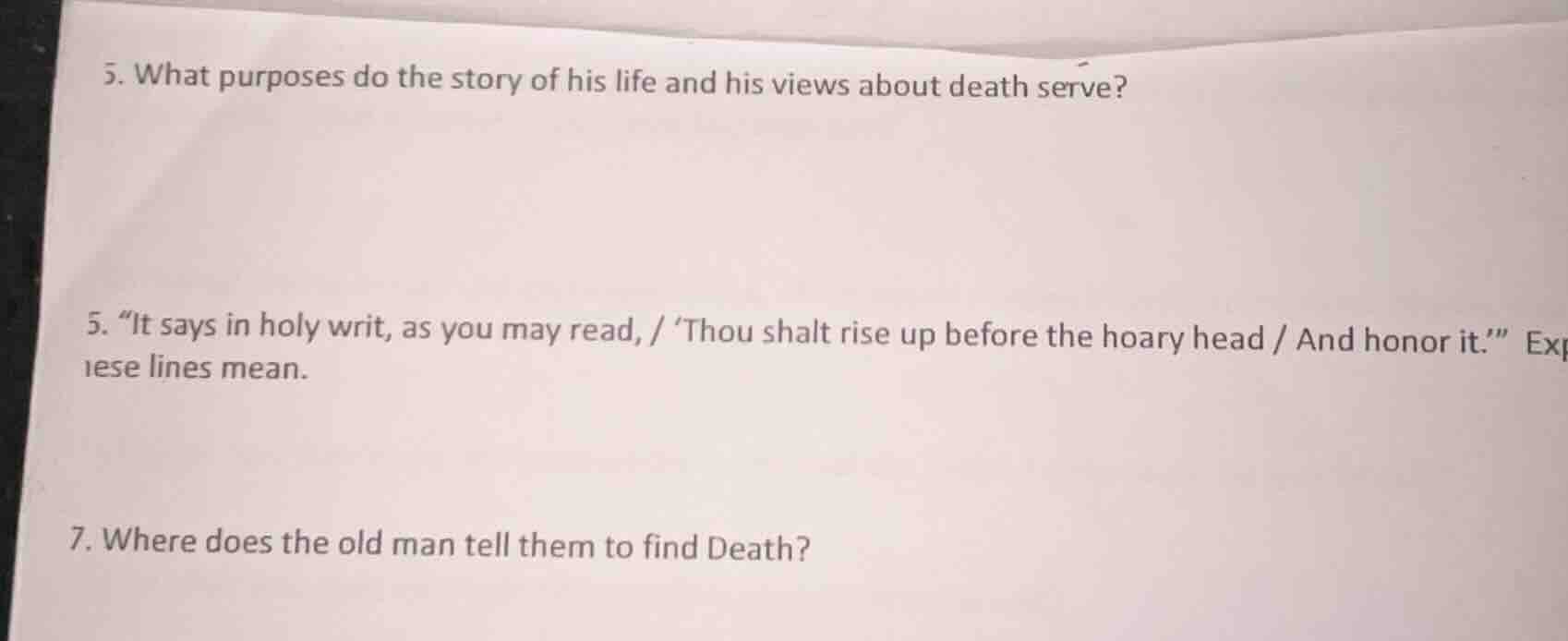
- what purposes do the story of his life and his views about death serve?
- \it says in holy writ, as you may read, / thou shalt rise up before the hoary head / and honor it.\ exp
hese lines mean.
- where does the old man tell them to find death?
Question 5 (about the story of his life and views on death)
To determine the purposes, we analyze the context (likely a literary work). The life story and death views often serve to develop the character, convey themes (like mortality, meaning of life), or advance the narrative. For example, in works like "The Pardoner’s Tale" (where such questions arise), the old man’s life story and death views might highlight moral lessons, contrast with the rioters’ greed, or symbolize the inevitability of death. They could also emphasize the theme of how one’s perspective on death shapes their life, or act as a narrative device to lead to the encounter with Death (as in the tale, connecting to the rioters’ quest).
The lines are from a religious text (likely the Bible, as "holy writ" refers to sacred scripture). "Hoary head" means a gray - haired (old) person. The command “Thou shalt rise up before the hoary head and honor it” is a directive to show respect to the elderly: physically rise (a sign of deference in olden times) and give them honor, emphasizing filial piety or societal respect for age, rooted in religious teachings about caring for/respecting the aged.
In "The Pardoner’s Tale", the old man tells the rioters to find Death under a tree (specifically, an oak tree) in a grove, where they later find a pile of gold instead. This is a narrative device: the “Death” here is symbolic (the gold represents the death - bringing nature of greed, as the rioters kill each other over it), but the old man directs them there to advance the plot, showing how their quest for Death (to kill it) leads them to their own downfall via greed.

Snap & solve any problem in the app
Get step-by-step solutions on Sovi AI
Photo-based solutions with guided steps
Explore more problems and detailed explanations
The story of his life and his views about death typically serve purposes like developing the character (the old man), conveying themes (e.g., mortality, moral lessons), advancing the narrative (leading to the rioters’ encounter with Death), or contrasting with other characters’ (rioters’) attitudes (e.g., their greed vs. his acceptance of death). In "The Pardoner’s Tale", they highlight the inevitability of death, moralize about respecting age/accepting mortality, and drive the plot toward the symbolic “Death” under the tree (where gold is found, representing how greed is a form of death).