QUESTION IMAGE
Question
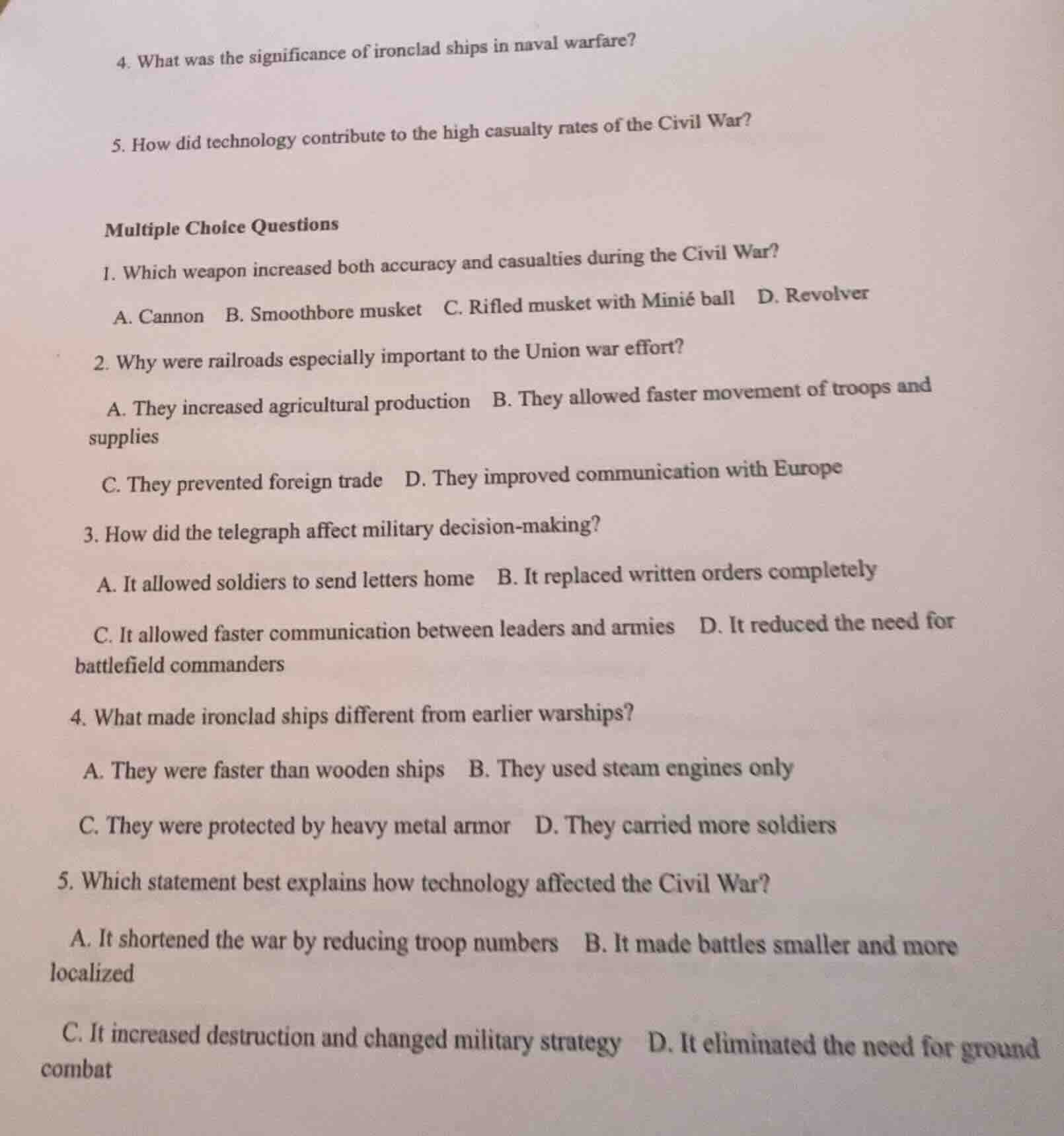
- what was the significance of ironclad ships in naval warfare?5. how did technology contribute to the high casualty rates of the civil war?multiple choice questions1. which weapon increased both accuracy and casualties during the civil war?a. cannon b. smoothbore musket c. rifled musket with minié ball d. revolver2. why were railroads especially important to the union war effort?a. they increased agricultural production b. they allowed faster movement of troops and suppliesc. they prevented foreign trade d. they improved communication with europe3. how did the telegraph affect military decision-making?a. it allowed soldiers to send letters home b. it replaced written orders completelyc. it allowed faster communication between leaders and armies d. it reduced the need for battlefield commanders4. what made ironclad ships different from earlier warships?a. they were faster than wooden ships b. they used steam engines onlyc. they were protected by heavy metal armor d. they carried more soldiers5. which statement best explains how technology affected the civil war?a. it shortened the war by reducing troop numbers b. it made battles smaller and more localizedc. it increased destruction and changed military strategy d. it eliminated the need for ground combat
Brief Explanations
- The rifled musket with Minié ball had spiral grooves in the barrel that stabilized the bullet, making it far more accurate than smoothbore weapons, and this accuracy led to higher casualty rates in the Civil War.
- Railroads were critical for the Union because they enabled rapid transportation of troops, food, weapons, and other supplies across large distances, which was essential for sustaining large-scale military operations.
- The telegraph allowed military leaders (like Lincoln) to send and receive real-time updates from armies in the field, drastically speeding up communication and enabling faster, more informed decision-making.
- The defining feature of ironclad ships was their heavy metal armor plating, which protected them from cannon fire that would destroy wooden warships.
- New technologies like rifled weapons, ironclads, and the telegraph increased the scale of destruction in battles and forced military leaders to adapt their strategies (such as moving away from massed infantry charges and improving logistics and communication).
- Ironclad ships revolutionized naval warfare by rendering wooden warships obsolete; their metal armor made them resistant to traditional cannon fire, and they set the standard for modern warship design, changing naval combat tactics and ship construction permanently.
- Technologies like rifled muskets with Minié balls (which were far more accurate and had longer range than previous weapons) led to massive casualties in open-field battles. Additionally, improved artillery and the lack of updated battlefield tactics (like massed infantry charges against fortified positions with modern weapons) amplified casualty rates.

Snap & solve any problem in the app
Get step-by-step solutions on Sovi AI
Photo-based solutions with guided steps
Explore more problems and detailed explanations
Short Answer Questions
- Ironclad ships made wooden warships obsolete, as their metal armor resisted cannon fire, revolutionizing naval combat tactics and ship design for future warfare.
- More accurate long-range weapons (like rifled muskets) and improved artillery, paired with outdated infantry tactics, led to unprecedented high casualty rates; better medical transport also counted more wounded soldiers, increasing recorded casualty numbers.
Multiple Choice Questions
- C. Rifled musket with Minié ball
- B. They allowed faster movement of troops and supplies
- C. It allowed faster communication between leaders and armies
- C. They were protected by heavy metal armor
- C. It increased destruction and changed military strategy