QUESTION IMAGE
Question
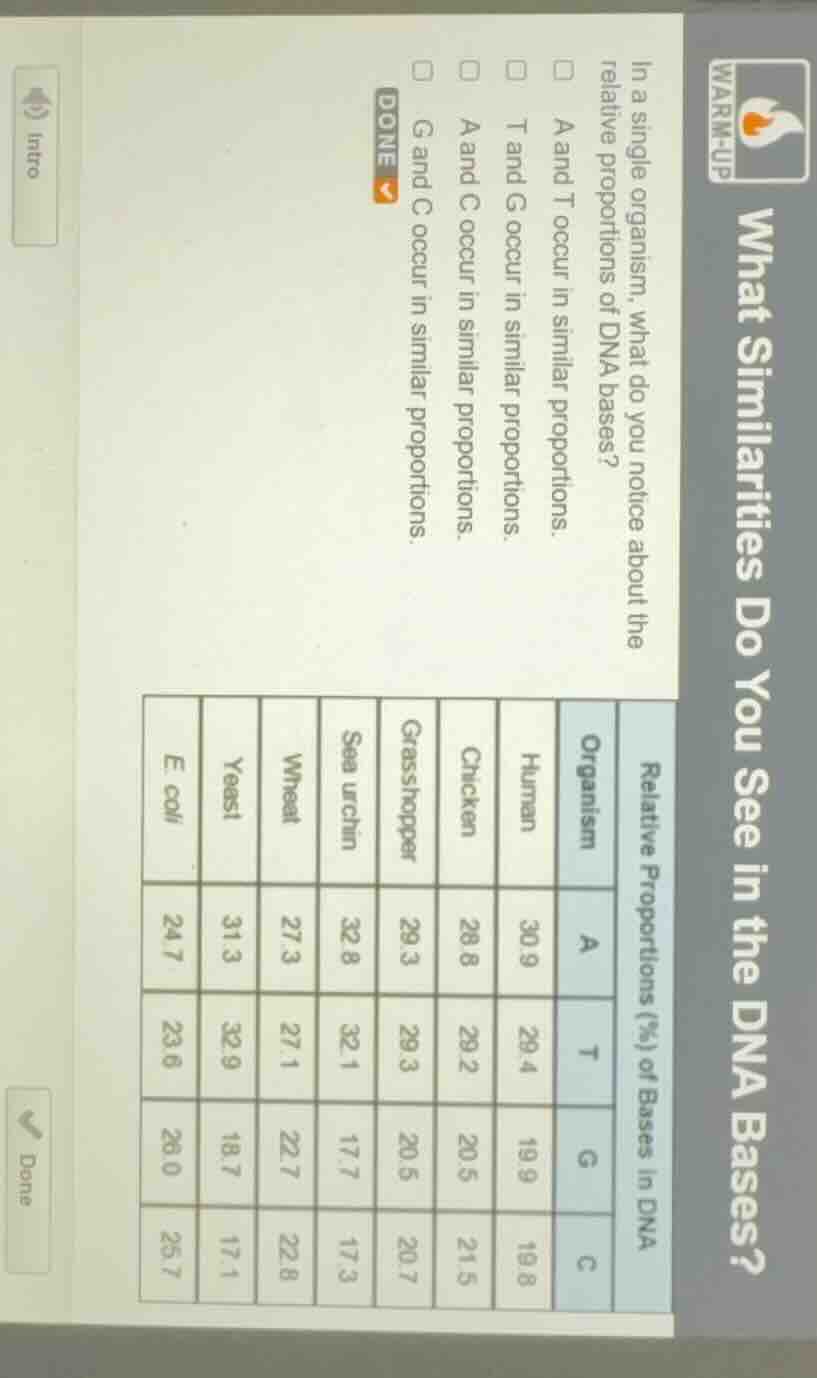
what similarities do you see in the dna bases? warm-up in a single organism, what do you notice about the relative proportions of dna bases? a and t occur in similar proportions. t and g occur in similar proportions. a and c occur in similar proportions. g and c occur in similar proportions. done relative proportions (%) of bases in dna organism a t g c human 30.9 29.4 19.9 19.8 chicken 28.8 29.2 20.5 21.5 grasshopper 29.3 29.3 20.5 20.7 sea urchin 32.8 32.1 17.7 17.3 wheat 27.3 27.1 22.7 22.8 yeast 31.3 32.9 18.7 17.1 e. coli 24.7 23.6 26.0 25.7
To determine the correct option, we analyze the relative proportions of DNA bases (A, T, G, C) for each organism:
- For "A and T occur in similar proportions": Check the values of A and T for each organism. For Human: A = 30.9, T = 29.4 (close). Chicken: A = 28.8, T = 29.2 (close). Grasshopper: A = 29.3, T = 29.3 (equal). Sea urchin: A = 32.8, T = 32.1 (close). Wheat: A = 27.3, T = 27.1 (close). Yeast: A = 31.3, T = 32.9 (close). E. coli: A = 24.7, T = 23.6 (close). These values are consistently similar.
- For "T and G occur in similar proportions": For Human, T = 29.4, G = 19.9 (not similar). Chicken: T = 29.2, G = 20.5 (not similar). So this is incorrect.
- For "A and C occur in similar proportions": For Human, A = 30.9, C = 19.8 (not similar). Chicken: A = 28.8, C = 21.5 (not similar). Incorrect.
- For "G and C occur in similar proportions": For Human, G = 19.9, C = 19.8 (close). Chicken: G = 20.5, C = 21.5 (close). Grasshopper: G = 20.5, C = 20.7 (close). Sea urchin: G = 17.7, C = 17.3 (close). Wheat: G = 22.7, C = 22.8 (close). Yeast: G = 18.7, C = 17.1 (close). E. coli: G = 26.0, C = 25.7 (close). These values are also consistently similar. Wait, but the question is about "in a single organism"—wait, no, the options are general. Wait, but the standard DNA base pairing is A-T and G-C, so both A-T and G-C should have similar proportions. But let's recheck the options. Wait, the first option: "A and T occur in similar proportions"—let's check Human: A=30.9, T=29.4 (difference ~1.5). Chicken: A=28.8, T=29.2 (difference ~0.4). Grasshopper: A=29.3, T=29.3 (difference 0). Sea urchin: A=32.8, T=32.1 (difference 0.7). Wheat: A=27.3, T=27.1 (difference 0.2). Yeast: A=31.3, T=32.9 (difference 1.6). E. coli: A=24.7, T=23.6 (difference 1.1). These are all relatively close. Now the fourth option: "G and C occur in similar proportions"—Human: G=19.9, C=19.8 (diff 0.1). Chicken: G=20.5, C=21.5 (diff 1.0). Grasshopper: G=20.5, C=20.7 (diff 0.2). Sea urchin: G=17.7, C=17.3 (diff 0.4). Wheat: G=22.7, C=22.8 (diff 0.1). Yeast: G=18.7, C=17.1 (diff 1.6). E. coli: G=26.0, C=25.7 (diff 0.3). Also close. But wait, the question is "in a single organism"—wait, no, the options are about what is noticed. Wait, maybe I made a mistake. Wait, let's check the original options again. The options are:
A. A and T occur in similar proportions.
B. T and G occur in similar proportions.
C. A and C occur in similar proportions.
D. G and C occur in similar proportions.
Wait, maybe the intended answer is A and D, but since it's a multiple-choice (maybe single correct), but looking at the data, both A-T and G-C have similar proportions (base pairing: A-T, G-C). But let's check the numbers again. For Human: A=30.9, T=29.4 (close); G=19.9, C=19.8 (close). Chicken: A=28.8, T=29.2 (close); G=20.5, C=21.5 (close). Grasshopper: A=29.3, T=29.3 (equal); G=20.5, C=20.7 (close). Sea urchin: A=32.8, T=32.1 (close); G=17.7, C=17.3 (close). Wheat: A=27.3, T=27.1 (close); G=22.7, C=22.8 (close). Yeast: A=31.3, T=32.9 (close); G=18.7, C=17.1 (close). E. coli: A=24.7, T=23.6 (close); G=26.0, C=25.7 (close). So both A (A and T) and D (G and C) have similar proportions. But maybe the question is designed to notice A and T first, or maybe D. Wait, but let's check the options again. Wait, the first option: "A and T occur in similar proportions"—the numbers for A and T are very close across all organisms. For example, Human: 30.9 vs 29.4 (diff 1.5), Chicken: 28.8 vs 29.2 (diff 0.4), Grasshopper: 29.3 vs 29.3 (same), Sea urchin: 32.8 vs 32.1 (diff 0.7), Wheat: 27.3 vs 27.1 (diff 0.2…

Snap & solve any problem in the app
Get step-by-step solutions on Sovi AI
Photo-based solutions with guided steps
Explore more problems and detailed explanations
A. A and T occur in similar proportions, D. G and C occur in similar proportions