QUESTION IMAGE
Question
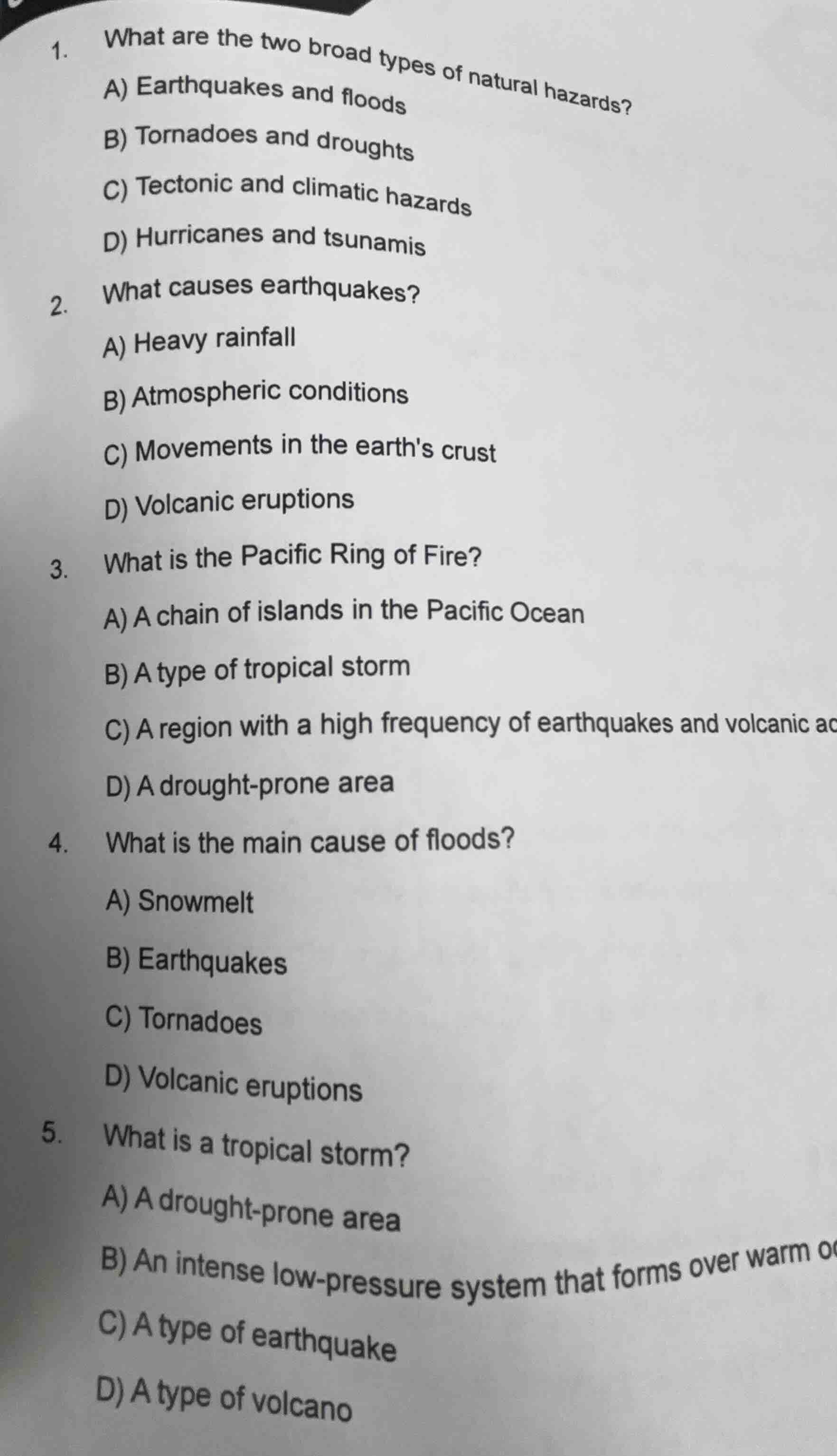
- what are the two broad types of natural hazards?
a) earthquakes and floods
b) tornadoes and droughts
c) tectonic and climatic hazards
d) hurricanes and tsunamis
- what causes earthquakes?
a) heavy rainfall
b) atmospheric conditions
c) movements in the earths crust
d) volcanic eruptions
- what is the pacific ring of fire?
a) a chain of islands in the pacific ocean
b) a type of tropical storm
c) a region with a high frequency of earthquakes and volcanic ac
d) a drought - prone area
- what is the main cause of floods?
a) snowmelt
b) earthquakes
c) tornadoes
d) volcanic eruptions
- what is a tropical storm?
a) a drought - prone area
b) an intense low - pressure system that forms over warm o
c) a type of earthquake
d) a type of volcano
Question 1
Natural hazards are broadly classified into tectonic (related to Earth's crust movements, like earthquakes) and climatic (related to weather/climate, like floods, droughts). Options A, B, D list specific hazards, not broad types. So C is correct.
Earthquakes are caused by the movement of tectonic plates in the Earth's crust. Heavy rainfall (A) causes floods, atmospheric conditions (B) relate to weather, and volcanic eruptions (D) can be a result of crust movements but not the direct cause of all earthquakes. So C is correct.
The Pacific Ring of Fire is a region around the Pacific Ocean with high seismic (earthquake) and volcanic activity due to tectonic plate boundaries. A is incorrect (it's not just islands), B is wrong (not a storm), D is wrong (not drought - prone). So C (even with a typo in the option, the meaning is clear) is correct.

Snap & solve any problem in the app
Get step-by-step solutions on Sovi AI
Photo-based solutions with guided steps
Explore more problems and detailed explanations
C. Tectonic and climatic hazards