QUESTION IMAGE
Question
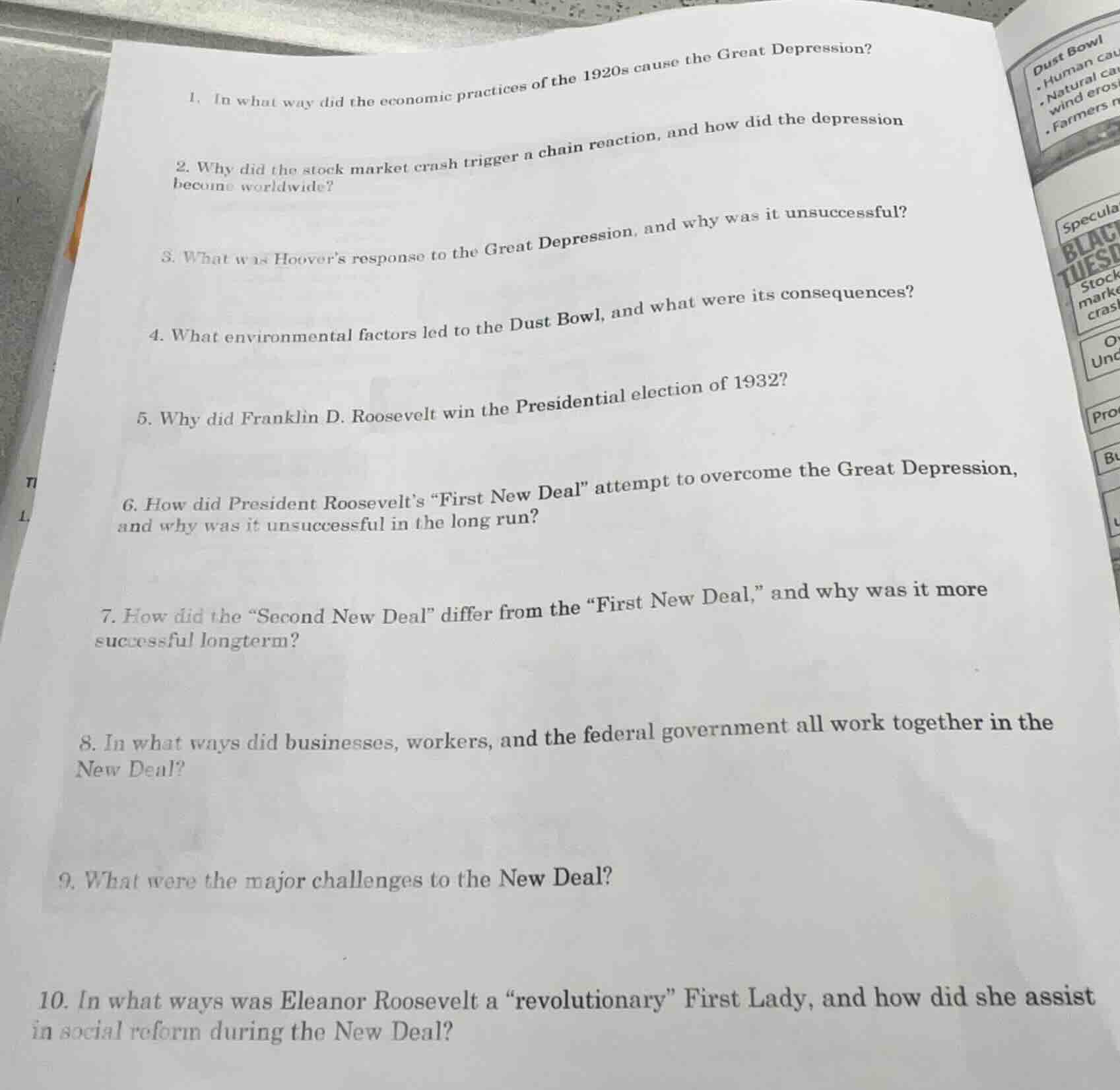
- in what way did the economic practices of the 1920s cause the great depression?
- why did the stock market crash trigger a chain reaction, and how did the depression become worldwide?
- what was hoovers response to the great depression, and why was it unsuccessful?
- what environmental factors led to the dust bowl, and what were its consequences?
- why did franklin d. roosevelt win the presidential election of 1932?
- how did president roosevelts \first new deal\ attempt to overcome the great depression, and why was it unsuccessful in the long run?
- how did the \second new deal\ differ from the \first new deal,\ and why was it more successful longterm?
- in what ways did businesses, workers, and the federal government all work together in the new deal?
- what were the major challenges to the new deal?
- in what ways was eleanor roosevelt a
evolutionary\ first lady, and how did she assist in social reform during the new deal?
Brief Explanations
- Question 1: 1920s economic practices included overproduction in industry/agriculture, risky stock market speculation (buying on margin), unequal wealth distribution, and weak banking regulation. Overproduction led to falling prices and layoffs; speculation inflated a stock bubble that burst, and unequal wealth limited consumer spending, all combining to collapse the economy.
- Question 2: The stock market crash wiped out personal and business wealth, causing banks to fail (as people withdrew savings and banks lost investments). Failed banks cut off business lending, leading to more layoffs and reduced consumer spending. The depression spread globally because the U.S. was a major global creditor; when U.S. banks recalled loans, foreign economies collapsed, and global trade dropped due to U.S. protectionist policies like the Smoot-Hawley Tariff.
- Question 3: Hoover relied on voluntary cooperation from businesses to keep wages/hours stable and local/state relief efforts, with limited federal intervention. It failed because businesses ignored voluntary agreements, local/state governments lacked resources to address widespread poverty, and Hoover resisted direct federal aid until too late, worsening suffering and economic decline.
- Question 4: Environmental factors included decades of intensive, drought-resistant farming that removed native prairie grasses (which held soil in place), followed by a severe, multi-year drought in the 1930s. Consequences were massive dust storms that destroyed farmland, displaced hundreds of thousands of farmers (the "Okies"), and worsened the economic hardship of the Great Depression.
- Question 5: Roosevelt won because Hoover's policies were widely seen as failing to address the Depression. Roosevelt offered a hopeful, proactive vision with his "New Deal" promise of direct federal action to relieve suffering, which resonated with voters facing mass unemployment, poverty, and despair.
- Question 6: The First New Deal focused on immediate relief (e.g., FERA), recovery (e.g., NRA to regulate business, AAA to raise farm prices), and reform (e.g., FDIC to insure bank deposits). It was unsuccessful long-term because the NRA was ruled unconstitutional, the AAA harmed small farmers, and it did not fully address high unemployment or unequal wealth, leaving the economy still weak by the mid-1930s.
- Question 7: The Second New Deal shifted to more direct aid to workers and the poor, with stronger social reform: it created the WPA (mass employment programs), Social Security (old-age pensions and unemployment insurance), and the Wagner Act (protecting union rights). It was more successful long-term because it established permanent social safety nets, empowered workers, and reduced inequality, laying the groundwork for broader economic stability.
- Question 8: Businesses worked with the government via programs like the NRA (following fair labor/price codes) and received loans from the Reconstruction Finance Corporation. Workers gained union protections from the Wagner Act, allowing them to negotiate better wages/hours, and were employed in federal work programs. The government provided regulation, funding, and oversight to coordinate these efforts and stimulate the economy.
- Question 9: Major challenges included conservative opposition (business leaders and Republicans argued the New Deal expanded government power too much and violated free markets), Supreme Court rulings that struck down key programs (like the NRA and AAA), and persistent high unemployment that showed th…

Snap & solve any problem in the app
Get step-by-step solutions on Sovi AI
Photo-based solutions with guided steps
Explore more problems and detailed explanations
- 1920s overproduction, stock speculation, unequal wealth, weak banking rules combined to collapse the economy.
- The crash destroyed wealth, collapsed banks, cut lending; global ties and U.S. protectionism spread the crisis worldwide.
- Hoover used voluntary business cooperation and local relief; it failed due to insufficient scale and delayed federal action.
- Intensive farming removed soil-holding grasses, plus severe drought; it displaced farmers and worsened Depression poverty.
- Roosevelt won by promising proactive federal "New Deal" relief, contrasting with Hoover's failed policies.
- The First New Deal focused on relief/recovery/reform but failed long-term due to court challenges and incomplete solutions.
- The Second New Deal added permanent social safety nets (Social Security) and worker protections, making it more successful long-term.
- Businesses followed federal codes; workers gained union rights; the government provided funding and regulation to coordinate efforts.
- Challenges included conservative opposition, Supreme Court strikes, and persistent high unemployment.
- She held press conferences, advocated for marginalized groups, and pushed for inclusive New Deal policies, advancing social reform.