QUESTION IMAGE
Question
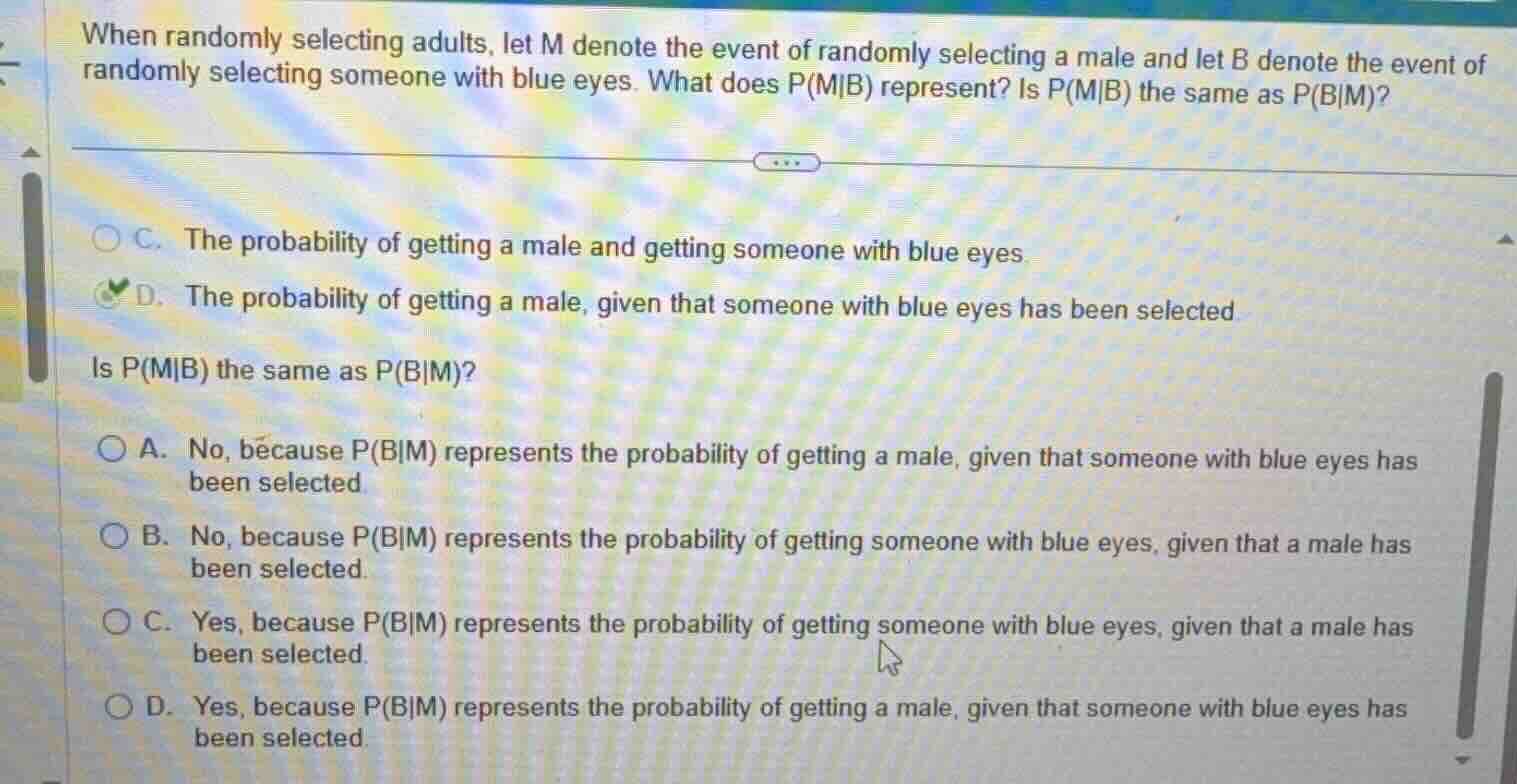
when randomly selecting adults, let m denote the event of randomly selecting a male and let b denote the event of randomly selecting someone with blue eyes. what does p(m|b) represent? is p(m|b) the same as p(b|m)?
○ c. the probability of getting a male and getting someone with blue eyes
○ d. the probability of getting a male, given that someone with blue eyes has been selected
is p(m|b) the same as p(b|m)?
○ a. no, because p(b|m) represents the probability of getting a male, given that someone with blue eyes has been selected.
○ b. no, because p(b|m) represents the probability of getting someone with blue eyes, given that a male has been selected.
○ c. yes, because p(b|m) represents the probability of getting someone with blue eyes, given that a male has been selected.
○ d. yes, because p(b|m) represents the probability of getting a male, given that someone with blue eyes has been selected.
Part 1: What does \( P(M|B) \) represent?
The notation \( P(A|B) \) in probability represents the conditional probability of event \( A \) occurring given that event \( B \) has already occurred. Here, \( A = M \) (selecting a male) and \( B = \text{blue eyes} \) (selecting someone with blue eyes). So \( P(M|B) \) is the probability of selecting a male, given that we have already selected someone with blue eyes. Among the options, option D matches this description.
Part 2: Is \( P(M|B) \) the same as \( P(B|M) \)?
- \( P(M|B) \): Probability of male given blue eyes (condition is blue eyes, event is male).
- \( P(B|M) \): Probability of blue eyes given male (condition is male, event is blue eyes).
These are different conditional probabilities because the conditions (the "given" part) and the events are swapped. Option B correctly states that \( P(B|M) \) is the probability of getting someone with blue eyes, given that a male has been selected, and thus they are not the same.
Final Answers
For the first question (what \( P(M|B) \) represents):
\( P(M|B) \) is conditional probability: event \( M \) (male) given condition \( B \) (blue eyes). Option D describes this.
\( P(M|B) \) (male|blue eyes) and \( P(B|M) \) (blue eyes|male) have different conditions/events. Option B explains \( P(B|M) \) correctly and states they differ.

Snap & solve any problem in the app
Get step-by-step solutions on Sovi AI
Photo-based solutions with guided steps
Explore more problems and detailed explanations
D. The probability of getting a male, given that someone with blue eyes has been selected
For the second question (are they the same):