QUESTION IMAGE
Question
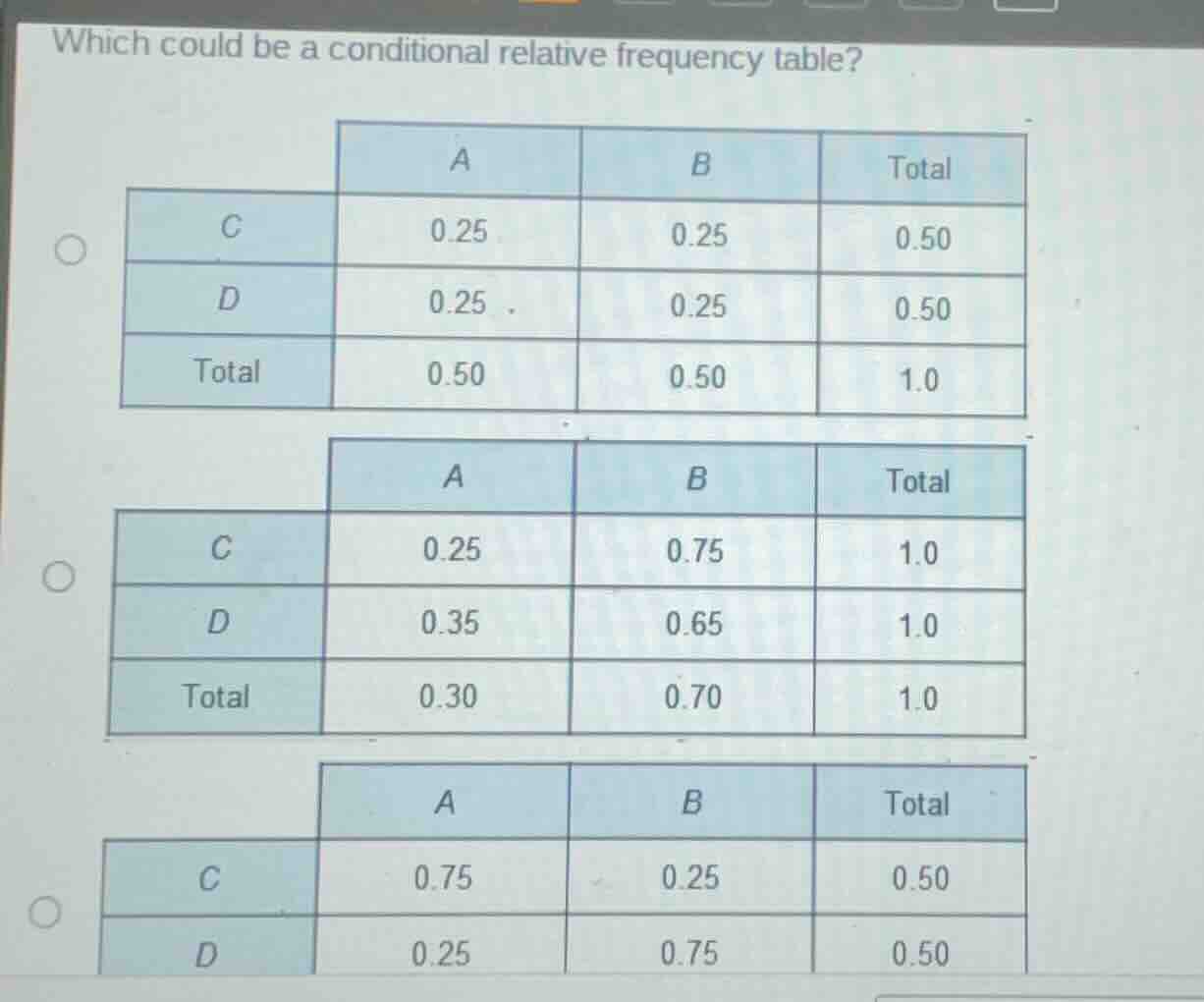
which could be a conditional relative frequency table?
first table:
| a | b | total | |
|---|---|---|---|
| d | 0.25 | 0.25 | 0.50 |
| total | 0.50 | 0.50 | 1.0 |
second table:
| a | b | total | |
|---|---|---|---|
| d | 0.35 | 0.65 | 1.0 |
| total | 0.30 | 0.70 | 1.0 |
third table (partial):
| a | b | total | |
|---|---|---|---|
| d | 0.25 | 0.75 | 0.50 |
Step1: Recall conditional frequency rules
A conditional relative frequency table has either:
- Row totals equal to 1.0 (conditioning on row categories), or
- Column totals equal to 1.0 (conditioning on column categories)
Step2: Analyze first table
Row totals = 0.50, column totals = 0.50. This is a joint relative frequency table, not conditional.
Step3: Analyze second table
Row totals for C and D are both 1.0. This fits the definition of a conditional relative frequency table (conditioning on rows C and D, showing relative frequencies of A/B within each row).
Step4: Analyze third table
Row totals = 0.50, column totals are not 1.0. This is not a conditional relative frequency table.

Snap & solve any problem in the app
Get step-by-step solutions on Sovi AI
Photo-based solutions with guided steps
Explore more problems and detailed explanations
The second table (with row totals of 1.0 for C and D):
| A | B | Total | |
|---|---|---|---|
| D | 0.35 | 0.65 | 1.0 |
| Total | 0.30 | 0.70 | 1.0 |