QUESTION IMAGE
Question
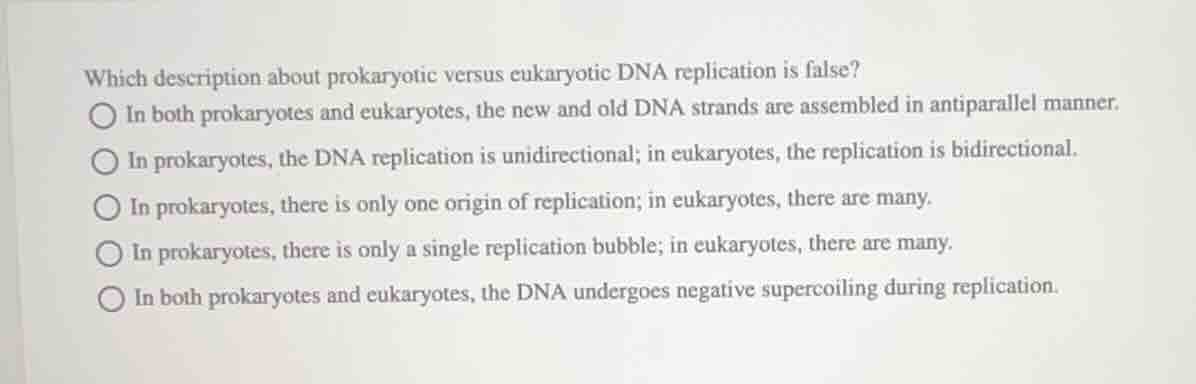
which description about prokaryotic versus eukaryotic dna replication is false?
in both prokaryotes and eukaryotes, the new and old dna strands are assembled in antiparallel manner.
in prokaryotes, the dna replication is unidirectional; in eukaryotes, the replication is bidirectional.
in prokaryotes, there is only one origin of replication; in eukaryotes, there are many.
in prokaryotes, there is only a single replication bubble; in eukaryotes, there are many.
in both prokaryotes and eukaryotes, the dna undergoes negative supercoiling during replication.
- Antiparallel assembly: DNA strands are antiparallel in all organisms, so new strands are synthesized to match this orientation in both prokaryotes and eukaryotes. This statement is true.
- Replication direction: Both prokaryotic and eukaryotic DNA replication proceeds bidirectionally from origins of replication. The claim that prokaryotic replication is unidirectional is false.
- Origins of replication: Prokaryotes have a single circular chromosome with one origin, while eukaryotes have large linear chromosomes with multiple origins to speed up replication. This statement is true.
- Replication bubbles: Each origin of replication forms a replication bubble. Since eukaryotes have multiple origins, they have multiple bubbles, while prokaryotes have one. This statement is true.
- Negative supercoiling: DNA gyrase (prokaryotes) and topoisomerases (eukaryotes) induce negative supercoiling to relieve tension during replication in both types of organisms. This statement is true.

Snap & solve any problem in the app
Get step-by-step solutions on Sovi AI
Photo-based solutions with guided steps
Explore more problems and detailed explanations
O In prokaryotes, the DNA replication is unidirectional; in eukaryotes, the replication is bidirectional.