QUESTION IMAGE
Question
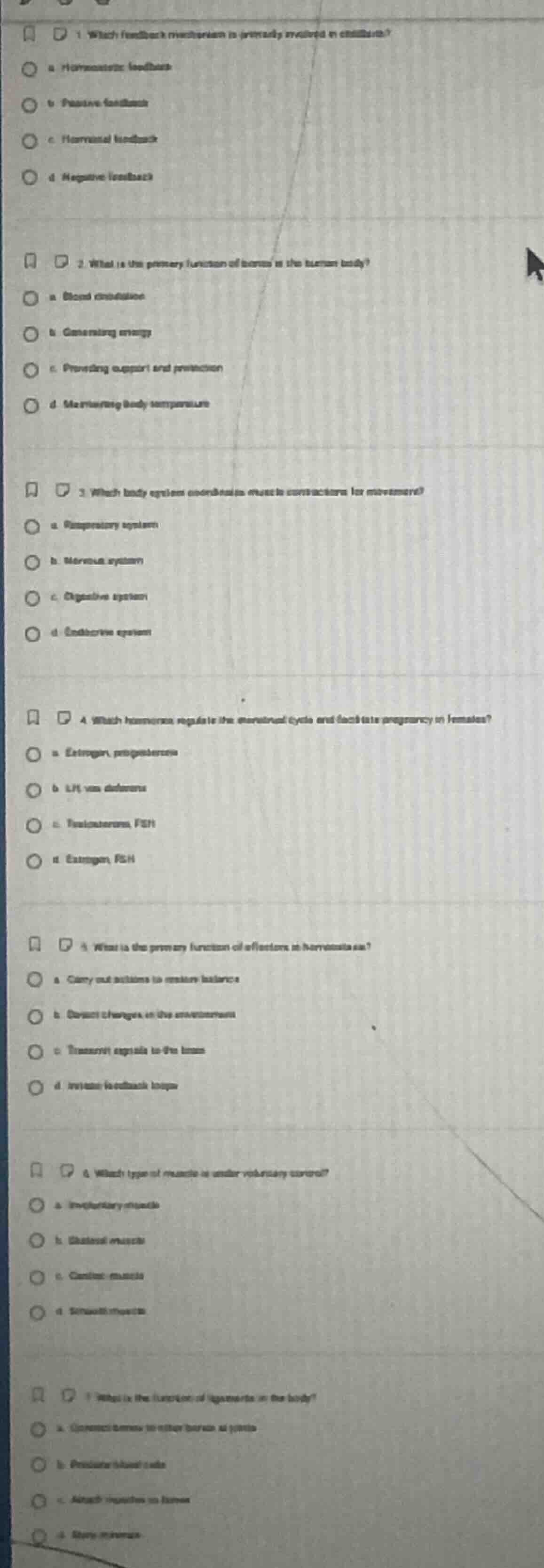
1 which feedback mechanism is primarily involved in childbirth?
a. homeostatic feedback
b. positive feedback
c. hormonal feedback
d. negative feedback
2 what is the primary function of bones in the human body?
a. blood circulation
b. generating energy
c. providing support and protection
d. maintaining body temperature
3 which body system coordinates muscle contractions for movement?
a. respiratory system
b. nervous system
c. digestive system
d. endocrine system
4 which hormones regulate the menstrual cycle and facilitate pregnancy in females?
a. estrogen, progesterone
b. lh, oxytocin
c. testosterone, fsh
d. estrogen, fsh
5 what is the primary function of effectors in homeostasis?
a. carry out actions to restore balance
b. detect changes in the environment
c. transport signals to the brain
d. receive feedback loops
6 which type of muscle is under voluntary control?
a. involuntary muscle
b. skeletal muscle
c. cardiac muscle
d. smooth muscle
7 what is the function of ligaments in the body?
a. connect bones to other bones at joints
b. produce blood cells
c. attach muscles to bones
d. store minerals
- Homeostasis relies on reversing deviations from a set point, which is negative feedback.
- Bones form the skeletal framework that supports the body and protects internal organs.
- The nervous system sends signals to coordinate muscle contractions for movement.
- Estrogen and progesterone regulate the menstrual cycle and prepare the uterus for pregnancy.
- Effectors carry out the actions signaled by the control center to restore homeostasis.
- Skeletal muscles are under voluntary control, allowing conscious movement.
- Ligaments are connective tissues that link bone to bone at joints to stabilize them.

Snap & solve any problem in the app
Get step-by-step solutions on Sovi AI
Photo-based solutions with guided steps
Explore more problems and detailed explanations
- d. Negative feedback
- c. Providing support and protection
- b. Nervous system
- a. Estrogen, progesterone
- a. Carry out actions to restore balance
- d. Skeletal muscles
- a. Connect bones to other bones at joints