QUESTION IMAGE
Question
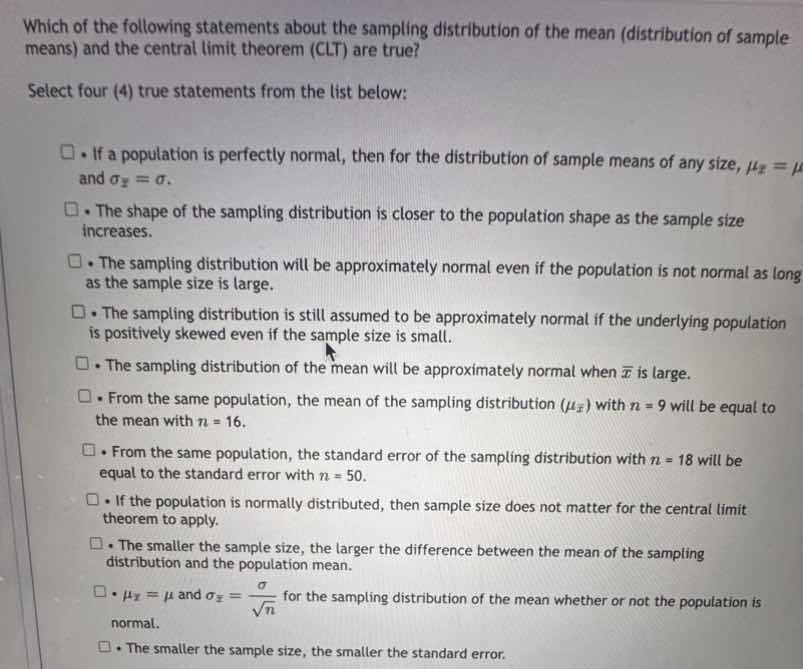
which of the following statements about the sampling distribution of the mean (distribution of sample means) and the central limit theorem (clt) are true?
select four (4) true statements from the list below:
- if a population is perfectly normal, then for the distribution of sample means of any size, $mu_{\bar{x}} = mu$ and $sigma_{\bar{x}} = sigma$.
- the shape of the sampling distribution is closer to the population shape as the sample size increases.
- the sampling distribution will be approximately normal even if the population is not normal as long as the sample size is large.
- the sampling distribution is still assumed to be approximately normal if the underlying population is positively skewed even if the sample size is small.
- the sampling distribution of the mean will be approximately normal when $\bar{x}$ is large.
- from the same population, the mean of the sampling distribution ($mu_{\bar{x}}$) with $n = 9$ will be equal to the mean with $n = 16$.
- from the same population, the standard error of the sampling distribution with $n = 18$ will be equal to the standard error with $n = 50$.
- if the population is normally distributed, then sample size does not matter for the central limit theorem to apply.
- the smaller the sample size, the larger the difference between the mean of the sampling distribution and the population mean.
- $mu_{\bar{x}} = mu$ and $sigma_{\bar{x}} = \frac{\sigma}{\sqrt{n}}$ for the sampling distribution of the mean whether or not the population is normal.
- the smaller the sample size, the smaller the standard error.
Brief Explanations
- For a perfectly normal population, the sampling distribution of the mean is normal for any sample size, with mean equal to the population mean ($\mu_{\bar{x}} = \mu$) but standard error $\sigma_{\bar{x}} = \frac{\sigma}{\sqrt{n}}$, not $\sigma$. This statement is false.
- As sample size increases, the sampling distribution of the mean approaches normality (per CLT), not the population shape. This statement is false.
- A core tenet of the Central Limit Theorem: for large sample sizes (typically $n \geq 30$), the sampling distribution of the mean is approximately normal regardless of the population distribution. This statement is true.
- A positively skewed population requires a large sample size for the sampling distribution of the mean to approximate normality; small samples will retain skewness. This statement is false.
- The approximation relies on a large sample size ($n$), not a large sample mean ($\bar{x}$). This statement is false.
- The mean of the sampling distribution of the mean always equals the population mean ($\mu_{\bar{x}} = \mu$), regardless of sample size. This statement is true.
- Standard error is $\sigma_{\bar{x}} = \frac{\sigma}{\sqrt{n}}$, which decreases as $n$ increases. $\frac{\sigma}{\sqrt{18}}
eq \frac{\sigma}{\sqrt{50}}$. This statement is false.
- If the population is already normal, the sampling distribution of the mean is normal for any sample size, so sample size does not affect the validity of the CLT (or the normality of the sampling distribution). This statement is true.
- The mean of the sampling distribution of the mean always equals the population mean ($\mu_{\bar{x}} = \mu$), regardless of sample size. This statement is false.
- $\mu_{\bar{x}} = \mu$ holds for any population, and $\sigma_{\bar{x}} = \frac{\sigma}{\sqrt{n}}$ holds for any population (when sampling with replacement or from an infinite population). This statement is true.
- Standard error is $\sigma_{\bar{x}} = \frac{\sigma}{\sqrt{n}}$, so smaller sample sizes lead to larger standard errors. This statement is false.

Snap & solve any problem in the app
Get step-by-step solutions on Sovi AI
Photo-based solutions with guided steps
Explore more problems and detailed explanations
- The sampling distribution will be approximately normal even if the population is not normal as long as the sample size is large.
- From the same population, the mean of the sampling distribution ($\mu_{\bar{x}}$) with $n = 9$ will be equal to the mean with $n = 16$.
- If the population is normally distributed, then sample size does not matter for the central limit theorem to apply.
- $\mu_{\bar{x}} = \mu$ and $\sigma_{\bar{x}} = \frac{\sigma}{\sqrt{n}}$ for the sampling distribution of the mean whether or not the population is normal.