QUESTION IMAGE
Question
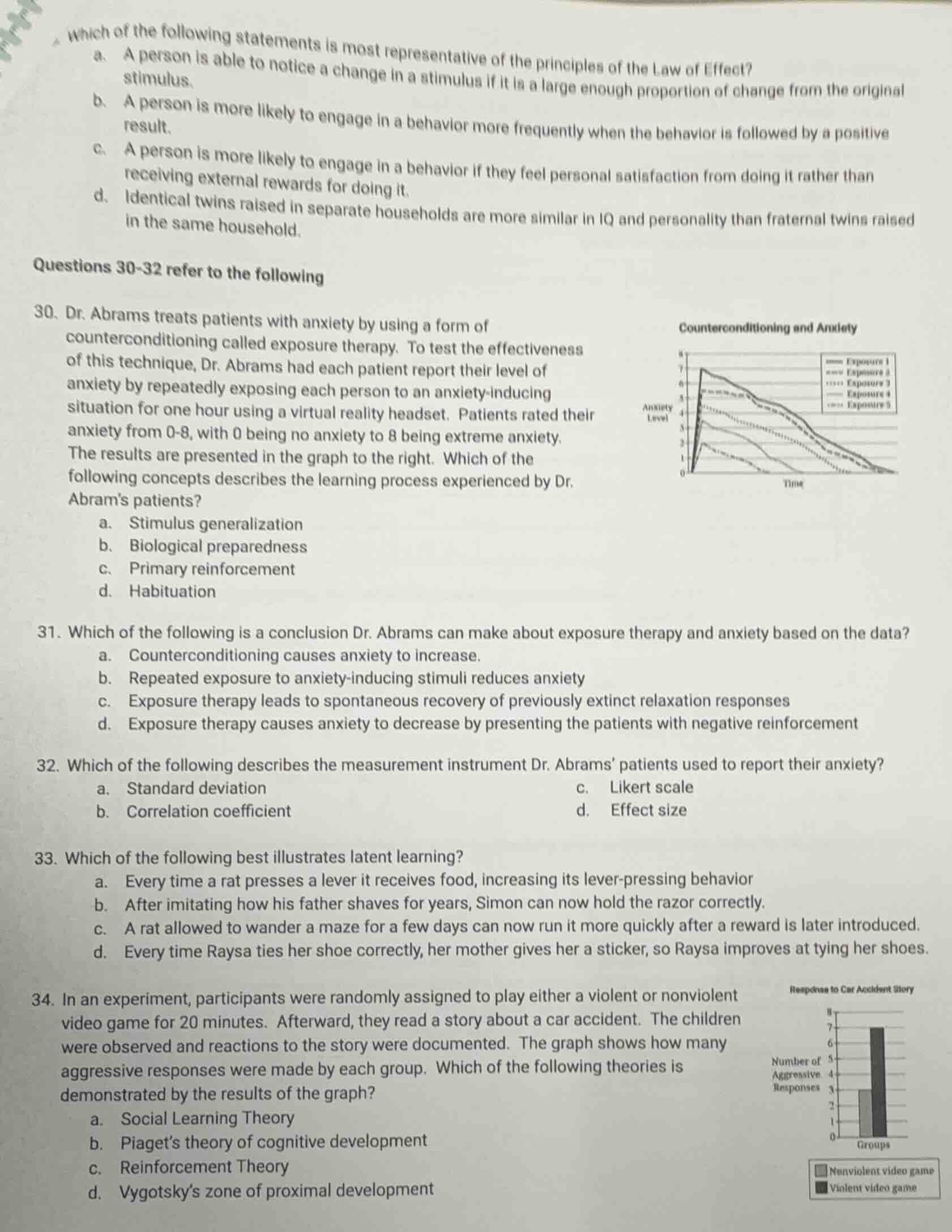
which of the following statements is most representative of the principles of the law of effect?a. a person is able to notice a change in a stimulus if it is a large enough proportion of change from the original stimulus.b. a person is more likely to engage in a behavior more frequently when the behavior is followed by a positive result.c. a person is more likely to engage in a behavior if they feel personal satisfaction from doing it rather than receiving external rewards for doing it.d. identical twins raised in separate households are more similar in iq and personality than fraternal twins raised in the same household.questions 30-32 refer to the following30. dr. abrams treats patients with anxiety by using a form of counterconditioning called exposure therapy. to test the effectiveness of this technique, dr. abrams had each patient report their level of anxiety by repeatedly exposing each person to an anxiety-inducing situation for one hour using a virtual reality headset. patients rated their anxiety from 0-8, with 0 being no anxiety to 8 being extreme anxiety. the results are presented in the graph to the right. which of the following concepts describes the learning process experienced by dr. abrams patients?a. stimulus generalizationb. biological preparednessc. primary reinforcementd. habituation31. which of the following is a conclusion dr. abrams can make about exposure therapy and anxiety based on the data?a. counterconditioning causes anxiety to increase.b. repeated exposure to anxiety-inducing stimuli reduces anxietyc. exposure therapy leads to spontaneous recovery of previously extinct relaxation responsesd. exposure therapy causes anxiety to decrease by presenting the patients with negative reinforcement32. which of the following describes the measurement instrument dr. abrams patients used to report their anxiety?a. standard deviationc. likert scaleb. correlation coefficientd. effect size33. which of the following best illustrates latent learning?a. every time a rat presses a lever it receives food, increasing its lever-pressing behaviorb. after imitating how his father shaves for years, simon can now hold the razor correctly.c. a rat allowed to wander a maze for a few days can now run it more quickly after a reward is later introduced.d. every time raysa ties her shoe correctly, her mother gives her a sticker, so raysa improves at tying her shoes.34. in an experiment, participants were randomly assigned to play either a violent or nonviolent video game for 20 minutes. afterward, they read a story about a car accident. the children were observed and reactions to the story were documented. the graph shows how many aggressive responses were made by each group. which of the following theories is demonstrated by the results of the graph?a. social learning theoryb. piagets theory of cognitive developmentc. reinforcement theoryd. vygotskys zone of proximal development
- Law of Effect Question: The Law of Effect states behaviors followed by positive outcomes are repeated. Option b matches this principle.
- Question 30: Habituation is the reduction of a response (anxiety) with repeated exposure to a stimulus, which matches the graph's downward trend in anxiety over exposures.
- Question 31: The graph shows anxiety levels drop with each repeated exposure to the anxiety-inducing situation, so this is the valid conclusion.
- Question 32: A Likert scale is a rating scale (0-8 here) used to measure subjective experiences like anxiety, which matches the patients' reporting method.
- Question 33: Latent learning is learning that is not demonstrated until a reward is introduced; the rat's improved maze performance after a reward is added fits this.
- Question 34: Social Learning Theory explains that people learn behaviors (like aggression) through observation, which matches the result that participants who played violent games showed more aggressive responses.

Snap & solve any problem in the app
Get step-by-step solutions on Sovi AI
Photo-based solutions with guided steps
Explore more problems and detailed explanations
- Law of Effect question: b. A person is more likely to engage in a behavior more frequently when the behavior is followed by a positive result.
- Question 30: d. Habituation
- Question 31: b. Repeated exposure to anxiety-inducing stimuli reduces anxiety
- Question 32: c. Likert scale
- Question 33: c. A rat allowed to wander a maze for a few days can now run it more quickly after a reward is later introduced.
- Question 34: a. Social Learning Theory