QUESTION IMAGE
Question
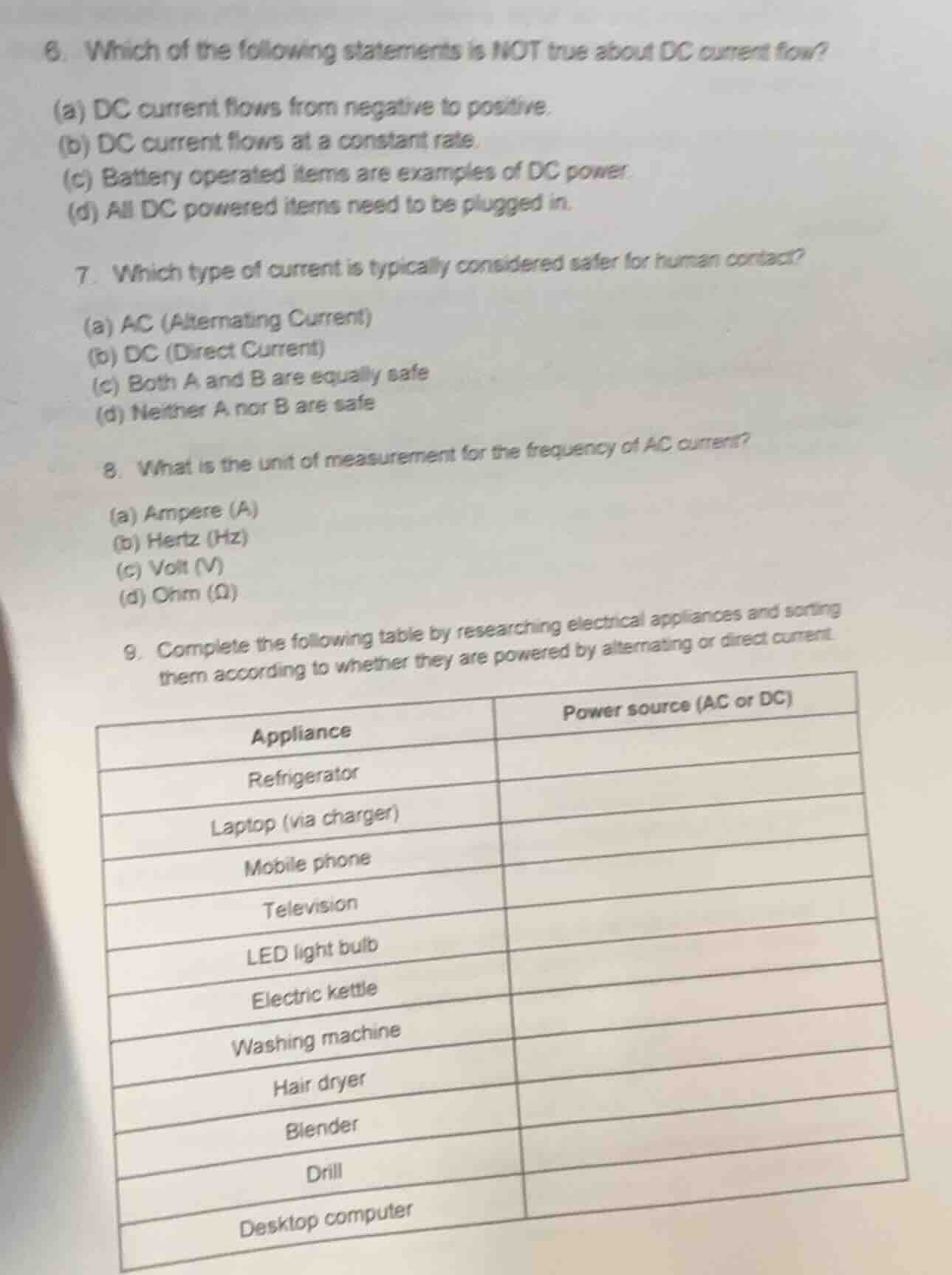
- which of the following statements is not true about dc current flow?(a) dc current flows from negative to positive.(b) dc current flows at a constant rate.(c) battery operated items are examples of dc power.(d) all dc powered items need to be plugged in.7. which type of current is typically considered safer for human contact?(a) ac (alternating current)(b) dc (direct current)(c) both a and b are equally safe(d) neither a nor b are safe8. what is the unit of measurement for the frequency of ac current?(a) ampere (a)(b) hertz (hz)(c) volt (v)(d) ohm (ω)9. complete the following table by researching electrical appliances and sorting them according to whether they are powered by alternating or direct current.appliance | power source (ac or dc)--- | ---refrigerator |laptop (via charger) |mobile phone |television |led light bulb |electric kettle |washing machine |hair dryer |blender |drill |desktop computer |
Step1: Analyze Q6 (DC current false statement)
DC current flows positive to negative (conventional), is constant, batteries are DC; DC items can be battery-powered (not plugged in). So (a) and (d) are false? Wait, conventional current is positive to negative, electron flow is negative to positive. But standard DC current flow convention is positive to negative, so (a) is false, and (d) is false? Wait no, the question asks which is NOT true. Wait:
- (a) DC current flows from negative to positive: electron flow is this, but conventional current is opposite. But in basic circuits, the stated current flow (conventional) is positive to negative, so (a) is incorrect. But (d): All DC powered items need to be plugged in: false, since batteries are DC. Wait, let's recheck:
Wait, the question is which is NOT true. Let's confirm each:
(a) DC current flows negative to positive: electron flow is this, but conventional current is positive to negative. So if the question refers to conventional current, (a) is false. (d) All DC items need plugging: false, because battery-powered items are DC and not plugged in. Wait, but let's check standard questions. Usually, (d) is the clear false statement, because (a) can refer to electron flow, but (d) is definitely false.
Step2: Analyze Q7 (Safer current)
DC is safer than AC at same voltage, as AC can cause muscle tetanus easier. So (b) is correct.
Step3: Analyze Q8 (AC frequency unit)
Frequency is measured in Hertz (Hz). Ampere is current, Volt is voltage, Ohm is resistance. So (b) is correct.
Step4: Analyze Q9 (Appliance power sources)
Classify each appliance based on standard power:
- Refrigerator: Uses wall AC
- Laptop (via charger): Charger converts AC to DC, so laptop runs on DC
- Mobile phone: Runs on DC (battery, charger converts AC to DC)
- Television: Modern TVs use AC (wall power, internal conversion but input is AC)
- LED light bulb: If plugged into wall, AC; but some are DC, but standard plug-in is AC
- Electric kettle: Uses AC (wall power)
- Washing machine: Uses AC (wall power)
- Hair dryer: Uses AC (wall power)
- Blender: Uses AC (wall power)
- Drill: Corded is AC, cordless is DC, but standard drill (corded) is AC; but if cordless, DC. But standard is AC for corded, but let's use common: corded drill is AC, but if we assume standard, AC.
- Desktop computer: Power supply converts AC to DC, so input is AC, but the computer uses DC; but the power source input is AC, but the question is powered by AC or DC. The desktop runs on DC, but gets AC from wall. Wait, no: the power source for the appliance: the laptop via charger: the charger takes AC, outputs DC to laptop, so laptop is powered by DC. Desktop same: power supply converts AC to DC, so desktop runs on DC. Wait, no, let's correct:
Wait, let's list correctly:
- Refrigerator: AC
- Laptop (via charger): DC (charger converts AC to DC for laptop)
- Mobile phone: DC (battery, charger provides DC)
- Television: AC (plugs into wall AC, internal conversion but power source is AC)
- LED light bulb (plug-in): AC; if battery, DC, but standard is AC
- Electric kettle: AC
- Washing machine: AC
- Hair dryer: AC
- Blender: AC
- Drill (corded): AC; cordless: DC, but standard is AC
- Desktop computer: DC (power supply converts AC to DC for the computer)

Snap & solve any problem in the app
Get step-by-step solutions on Sovi AI
Photo-based solutions with guided steps
Explore more problems and detailed explanations
- (d) All DC powered items need to be plugged in.
- (b) DC (Direct Current)
- (b) Hertz (Hz)
9.
| Appliance | Power source (AC or DC) |
|---|---|
| Laptop (via charger) | DC |
| Mobile phone | DC |
| Television | AC |
| LED light bulb | AC |
| Electric kettle | AC |
| Washing machine | AC |
| Hair dryer | AC |
| Blender | AC |
| Drill | AC |
| Desktop computer | DC |