QUESTION IMAGE
Question
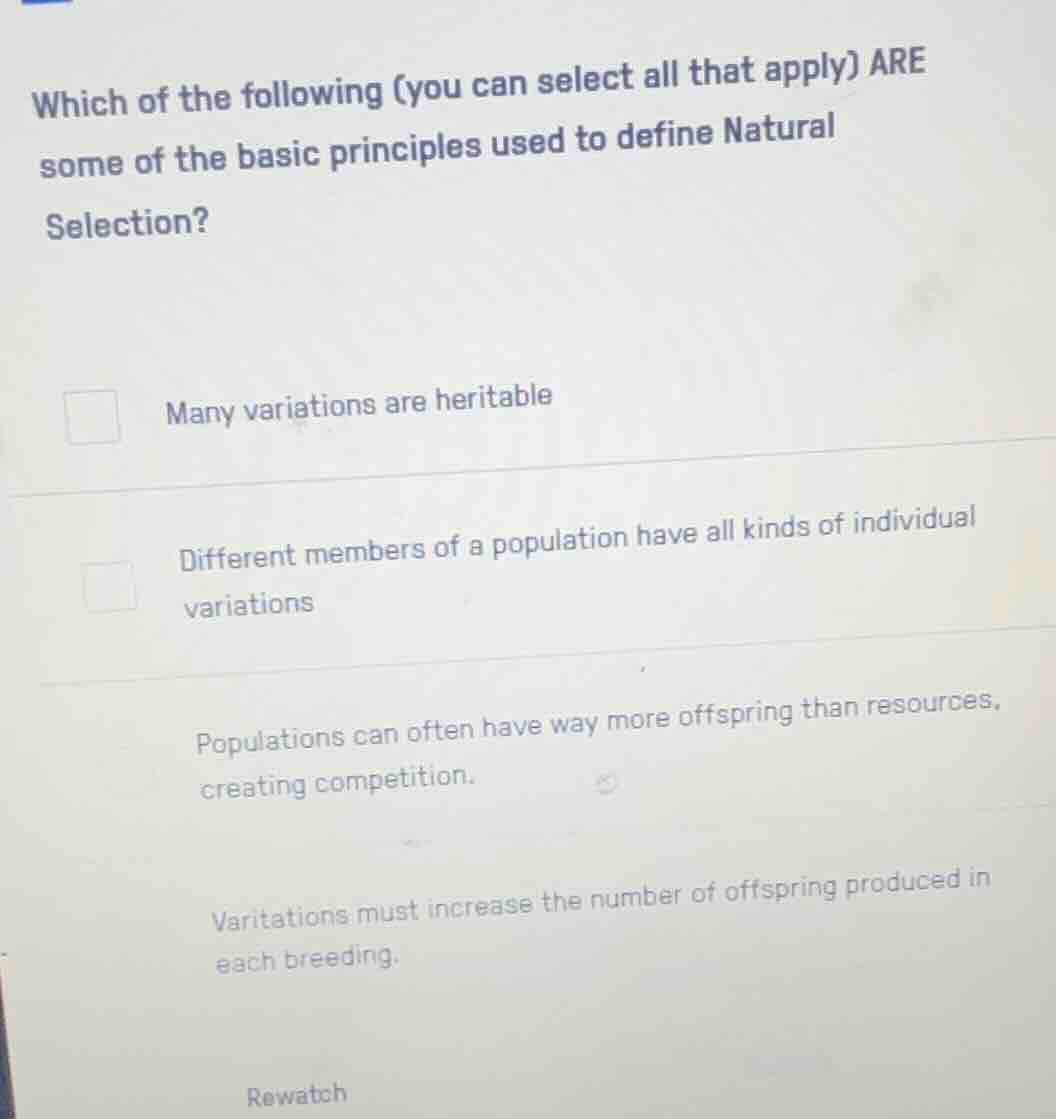
which of the following (you can select all that apply) are some of the basic principles used to define natural selection? many variations are heritable different members of a population have all kinds of individual variations populations can often have way more offspring than resources, creating competition. variations must increase the number of offspring produced in each breeding. rewatch
Brief Explanations
To determine the principles of natural selection:
- "Many variations are heritable": A key principle—heritable variations are necessary for traits to be passed to future generations, driving evolution.
- "Different members of a population have all kinds of individual variations": Natural selection requires variation within a population (e.g., in traits like size, color, or behavior) as the raw material for selection.
- "Populations can often have way more offspring than resources, creating competition": Overproduction of offspring leads to competition for limited resources (food, space, mates), so only some survive and reproduce (survival of the fittest).
- "Variations must increase the number of offspring produced in each breeding": Incorrect. Natural selection favors variations that increase survival and reproductive success (not necessarily just the number of offspring per breeding; e.g., a trait that improves offspring survival is also selected, even if it does not increase immediate offspring count).

Snap & solve any problem in the app
Get step-by-step solutions on Sovi AI
Photo-based solutions with guided steps
Explore more problems and detailed explanations
- Many variations are heritable
- Different members of a population have all kinds of individual variations
- Populations can often have way more offspring than resources, creating competition