QUESTION IMAGE
Question
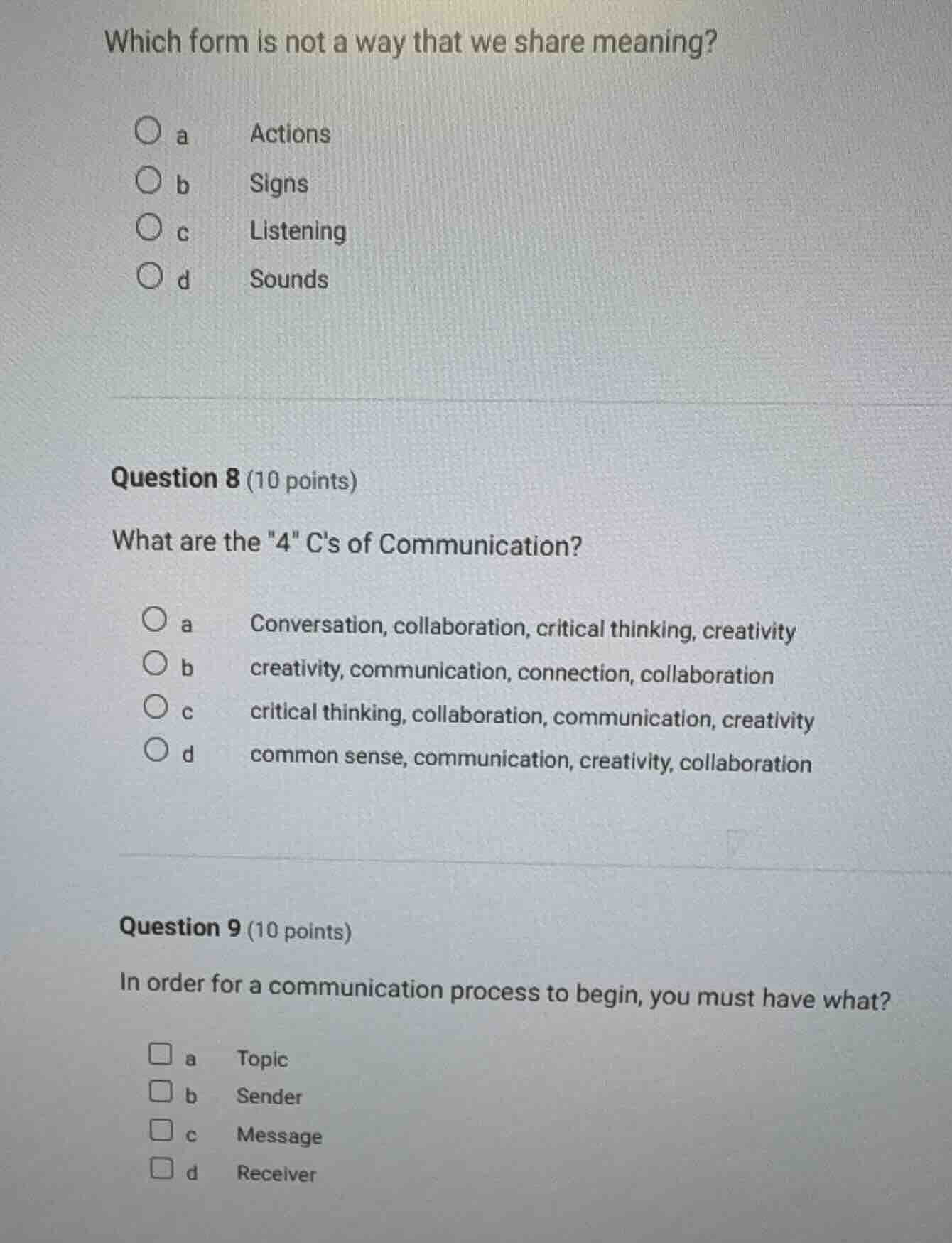
which form is not a way that we share meaning?
a actions
b signs
c listening
d sounds
question 8 (10 points)
what are the \4\ cs of communication?
a conversation, collaboration, critical thinking, creativity
b creativity, communication, connection, collaboration
c critical thinking, collaboration, communication, creativity
d common sense, communication, creativity, collaboration
question 9 (10 points)
in order for a communication process to begin, you must have what?
a topic
b sender
c message
d receiver
Question (First one: Which form is not a way that we share meaning?)
To determine which is not a meaning - sharing form, we analyze each option:
- Actions: Can convey meaning (e.g., a wave to greet).
- Signs: Are used to share meaning (e.g., a stop sign).
- Listening: Is a part of receiving meaning, not a way to share it.
- Sounds: Like speech sounds, are used to share meaning.
The 4 C's of communication (in the context of 21st - century skills related to communication and collaboration) are critical thinking, collaboration, communication, and creativity.
- Option a: Conversation is not one of the 4 C's.
- Option b: Connection is not part of the 4 C's.
- Option c: Matches the 4 C's (critical thinking, collaboration, communication, creativity).
- Option d: Common sense is not part of the 4 C's.
In the communication process:
- Sender: Initiates the communication by encoding a message. Without a sender, there is no one to start the communication.
- Message: Is what the sender wants to communicate. But a sender is needed to create and send the message.
- Receiver: Is the target of the communication, but the process starts with the sender.
- Topic: Is related to the message, but the sender is the one who starts the process. However, in the communication process, the basic elements to start are a sender (to initiate), a message (what is being sent), and a receiver (to receive). But among the options, the sender is the one who begins the process by creating and sending the message. Also, a message is necessary as it is the content of communication. And a receiver is needed to complete the communication, but for the process to begin, a sender (who has a message) and a receiver (to receive) are needed. But looking at the options, the key element to start the process is the sender (who initiates) and also the message (the content) and the receiver (the target). But in the standard communication process, the sender is the one who starts by formulating a message to send to a receiver. So the necessary elements to begin are sender, message, and receiver. But if we consider the start, the sender is the one who starts the process. However, in the options, the correct elements are sender, message, and receiver. But let's analyze each option:
- Option a: Topic is not a necessary element to start the process.
- Option b: Sender is necessary as they start the communication.
- Option c: Message is necessary as it is the content of communication.
- Option d: Receiver is necessary as the communication is directed to them.
So the correct options are b, c, d (and a is incorrect as topic is not a must - have to start the process). But if we follow the standard communication process, the minimum to start is a sender (who has a message) and a receiver. But in the given options, the correct elements are sender, message, and receiver.

Snap & solve any problem in the app
Get step-by-step solutions on Sovi AI
Photo-based solutions with guided steps
Explore more problems and detailed explanations
c. Listening