QUESTION IMAGE
Question
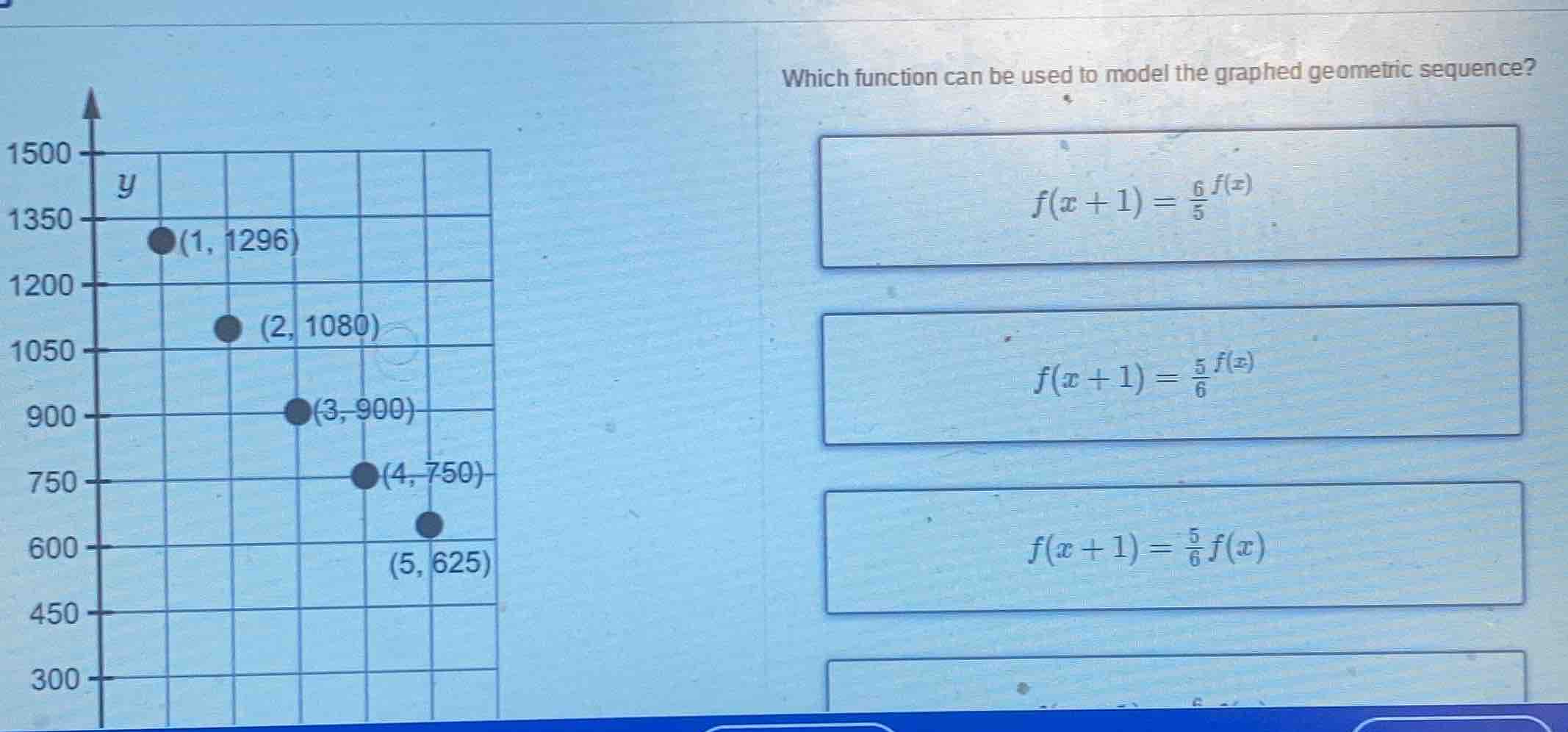
which function can be used to model the graphed geometric sequence? the graph has points (1, 1296), (2, 1080), (3, 900), (4, 750), (5, 625). the options are: $f(x + 1) = \frac{6}{5}f(x)$; $f(x + 1) = \frac{5}{6}f(x)$; $f(x + 1) = \frac{5}{6}f(x)$ (and another option partially visible)
Step1: Find the common ratio
To find the common ratio \( r \) of a geometric sequence, we divide a term by its previous term. Let's take the second term \( f(2) = 1080 \) and the first term \( f(1) = 1296 \). So \( r=\frac{f(2)}{f(1)}=\frac{1080}{1296}\). Simplify this fraction: divide numerator and denominator by 216, we get \( \frac{1080\div216}{1296\div216}=\frac{5}{6} \). Let's check with another pair, say \( f(3) = 900 \) and \( f(2) = 1080 \). \( \frac{900}{1080}=\frac{5}{6} \) (divide numerator and denominator by 180). So the common ratio \( r = \frac{5}{6} \).
Step2: Relate to the recursive formula
In a geometric sequence, the recursive formula is \( f(x + 1)=r\times f(x) \). Since we found \( r=\frac{5}{6} \), the formula should be \( f(x + 1)=\frac{5}{6}f(x) \).

Snap & solve any problem in the app
Get step-by-step solutions on Sovi AI
Photo-based solutions with guided steps
Explore more problems and detailed explanations
\( f(x + 1)=\frac{5}{6}f(x) \) (the option with \( f(x + 1)=\frac{5}{6}f(x) \))