QUESTION IMAGE
Question
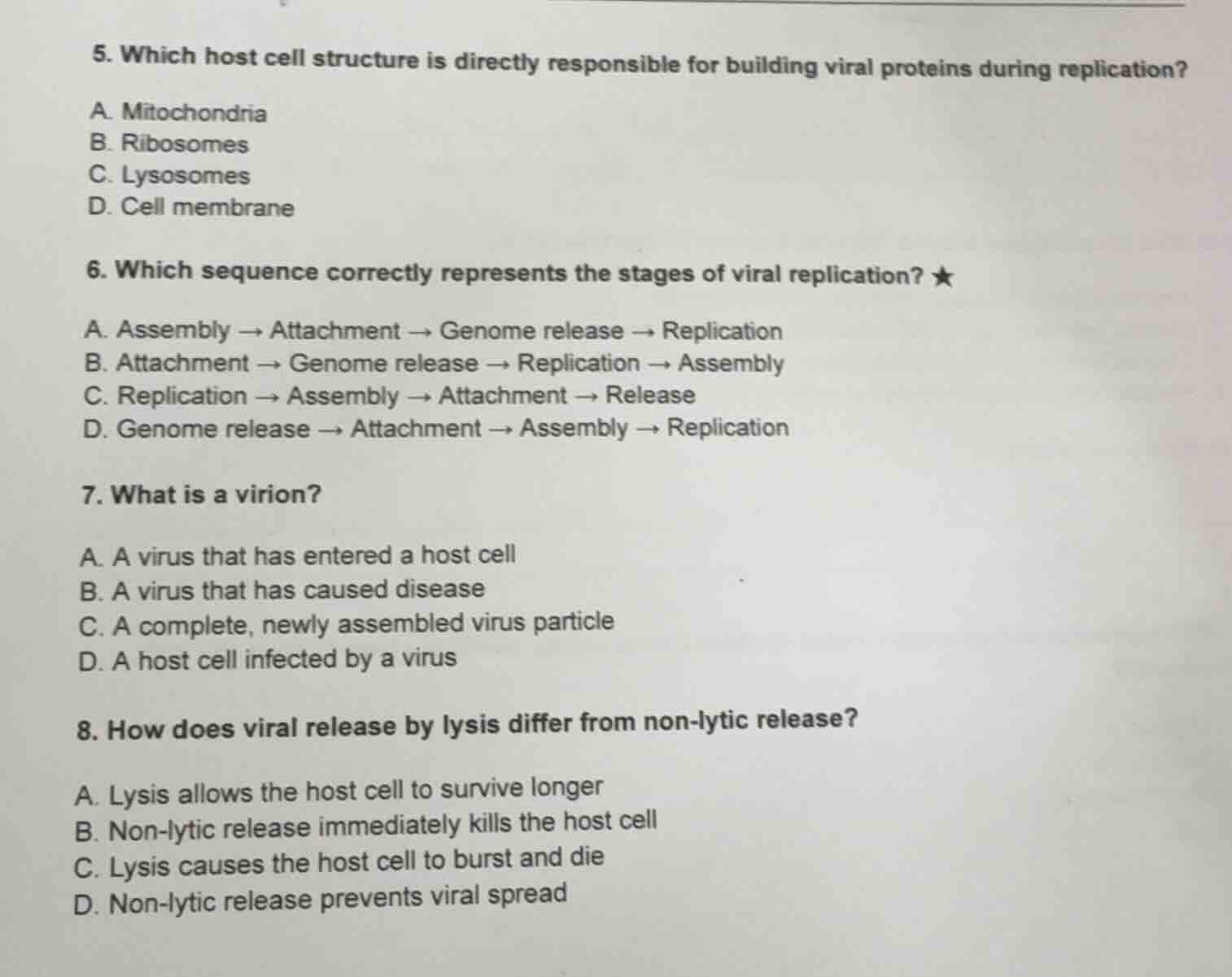
- which host cell structure is directly responsible for building viral proteins during replication?
a. mitochondria
b. ribosomes
c. lysosomes
d. cell membrane
- which sequence correctly represents the stages of viral replication? ★
a. assembly → attachment → genome release → replication
b. attachment → genome release → replication → assembly
c. replication → assembly → attachment → release
d. genome release → attachment → assembly → replication
- what is a virion?
a. a virus that has entered a host cell
b. a virus that has caused disease
c. a complete, newly assembled virus particle
d. a host cell infected by a virus
- how does viral release by lysis differ from non - lytic release?
a. lysis allows the host cell to survive longer
b. non - lytic release immediately kills the host cell
c. lysis causes the host cell to burst and die
d. non - lytic release prevents viral spread
- For question 5: Ribosomes are the cellular structures that synthesize proteins, including viral proteins, using viral mRNA in the host cell. Mitochondria produce energy, lysosomes break down materials, and the cell membrane regulates transport, none build proteins directly.
- For question 6: Viral replication follows the order: first attachment to the host cell, then genome release into the cell, replication of viral genetic material and proteins, finally assembly of new viral particles.
- For question 7: A virion is defined as a fully assembled, infectious virus particle that can exit the host cell to infect new cells. It is the extracellular, complete form of a virus.
- For question 8: Lytic release involves the host cell bursting (lysing) to release new virions, which kills the host cell. Non-lytic release (budding) allows the host cell to survive temporarily, so new virions exit without immediate cell death.

Snap & solve any problem in the app
Get step-by-step solutions on Sovi AI
Photo-based solutions with guided steps
Explore more problems and detailed explanations
- B. Ribosomes
- B. Attachment → Genome release → Replication → Assembly
- C. A complete, newly assembled virus particle
- C. Lysis causes the host cell to burst and die