QUESTION IMAGE
Question
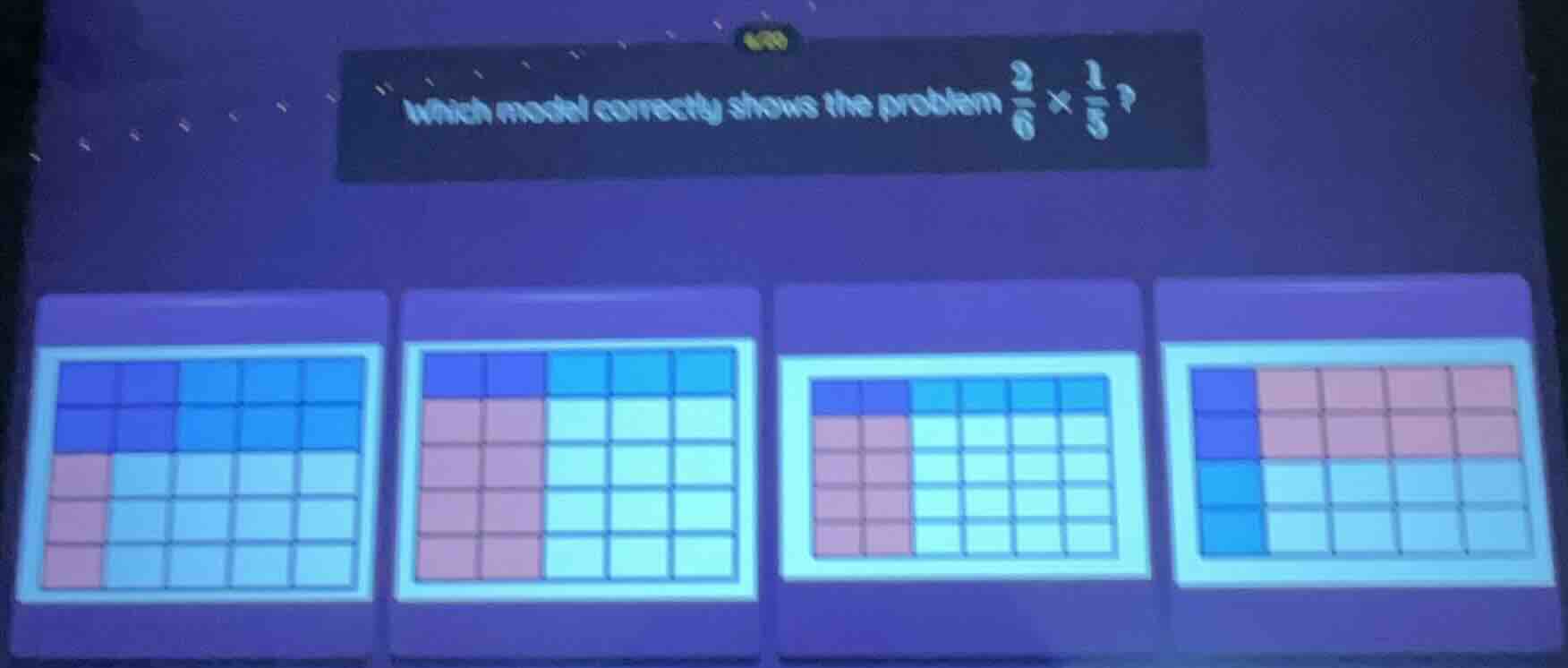
which model correctly shows the problem $\frac{2}{6} \times \frac{1}{5}$?
To determine the correct model for $\frac{2}{6} \times \frac{1}{5}$, we analyze the multiplication of fractions using area models:
Step 1: Interpret $\frac{2}{6}$
- $\frac{2}{6}$ means dividing a whole into 6 equal rows (vertical or horizontal) and shading 2 of them. For example, if we consider rows, we shade 2 out of 6 rows.
Step 2: Interpret $\frac{1}{5}$
- $\frac{1}{5}$ means dividing a whole into 5 equal columns and shading 1 of them.
Step 3: Analyze the Area Model for $\frac{2}{6} \times \frac{1}{5}$
- The product $\frac{2}{6} \times \frac{1}{5}$ represents the overlapping region (double - shaded) when we first shade $\frac{2}{6}$ of the whole (by rows) and then shade $\frac{1}{5}$ of that shaded part (by columns).
- First, identify the model where 2 out of 6 rows are initially shaded (to represent $\frac{2}{6}$). Then, within those 2 shaded rows, 1 out of 5 columns is shaded (to represent $\frac{1}{5}$ of the $\frac{2}{6}$ part).
Looking at the given models:
- The fourth model (from the left) has 2 rows shaded (to represent $\frac{2}{6}$ if we consider 6 rows in total? Wait, no, let's re - evaluate. Wait, actually, let's count the number of rows and columns. Let's assume the whole is a rectangle with, say, 6 rows and 5 columns (since the denominators are 6 and 5).
- For $\frac{2}{6}$, we shade 2 rows out of 6. For $\frac{1}{5}$, we shade 1 column out of 5. The overlapping area (the part that is shaded twice) should represent the product.
- Let's check the fourth model: It has 3 rows? No, wait, maybe the number of rows and columns is such that the first shading (for $\frac{2}{6}$) is along the rows and the second (for $\frac{1}{5}$) along the columns.
Wait, another approach: The formula for multiplying fractions is $\frac{a}{b}\times\frac{c}{d}=\frac{a\times c}{b\times d}$. So $\frac{2}{6}\times\frac{1}{5}=\frac{2\times1}{6\times5}=\frac{2}{30}=\frac{1}{15}$.
Now, let's analyze each model:
- Model 1: The shading doesn't seem to follow the 2 rows (for $\frac{2}{6}$) and 1 column (for $\frac{1}{5}$) pattern.
- Model 2: The initial shading (the pink part) is 2 columns? No, that's not for $\frac{2}{6}$.
- Model 3: The number of rows and columns doesn't match the 6 - row and 5 - column structure.
- Model 4: Let's count the rows and columns. If we consider that there are 6 rows (since the denominator of the first fraction is 6) and 5 columns (denominator of the second fraction is 5). The first shading (blue) is 2 rows (out of 6) and then within those 2 rows, 1 column (out of 5) is shaded (the darker blue or the overlapping with another color). Wait, actually, the fourth model has 2 rows shaded (the blue and pink rows? No, let's look at the colors. The blue part is 2 rows (vertical? No, horizontal) and then within that, 1 column? Wait, maybe the correct model is the fourth one. Wait, no, let's re - examine.
Wait, maybe the correct model is the one where:
- First, we divide the rectangle into 6 equal parts vertically (columns) and shade 2 of them (for $\frac{2}{6}$), then divide the rectangle into 5 equal parts horizontally (rows) and shade 1 of them (for $\frac{1}{5}$). The overlapping area is the product.
Looking at the fourth model: It has 2 columns shaded (for $\frac{2}{6}$ if we consider 6 columns? No, the denominator is 6, so maybe 6 rows. Wait, I think I made a mistake in row - column assignment. Let's assume the whole is a grid with 6 rows and 5 columns.
- To represent $\frac{2}{6}$, we shade 2 rows out of 6 (so 2 horizontal strips).
- To represent $\frac{1}{5}$, we shade 1 column out of 5 (so 1 vertical str…

Snap & solve any problem in the app
Get step-by-step solutions on Sovi AI
Photo-based solutions with guided steps
Explore more problems and detailed explanations
The fourth model (the right - most one) correctly shows the problem $\frac{2}{6}\times\frac{1}{5}$.