QUESTION IMAGE
Question
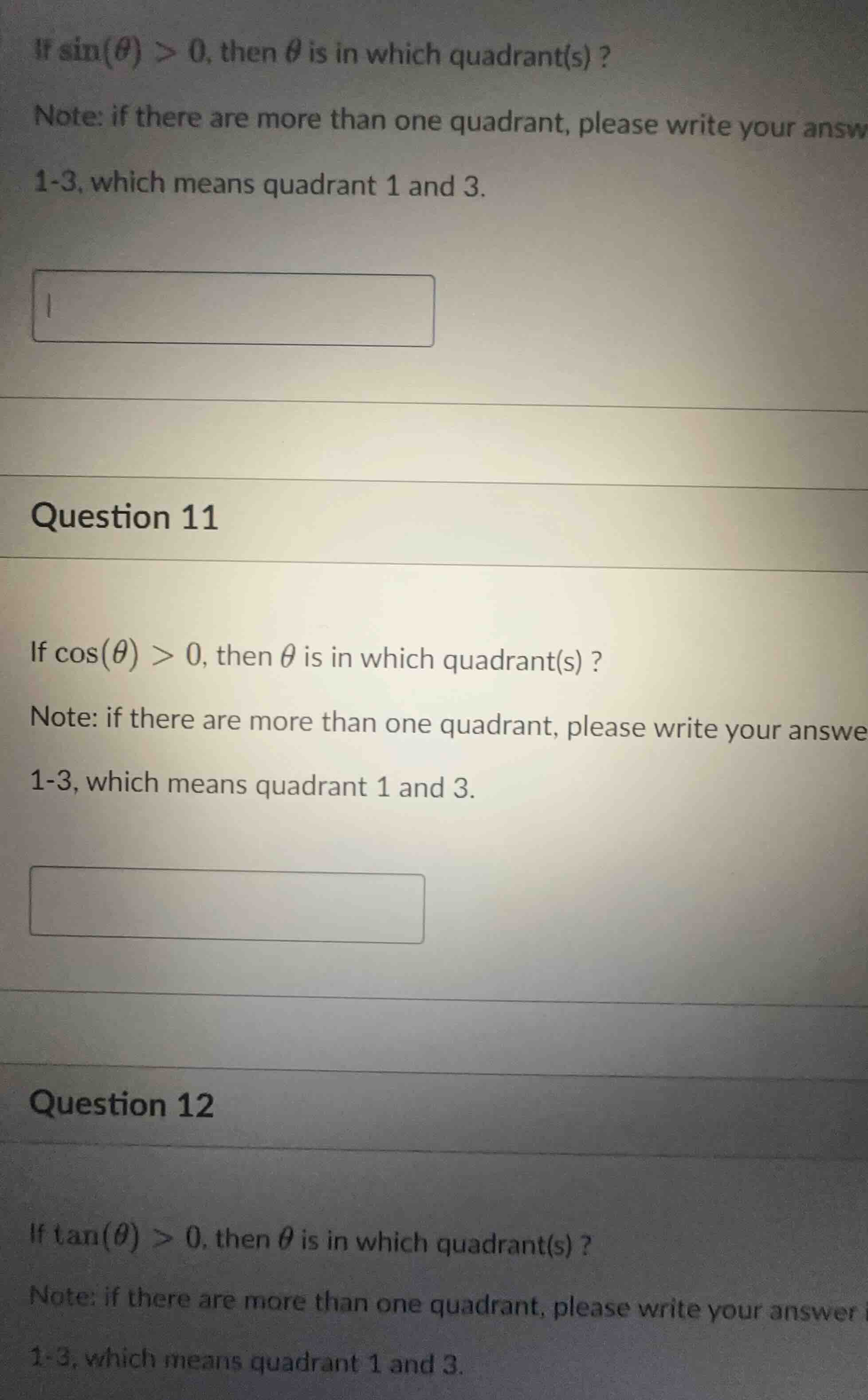
if \\(\sin(\theta) > 0\\), then \\(\theta\\) is in which quadrant(s)? note: if there are more than one quadrant, please write your answer 1-3, which means quadrant 1 and 3. question 11 if \\(\cos(\theta) > 0\\), then \\(\theta\\) is in which quadrant(s)? note: if there are more than one quadrant, please write your answer 1-3, which means quadrant 1 and 3. question 12 if \\(\tan(\theta) > 0\\), then \\(\theta\\) is in which quadrant(s)? note: if there are more than one quadrant, please write your answer 1-3, which means quadrant 1 and 3.
Question (about \(\sin(\theta) > 0\))
Step1: Recall sine sign rules
In unit circle, \(\sin(\theta)\) is \(y\)-coordinate. In quadrant 1, \(y>0\); quadrant 2, \(y>0\); quadrant 3, \(y<0\); quadrant 4, \(y<0\).
Step2: Determine quadrants
Since \(\sin(\theta)>0\) ( \(y>0\) ), \(\theta\) is in quadrant 1 and 2.
Step1: Recall cosine sign rules
\(\cos(\theta)\) is \(x\)-coordinate. In quadrant 1, \(x>0\); quadrant 2, \(x<0\); quadrant 3, \(x<0\); quadrant 4, \(x>0\).
Step2: Determine quadrants
Since \(\cos(\theta)>0\) ( \(x>0\) ), \(\theta\) is in quadrant 1 and 4.
Step1: Recall tangent definition
\(\tan(\theta)=\frac{\sin(\theta)}{\cos(\theta)}\). For \(\tan(\theta)>0\), \(\sin(\theta)\) and \(\cos(\theta)\) must have same sign.
Step2: Analyze quadrants
- Quadrant 1: \(\sin>0\), \(\cos>0\) (same sign, \(\tan>0\)).
- Quadrant 2: \(\sin>0\), \(\cos<0\) (different sign, \(\tan<0\)).
- Quadrant 3: \(\sin<0\), \(\cos<0\) (same sign, \(\tan>0\)).
- Quadrant 4: \(\sin<0\), \(\cos>0\) (different sign, \(\tan<0\)).
So \(\theta\) is in quadrant 1 and 3.

Snap & solve any problem in the app
Get step-by-step solutions on Sovi AI
Photo-based solutions with guided steps
Explore more problems and detailed explanations
1-2