QUESTION IMAGE
Question
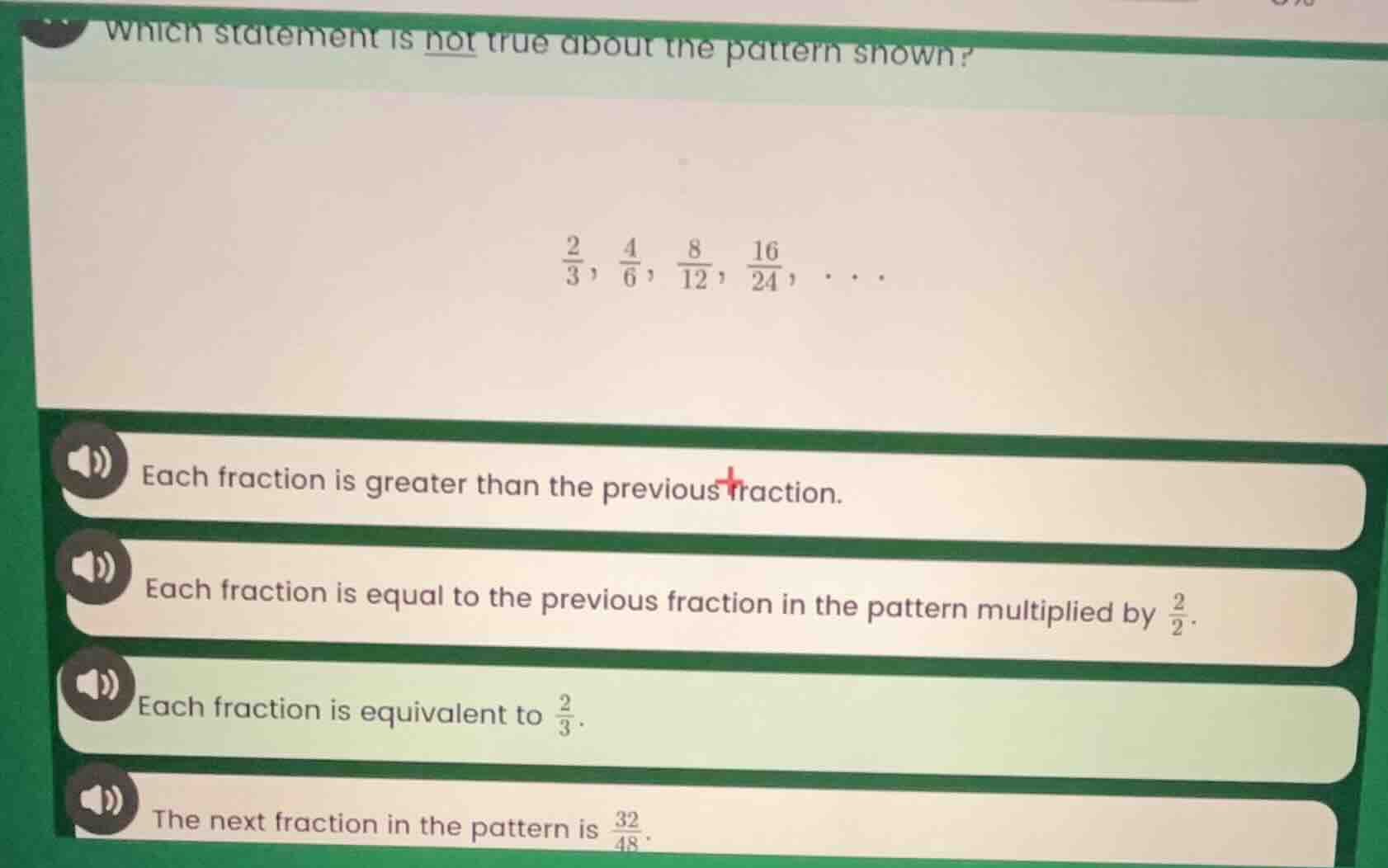
which statement is not true about the pattern shown?
\\(\frac{2}{3}, \frac{4}{6}, \frac{8}{12}, \frac{16}{24}, dots\\)
- each fraction is greater than the previous fraction.
- each fraction is equal to the previous fraction in the pattern multiplied by \\(\frac{2}{2}\\).
- each fraction is equivalent to \\(\frac{2}{3}\\).
- the next fraction in the pattern is \\(\frac{32}{48}\\).
Step1: Simplify each fraction
$\frac{2}{3} = \frac{2}{3}$, $\frac{4}{6} = \frac{2}{3}$, $\frac{8}{12} = \frac{2}{3}$, $\frac{16}{24} = \frac{2}{3}$
Step2: Analyze Option 1
All fractions equal $\frac{2}{3}$, so no fraction is greater than the prior one.
Step3: Analyze Option 2
Multiply $\frac{2}{3}$ by $\frac{2}{2}$: $\frac{2}{3} \times \frac{2}{2} = \frac{4}{6}$, which matches the pattern. This holds for all terms.
Step4: Analyze Option 3
As shown in Step1, every fraction simplifies to $\frac{2}{3}$, so they are equivalent.
Step5: Analyze Option 4
Multiply the last term $\frac{16}{24}$ by $\frac{2}{2}$: $\frac{16}{24} \times \frac{2}{2} = \frac{32}{48}$, which is the next term.

Snap & solve any problem in the app
Get step-by-step solutions on Sovi AI
Photo-based solutions with guided steps
Explore more problems and detailed explanations
A. Each fraction is greater than the previous fraction.