QUESTION IMAGE
Question
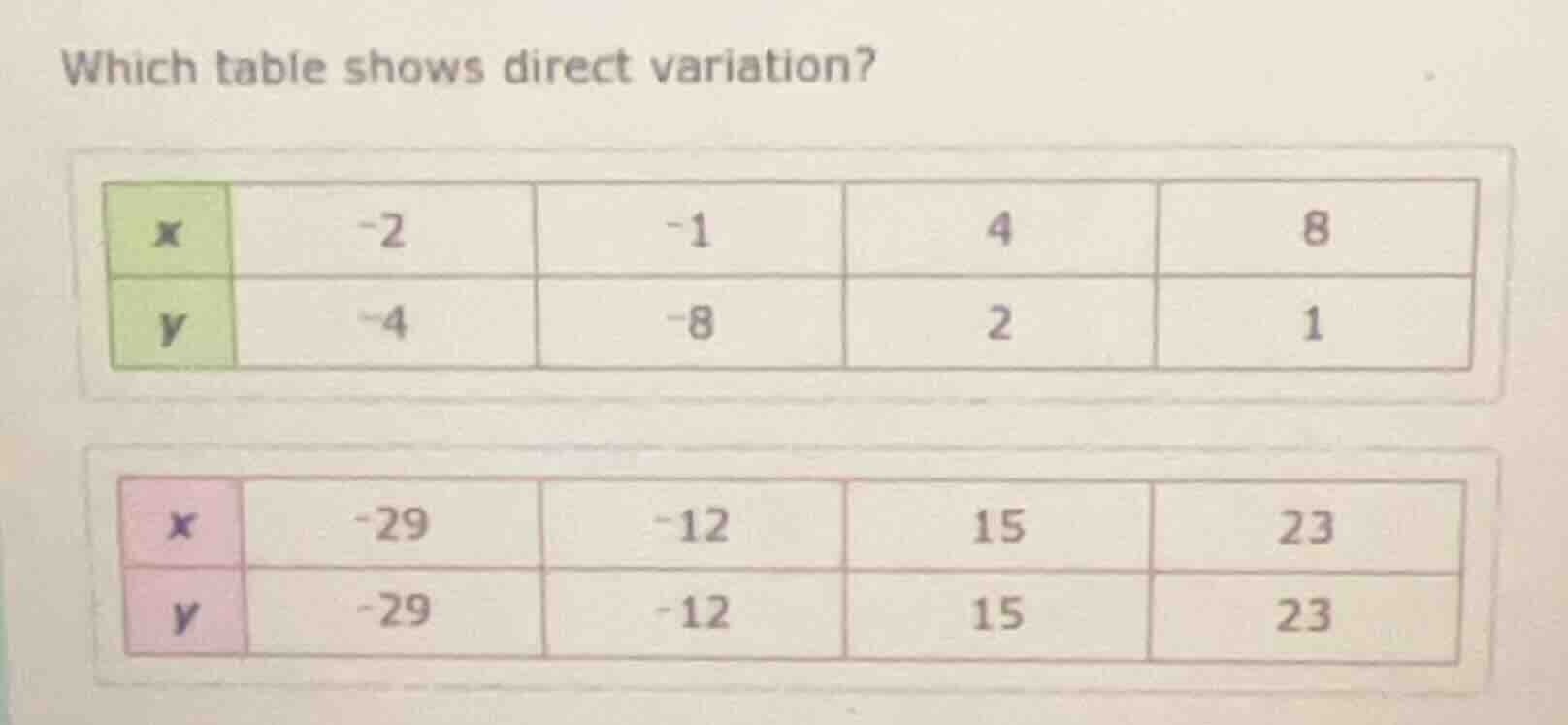
which table shows direct variation?
| x | -2 | -1 | 4 | 8 |
| y | -4 | -8 | 2 | 1 |
| x | -29 | -12 | 15 | 23 |
| y | -29 | -12 | 15 | 23 |
Step1: Recall direct variation rule
Direct variation follows $y = kx$, so $\frac{y}{x} = k$ (constant) for all non-zero $x$.
Step2: Check first table
Calculate $\frac{y}{x}$ for each pair:
$\frac{-4}{-2}=2$, $\frac{-8}{-1}=8$, $\frac{2}{4}=0.5$, $\frac{1}{8}=0.125$.
Values are not constant.
Step3: Check second table
Calculate $\frac{y}{x}$ for each pair:
$\frac{-29}{-29}=1$, $\frac{-12}{-12}=1$, $\frac{15}{15}=1$, $\frac{23}{23}=1$.
Values are constant ($k=1$).

Snap & solve any problem in the app
Get step-by-step solutions on Sovi AI
Photo-based solutions with guided steps
Explore more problems and detailed explanations
The second table (with x-values -29, -12, 15, 23 and matching y-values -29, -12, 15, 23) shows direct variation.