QUESTION IMAGE
Question
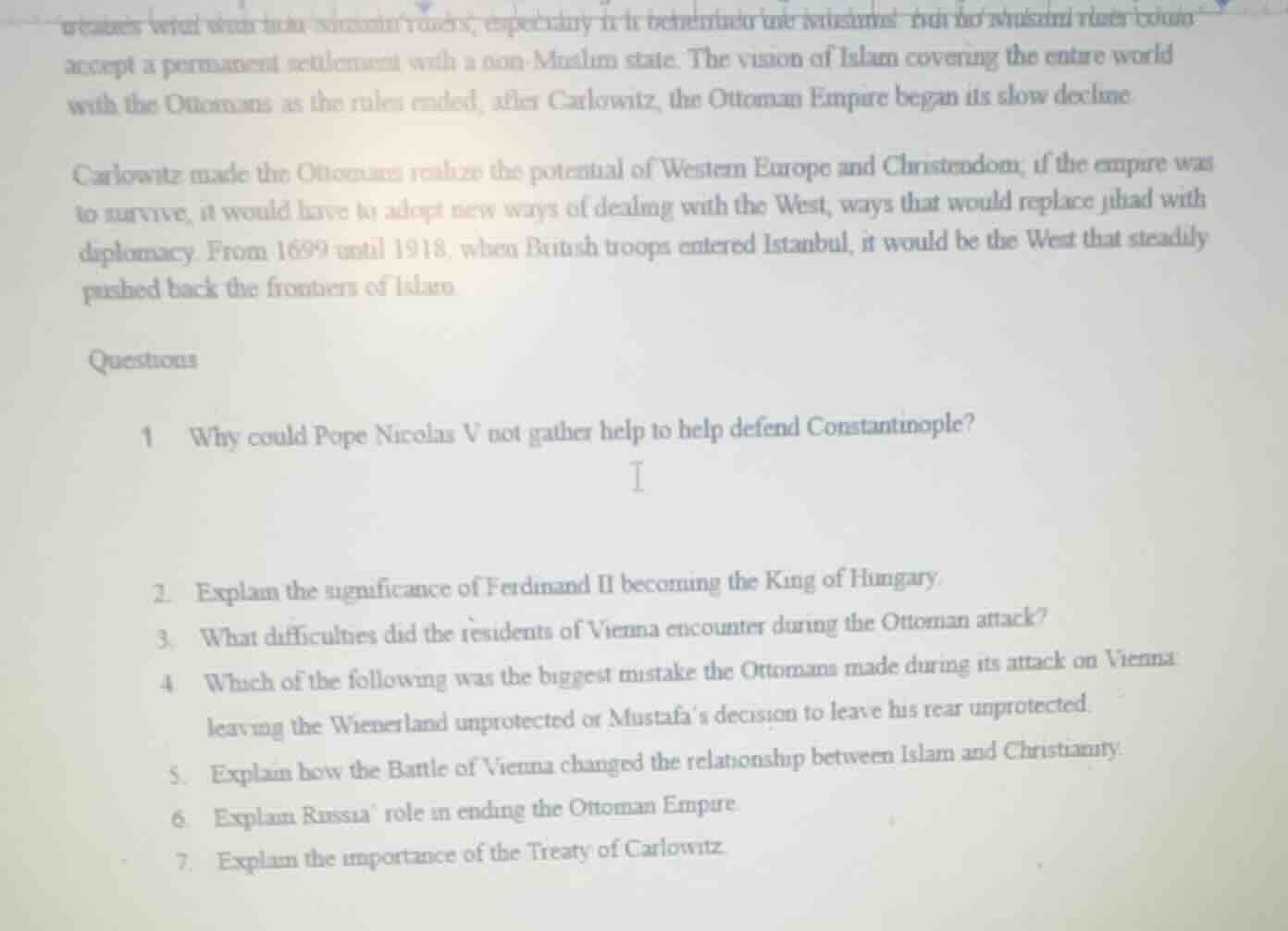
wishes what won him ‘succession’ today, especially if it benefitted the muslims’ but for muslims rulers to accept a permanent settlement with a non - muslim state. the vision of islam covering the entire world with the ottomans as the rulers ended, after carlowitz, the ottoman empire began its slow decline.
carlowitz made the ottomans realize the potential of western europe and christendom; if the empire was to survive, it would have to adopt new ways of dealing with the west, ways that would replace jihad with diplomacy. from 1699 until 1918, when british troops entered istanbul, it would be the west that steadily pushed back the frontiers of islam.
questions
1 why could pope nicolas v not gather help to help defend constantinople?
2 explain the significance of ferdinand ii becoming the king of hungary.
3 what difficulties did the residents of vienna encounter during the ottoman attack?
4 which of the following was the biggest mistake the ottomans made during its attack on vienna: leaving the wienerland unprotected or mustafa’s decision to leave his rear unprotected?
5 explain how the battle of vienna changed the relationship between islam and christianity.
6 explain russia’ role in ending the ottoman empire.
7 explain the importance of the treaty of carlowitz.
- Pope Nicholas V failed to gather aid for Constantinople because Western European powers were fragmented: many were focused on internal conflicts, rivalry between city-states and kingdoms, and some even had diplomatic or trade ties with the Ottomans that they were reluctant to break. Additionally, the call for a crusade lacked unified enthusiasm.
- Ferdinand II becoming King of Hungary meant a unified Christian front against Ottoman expansion in Central Europe; his claim tied Habsburg power to Hungary, turning the region into a key defensive line against Ottoman incursions and escalating the Habsburg-Ottoman rivalry.
- During the Ottoman attack on Vienna, residents faced food and water shortages from the long siege, constant artillery bombardment, fear of capture or death, breakdowns in public order, and the threat of the city's defenses being breached.
- Mustafa's decision to leave his rear unprotected was the bigger mistake: this left the Ottoman supply lines and camp vulnerable, which the allied Christian forces exploited to launch a surprise counterattack that routed the Ottomans.
- The Battle of Vienna shifted the power dynamic: it ended Ottoman expansion into Europe, boosted Christian confidence, led to a period of Christian powers pushing back Ottoman territories, and replaced the idea of Ottoman invincibility with a new era of diplomatic and military competition between Islamic and Christian powers instead of one-sided Ottoman advance.
- Russia repeatedly waged wars against the Ottomans over centuries, seizing key Black Sea and Balkan territories, weakening Ottoman military and economic power. It also supported nationalist uprisings in Ottoman-held Balkan regions, further fragmenting the empire, and its military pressure contributed to the empire's final collapse in the early 20th century.
- The Treaty of Carlowitz was the first time the Ottomans lost significant territory to European powers, marking the start of their long decline. It forced the Ottomans to adopt diplomatic (instead of jihad-focused) approaches to Western powers, and established the principle that European powers could challenge and defeat Ottoman military forces.

Snap & solve any problem in the app
Get step-by-step solutions on Sovi AI
Photo-based solutions with guided steps
Explore more problems and detailed explanations
- Western European powers were fragmented by internal conflicts, rivalries, and some had ties to the Ottomans, so there was no unified support for a crusade to defend Constantinople.
- It unified Habsburg and Hungarian resistance against Ottoman expansion, turning Hungary into a key defensive front against Ottoman incursions in Central Europe.
- Residents faced food/water shortages, constant bombardment, fear of capture, public order breakdowns, and the threat of defensive collapse.
- Mustafa's decision to leave his rear unprotected.
- It halted Ottoman European expansion, reversed the power dynamic, led to Christian powers pushing back Ottoman territories, and shifted interactions to diplomatic/military competition rather than Ottoman dominance.
- Russia waged repeated wars to seize Ottoman territory, supported Balkan nationalist uprisings to fragment the empire, and sustained military pressure that weakened the Ottomans until their collapse.
- It marked the start of Ottoman decline, was the first major Ottoman territorial loss to Europe, and forced the Ottomans to replace jihad with diplomacy in dealings with the West.