QUESTION IMAGE
Question
3
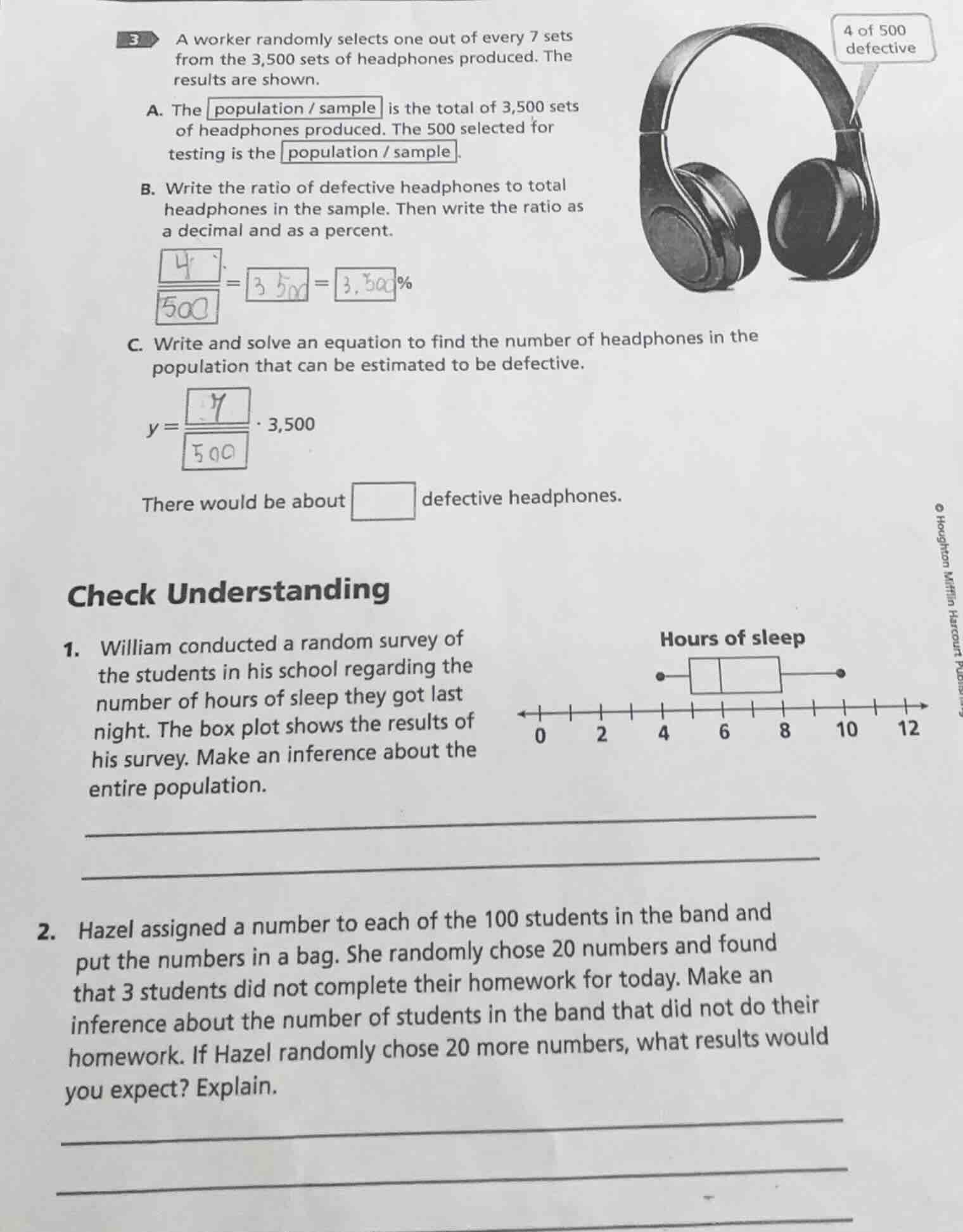
a worker randomly selects one out of every 7 sets from the 3,500 sets of headphones produced. the results are shown.
a. the population / sample is the total of 3,500 sets of headphones produced. the 500 selected for testing is the population / sample.
b. write the ratio of defective headphones to total headphones in the sample. then write the ratio as a decimal and as a percent.
\frac{4}{500}= = %
c. write and solve an equation to find the number of headphones in the population that can be estimated to be defective.
y = \frac{4}{500} \cdot 3,500
there would be about defective headphones.
check understanding
- william conducted a random survey of the students in his school regarding the number of hours of sleep they got last night. the box plot shows the results of his survey. make an inference about the entire population.
- hazel assigned a number to each of the 100 students in the band and put the numbers in a bag. she randomly chose 20 numbers and found that 3 students did not complete their homework for today. make an inference about the number of students in the band that did not do their homework. if hazel randomly chose 20 more numbers, what results would you expect? explain.
Part A
- Population: The entire group we want to study, here all 3,500 headphones.
- Sample: A part of the population selected for testing, here 500 selected.
Step1: Find the ratio of defective to total in sample
The number of defective in sample is 4, total in sample is 500. So the ratio is $\frac{4}{500}$.
Step2: Convert ratio to decimal
Divide 4 by 500: $4\div500 = 0.008$.
Step3: Convert decimal to percent
Multiply decimal by 100: $0.008\times100 = 0.8\%$.
Step1: Identify the formula
The formula is $y=\frac{4}{500}\cdot3500$, where $\frac{4}{500}$ is the proportion of defective in sample, and 3500 is the population size.
Step2: Solve the equation
First, simplify $\frac{4}{500}=\frac{1}{125}$. Then $y=\frac{1}{125}\times3500$. Calculate $3500\div125 = 28$.

Snap & solve any problem in the app
Get step-by-step solutions on Sovi AI
Photo-based solutions with guided steps
Explore more problems and detailed explanations
The population is the total of 3,500 sets of headphones produced. The 500 selected for testing is the sample.