QUESTION IMAGE
Question
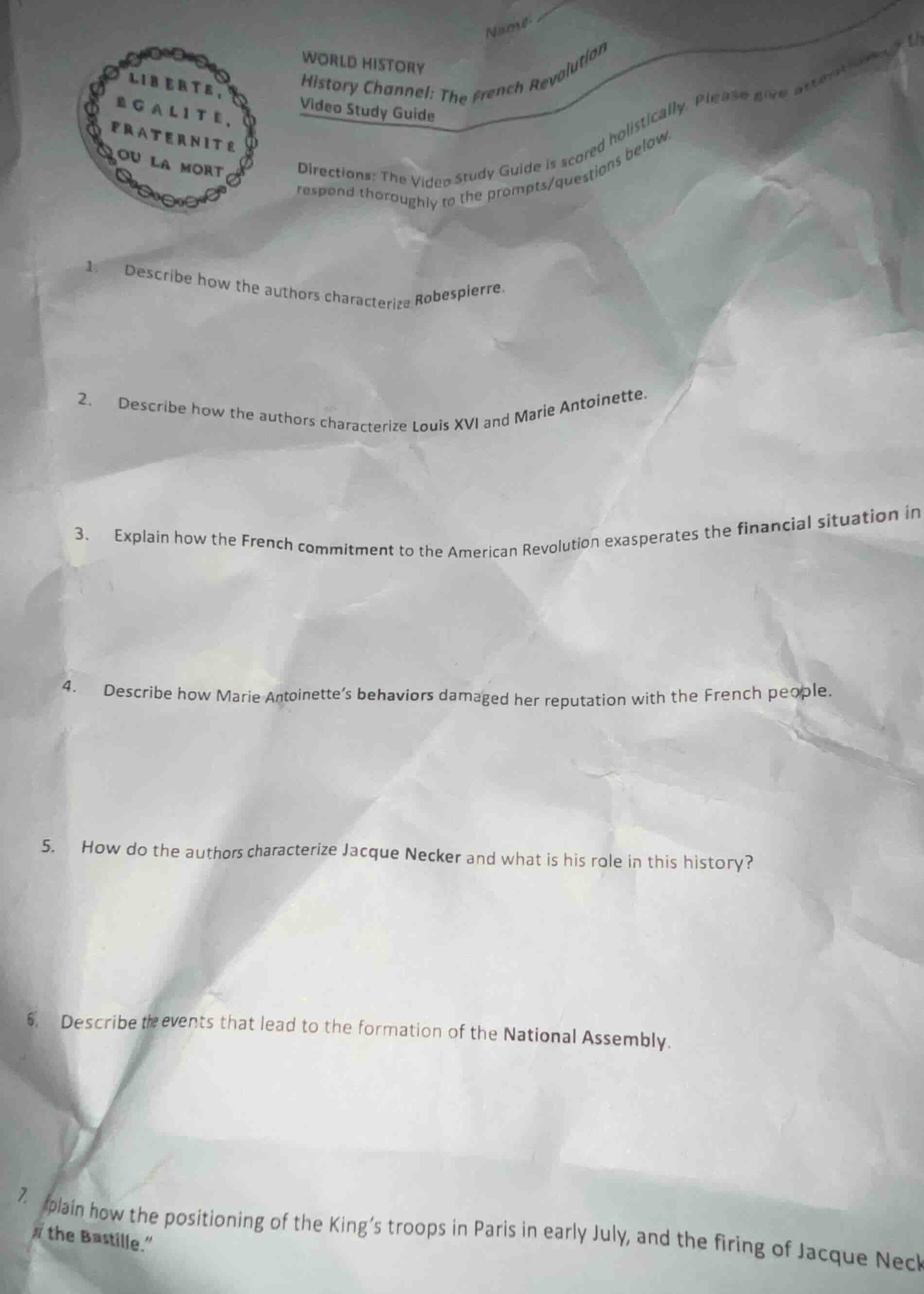
world history
history channel: the french revolution
video study guide
directions: the video study guide is scored holistically. please give attention to respond thoroughly to the prompts/questions below.
- describe how the authors characterize robespierre.
- describe how the authors characterize louis xvi and marie antoinette.
- explain how the french commitment to the american revolution exasperates the financial situation in
- describe how marie antoinette’s behaviors damaged her reputation with the french people.
- how do the authors characterize jacque necker and what is his role in this history?
- describe the events that lead to the formation of the national assembly.
- explain how the positioning of the king’s troops in paris in early july, and the firing of jacque neck at the bastille.
To answer these questions, we analyze each one based on knowledge of the French Revolution:
Question 1: Characterize Robespierre
Robespierre is often portrayed as a complex figure: a dedicated revolutionary who championed the ideals of liberty, equality, and fraternity but also became associated with the Reign of Terror. He was seen as idealistic yet uncompromising, driven by a vision of a virtuous republic but willing to use extreme measures (like the guillotine) to eliminate “enemies of the revolution.” His rhetoric emphasized virtue and the general will, but his actions led to widespread executions, creating a paradox of a revolutionary who both advanced and endangered the revolution’s goals.
Question 2: Characterize Louis XVI and Marie Antoinette
- Louis XVI: Depicted as indecisive, weak-willed, and out of touch with the struggles of the French people. He struggled to navigate the crisis of the revolution, vacillating between concessions (like calling the Estates-General) and attempts to retain royal authority. His inability to reform the financial system or address public grievances contributed to his downfall.
- Marie Antoinette: Portrayed as extravagant, out of touch, and a symbol of royal excess. Myths (like “Let them eat cake,” though likely apocryphal) and her lavish spending (e.g., on fashion, palaces) damaged her reputation. She was also seen as a foreign influence (Austrian-born) and a meddler in politics, further alienating the public.
Question 3: French Commitment to American Revolution and Finance
France’s support for the American Revolution (1775–1783) was costly. France provided military aid, loans, and supplies to the American colonists to weaken Britain (a historical rival). This spending exacerbated France’s existing financial crisis: the monarchy was already burdened by debt from previous wars (e.g., the Seven Years’ War) and a regressive tax system. The added expense of the American Revolution drained the treasury, making the government’s deficit worse and fueling public anger over taxation (especially on the Third Estate), which became a key trigger for the French Revolution.
Question 4: Marie Antoinette’s Reputation
Marie Antoinette’s behavior damaged her reputation through:
- Extravagance: Her lavish spending on palaces (e.g., the Petit Trianon), fashion, and parties contrasted sharply with the poverty of most French citizens.
- Foreign Influence: As an Austrian, she was viewed with suspicion, especially during tensions with Austria. Rumors (true or false) of her meddling in politics (e.g., opposing reforms) made her a target of public resentment.
- Symbol of Royal Decadence: She became a symbol of the monarchy’s detachment from the people’s suffering, with myths (like the “cake” quote) reinforcing her image as uncaring.
Question 5: Jacque Necker’s Characterization and Role
- Characterization: Necker was portrayed as a reform-minded, capable finance minister. He was sympathetic to the Third Estate, advocating for tax reform (e.g., taxing the nobility) and greater transparency in government finances.
- Role: He served as France’s finance minister, trying to address the financial crisis. His 1781 “Compte rendu au roi” (report to the king) exaggerated France’s financial health, but his dismissal in 1789 (for pushing reforms) sparked public outrage, contributing to the storming of the Bastille and the revolution’s escalation. He was seen as a moderate reformer who briefly united the people’s hopes before being sidelined.
Question 6: Formation of the Natio…

Snap & solve any problem in the app
Get step-by-step solutions on Sovi AI
Photo-based solutions with guided steps
Explore more problems and detailed explanations
To answer these questions, we analyze each one based on knowledge of the French Revolution:
Question 1: Characterize Robespierre
Robespierre is often portrayed as a complex figure: a dedicated revolutionary who championed the ideals of liberty, equality, and fraternity but also became associated with the Reign of Terror. He was seen as idealistic yet uncompromising, driven by a vision of a virtuous republic but willing to use extreme measures (like the guillotine) to eliminate “enemies of the revolution.” His rhetoric emphasized virtue and the general will, but his actions led to widespread executions, creating a paradox of a revolutionary who both advanced and endangered the revolution’s goals.
Question 2: Characterize Louis XVI and Marie Antoinette
- Louis XVI: Depicted as indecisive, weak-willed, and out of touch with the struggles of the French people. He struggled to navigate the crisis of the revolution, vacillating between concessions (like calling the Estates-General) and attempts to retain royal authority. His inability to reform the financial system or address public grievances contributed to his downfall.
- Marie Antoinette: Portrayed as extravagant, out of touch, and a symbol of royal excess. Myths (like “Let them eat cake,” though likely apocryphal) and her lavish spending (e.g., on fashion, palaces) damaged her reputation. She was also seen as a foreign influence (Austrian-born) and a meddler in politics, further alienating the public.
Question 3: French Commitment to American Revolution and Finance
France’s support for the American Revolution (1775–1783) was costly. France provided military aid, loans, and supplies to the American colonists to weaken Britain (a historical rival). This spending exacerbated France’s existing financial crisis: the monarchy was already burdened by debt from previous wars (e.g., the Seven Years’ War) and a regressive tax system. The added expense of the American Revolution drained the treasury, making the government’s deficit worse and fueling public anger over taxation (especially on the Third Estate), which became a key trigger for the French Revolution.
Question 4: Marie Antoinette’s Reputation
Marie Antoinette’s behavior damaged her reputation through:
- Extravagance: Her lavish spending on palaces (e.g., the Petit Trianon), fashion, and parties contrasted sharply with the poverty of most French citizens.
- Foreign Influence: As an Austrian, she was viewed with suspicion, especially during tensions with Austria. Rumors (true or false) of her meddling in politics (e.g., opposing reforms) made her a target of public resentment.
- Symbol of Royal Decadence: She became a symbol of the monarchy’s detachment from the people’s suffering, with myths (like the “cake” quote) reinforcing her image as uncaring.
Question 5: Jacque Necker’s Characterization and Role
- Characterization: Necker was portrayed as a reform-minded, capable finance minister. He was sympathetic to the Third Estate, advocating for tax reform (e.g., taxing the nobility) and greater transparency in government finances.
- Role: He served as France’s finance minister, trying to address the financial crisis. His 1781 “Compte rendu au roi” (report to the king) exaggerated France’s financial health, but his dismissal in 1789 (for pushing reforms) sparked public outrage, contributing to the storming of the Bastille and the revolution’s escalation. He was seen as a moderate reformer who briefly united the people’s hopes before being sidelined.
Question 6: Formation of the National Assembly
The National Assembly formed in response to royal resistance to reform:
- Estates-General Deadlock: In 1789, Louis XVI called the Estates-General to address the financial crisis. The Third Estate (commoners) demanded equal representation and voting by head (not order).
- Tennis Court Oath: When the king tried to dissolve the Estates-General, the Third Estate (joined by some clergy and nobles) declared themselves the “National Assembly” on June 17, 1789. They swore the Tennis Court Oath (June 20) to not disband until a new constitution was written, asserting popular sovereignty over royal authority.
- Royal Concessions: Faced with public unrest, Louis XVI reluctantly recognized the National Assembly, which became the core of revolutionary governance.
Question 7: King’s Troops, Necker’s Firing, and the Bastille
- King’s Troops in Paris (Early July 1789): Louis XVI stationed troops in Paris, ostensibly to maintain order, but the public saw it as a threat to the revolution. This militarization heightened tensions, as citizens feared a royal coup against the National Assembly.
- Firing of Necker: Necker’s dismissal (July 11, 1789) for advocating reform enraged the public, who saw him as a champion of the people.
- Storming the Bastille (July 14, 1789): The combination of troop deployment and Necker’s firing triggered panic and rebellion. The Bastille, a symbol of royal tyranny, was stormed to seize weapons and overthrow royal authority. This event marked the start of the French Revolution, as it demonstrated the people’s willingness to fight against the monarchy.
These answers draw on historical analysis of the French Revolution, focusing on key figures, events, and their causes/effects.