QUESTION IMAGE
Question
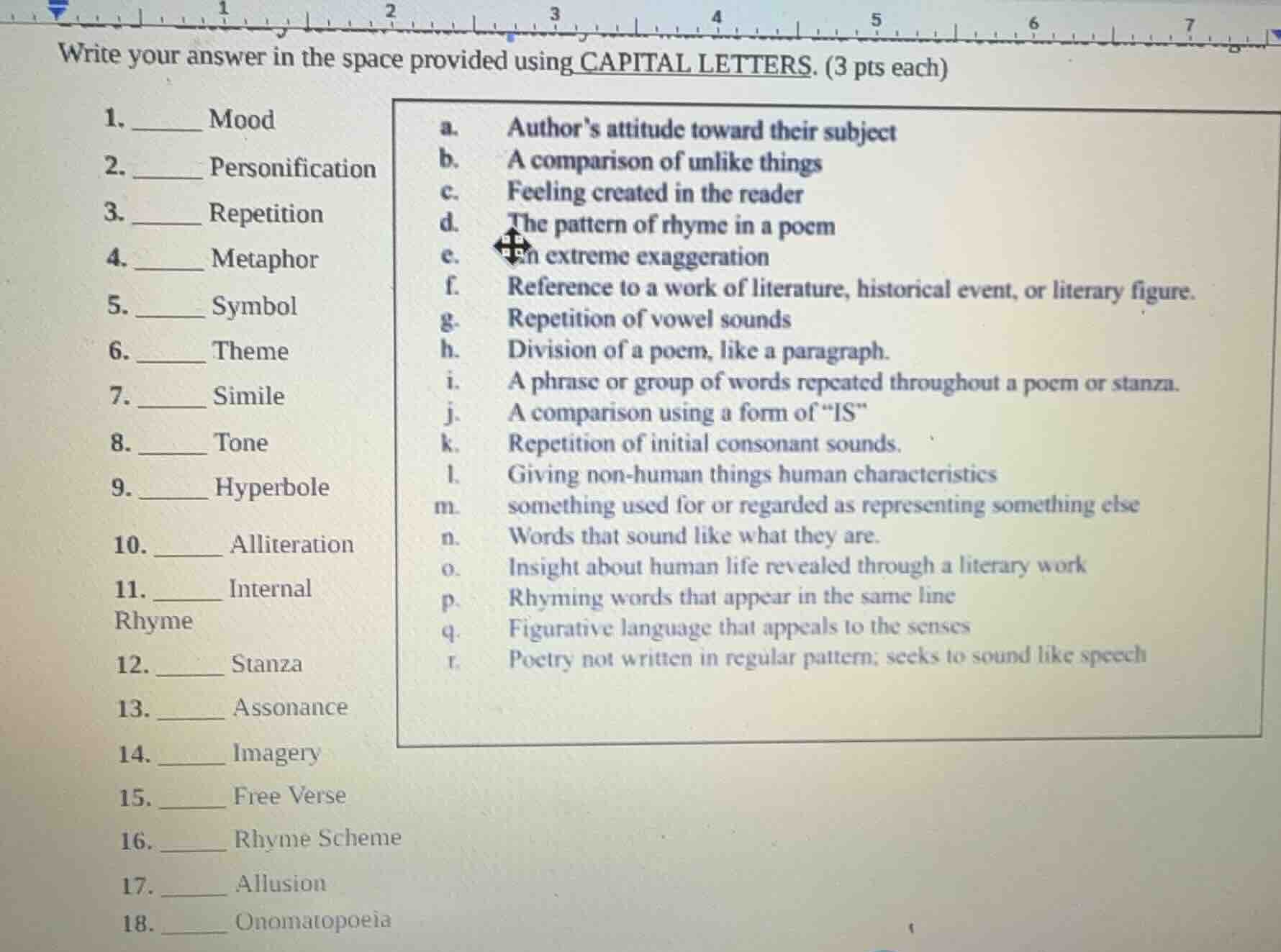
write your answer in the space provided using capital letters. (3 pts each)
- ______ mood
- ______ personification
- ______ repetition
- ______ metaphor
- ______ symbol
- ______ theme
- ______ simile
- ______ tone
- ______ hyperbole
- ______ alliteration
- ______ internal rhyme
- ______ stanza
- ______ assonance
- ______ imagery
- ______ free verse
- ______ rhyme scheme
- ______ allusion
- ______ onomatopoeia
a. author’s attitude toward their subject
b. a comparison of unlike things
c. feeling created in the reader
d. the pattern of rhyme in a poem
e. an extreme exaggeration
f. reference to a work of literature, historical event, or literary figure.
g. repetition of vowel sounds
h. division of a poem, like a paragraph.
i. a phrase or group of words repeated throughout a poem or stanza.
j. a comparison using a form of \is\
k. repetition of initial consonant sounds.
l. giving non - human things human characteristics
m. something used for or regarded as representing something else
n. words that sound like what they are.
o. insight about human life revealed through a literary work
p. rhyming words that appear in the same line
q. figurative language that appeals to the senses
r. poetry not written in regular pattern; seeks to sound like speech
Each literary term is matched to its standard definition from the provided options:
- Mood is the feeling evoked in the reader.
- Personification gives non-human things human traits.
- Repetition is repeating words/phrases in a work.
- Metaphor compares unlike things using "is".
- A Symbol represents something else.
- Theme is a story's insight about human life.
- Simile is a comparison of unlike things.
- Tone is the author's attitude toward their subject.
- Hyperbole is extreme exaggeration.
- Alliteration repeats initial consonant sounds.
- Internal Rhyme has rhyming words in the same line.
- Stanza is a poem's paragraph-like division.
- Assonance repeats vowel sounds.
- Imagery is figurative language appealing to senses.
- Free Verse is poetry without a regular pattern.
- Rhyme Scheme is a poem's rhyme pattern.
- Allusion references a literary/historical work/figure.
- Onomatopoeia uses words that sound like their meaning.

Snap & solve any problem in the app
Get step-by-step solutions on Sovi AI
Photo-based solutions with guided steps
Explore more problems and detailed explanations
- c. Feeling created in the reader
- l. Giving non-human things human characteristics
- i. A phrase or group of words repeated throughout a poem or stanza.
- j. A comparison using a form of "IS"
- m. something used for or regarded as representing something else
- o. Insight about human life revealed through a literary work
- b. A comparison of unlike things
- a. Author's attitude toward their subject
- e. an extreme exaggeration
- k. Repetition of initial consonant sounds.
- p. Rhyming words that appear in the same line
- h. Division of a poem, like a paragraph.
- g. Repetition of vowel sounds
- q. Figurative language that appeals to the senses
- r. Poetry not written in regular pattern; seeks to sound like speech
- d. The pattern of rhyme in a poem
- f. Reference to a work of literature, historical event, or literary figure.
- n. Words that sound like what they are.