QUESTION IMAGE
Question
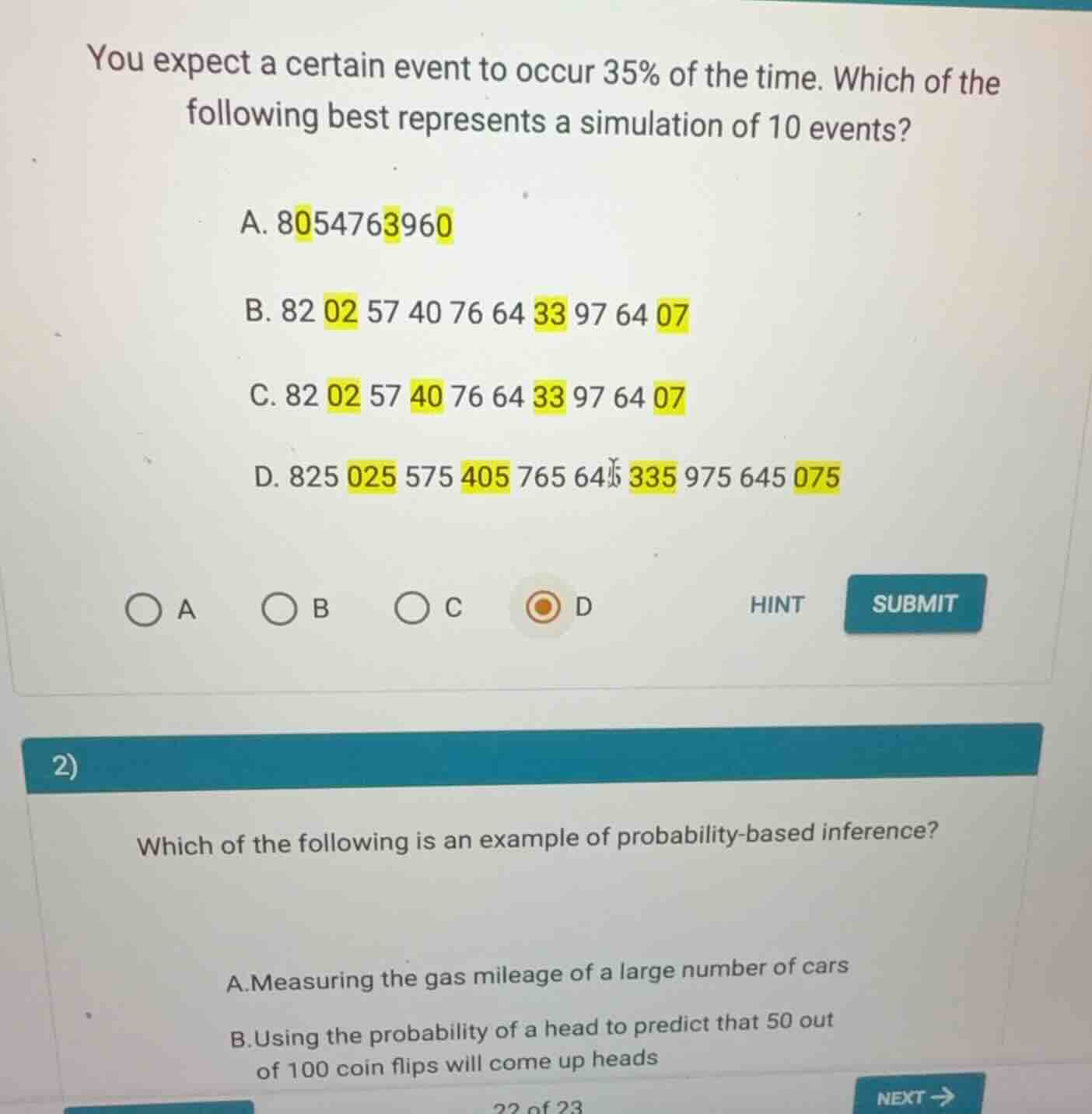
- you expect a certain event to occur 35% of the time. which of the following best represents a simulation of 10 events?
a. 8054763960
b. 82 02 57 40 76 64 33 97 64 07
c. 82 02 57 40 76 64 33 97 64 07
d. 825 025 575 405 765 645 335 975 645 075
- which of the following is an example of probability-based inference?
a.measuring the gas mileage of a large number of cars
b.using the probability of a head to predict that 50 out of 100 coin flips will come up heads
First Question (Simulation of 10 Events)
Step1: Define success range
Since the event occurs 35% of the time, we assign numbers 00-34 as a "success" (event occurs), 35-99 as "failure". We need 10 trials, with ~3-4 successes.
Step2: Analyze Option A
10 single digits; only 0,3 are successes (2 total, too low).
Step3: Analyze Option B
10 two-digit numbers: 02,33,07 are successes (3 total, matches 35% expectation).
Step4: Analyze Option C
10 two-digit numbers: 02,40,33,07 are successes (4 total, 40% close but 3 is closer to 35%).
Step5: Analyze Option D
10 three-digit numbers: 025,405,335,075 are successes (4 total; 405 is >34, incorrectly counted as success).
Probability-based inference uses known probability to make predictions about outcomes. Option A is data collection, not inference. Option B uses the 50% probability of heads to predict the number of heads in 100 flips, which is probability-based inference.

Snap & solve any problem in the app
Get step-by-step solutions on Sovi AI
Photo-based solutions with guided steps
Explore more problems and detailed explanations
B. 82 02 57 40 76 64 33 97 64 07
---