QUESTION IMAGE
Question
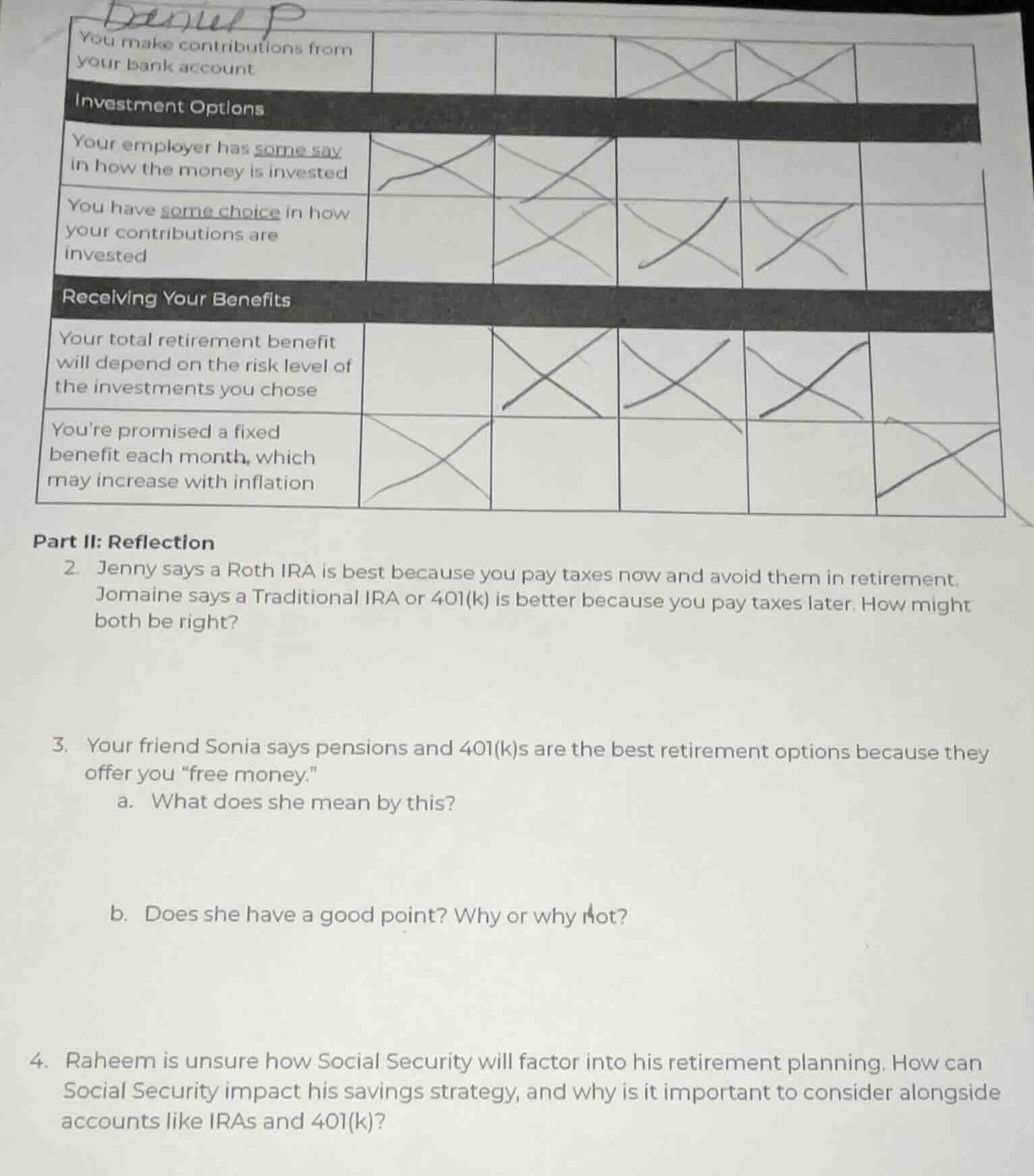
you make contributions from your bank account
investment options
your employer has some say in how the money is invested
you have some choice in how your contributions are invested
receiving your benefits
your total retirement benefit will depend on the risk level of the investments you chose
youre promised a fixed benefit each month, which may increase with inflation
part ii: reflection
- jenny says a roth ira is best because you pay taxes now and avoid them in retirement. jomaine says a traditional ira or 401(k) is better because you pay taxes later. how might both be right?
- your friend sonia says pensions and 401(k)s are the best retirement options because they offer you \free money.\
a. what does she mean by this?
b. does she have a good point? why or why not?
- raheem is unsure how social security will factor into his retirement planning. how can social security impact his savings strategy, and why is it important to consider alongside accounts like iras and 401(k)?
For Question 2:
The validity of each retirement account depends on an individual's current and projected future tax situation. A Roth IRA benefits those who expect to be in a higher tax bracket during retirement, as paying taxes on contributions now avoids higher taxes on withdrawals later. A Traditional IRA/401(k) benefits those who expect to be in a lower tax bracket in retirement, as deducting contributions now reduces current taxable income, and withdrawals are taxed at a lower rate later.
For Question 3a:
"Free money" refers to employer matching contributions. For 401(k)s, many employers match a portion of an employee's contributions (e.g., 50% of the first 6% of salary contributed). Pensions are often fully or partially funded by employers, so the employer-provided portion is essentially "free" retirement income the employee does not have to contribute to directly.
For Question 3b:
She has a good point. Employer matching contributions to 401(k)s are an immediate, risk-free return on investment—declining them means leaving money unclaimed. Employer-funded pensions provide guaranteed retirement income without additional employee costs. However, these options have limitations: 401(k)s have contribution limits and investment risks, and pensions are less common and may have strict eligibility rules.
For Question 4:
Social Security provides a baseline of guaranteed retirement income. If Raheem expects significant Social Security benefits, he may need to save less in IRAs/401(k)s, or he can use those accounts to supplement Social Security for a more comfortable retirement. It is important to consider alongside other accounts because Social Security alone is often not enough to cover all retirement expenses, and combining it with personal retirement savings creates a more stable, diversified income stream. It also helps with tax planning, as Social Security benefits may be taxed differently than withdrawals from IRAs/401(k)s.

Snap & solve any problem in the app
Get step-by-step solutions on Sovi AI
Photo-based solutions with guided steps
Explore more problems and detailed explanations
- Both can be right depending on a person's tax situation: those expecting higher future tax rates benefit from a Roth IRA, while those expecting lower future tax rates benefit from a Traditional IRA/401(k).
3a. "Free money" means employer matching for 401(k)s and employer-funded pension contributions that require no direct employee cost.
3b. She has a good point: employer matches/pensions are essentially unclaimed money with strong benefits, but these options have limits like contribution caps, investment risks, or strict eligibility.
- Social Security provides guaranteed baseline income, allowing Raheem to adjust savings levels in IRAs/401(k)s. It is critical to combine with these accounts because Social Security alone rarely covers all retirement costs, creating a more stable, diversified retirement income stream and supporting better tax planning.