QUESTION IMAGE
Question
a. as you read
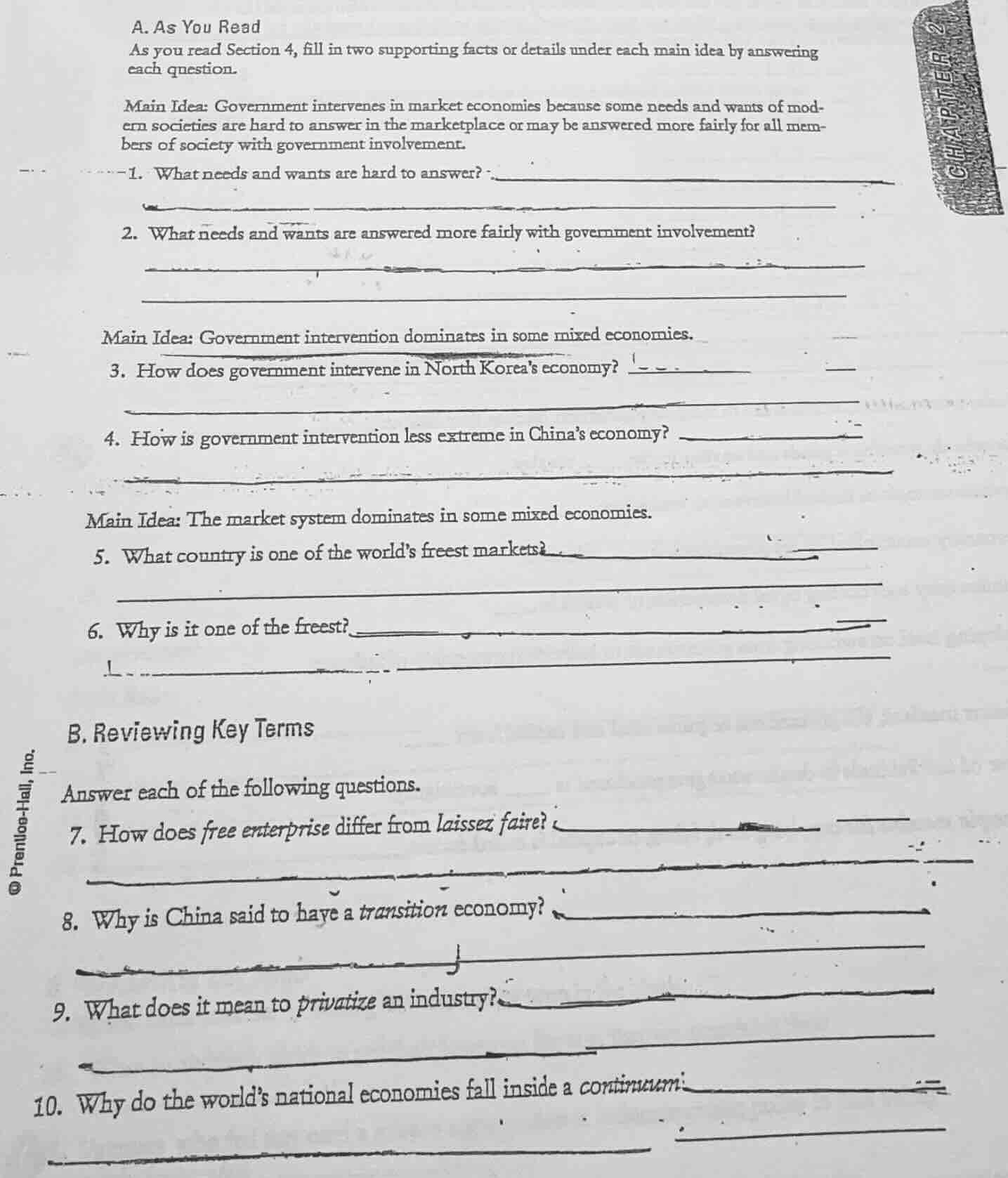
as you read section 4, fill in two supporting facts or details under each main idea by answering
each question.
main idea: government intervenes in market economies because some needs and wants of mod-
ern societies are hard to answer in the marketplace or may be answered more fairly for all mem-
bers of society with government involvement.
- what needs and wants are hard to answer?
- what needs and wants are answered more fairly with government involvement?
main idea: government intervention dominates in some mixed economies.
- how does government intervene in north koreas economy?
- how is government intervention less extreme in chinas economy?
main idea: the market system dominates in some mixed economies.
- what country is one of the worlds freest markets?
- why is it one of the freest?
b. reviewing key terms
answer each of the following questions.
- how does free enterprise differ from laissez faire?
- why is china said to have a transition economy?
- what does it mean to privatize an industry?
- why do the worlds national economies fall inside a continuum
A. As You Read
Main Idea 1: Government intervenes in market economies...
- What needs and wants are hard to answer?
- Public goods (e.g., national defense, street lighting) as private firms may not provide them due to free - rider problems.
- Merit goods (e.g., basic education, healthcare) where market may under - provide as people may not fully recognize their long - term benefits.
- What needs and wants are answered more fairly with government involvement?
- Income redistribution (ensuring a more equitable distribution of income through taxes and welfare programs).
- Provision of public services like universal healthcare or public education to ensure access for all, regardless of income.
Main Idea 2: Government intervention dominates in some mixed economies.
- How does government intervene in North Korea’s economy?
- North Korea has a command economy where the government owns and controls most means of production. It plans production, sets prices, and allocates resources centrally, with little private enterprise.
- How is government intervention less extreme in China’s economy?
- China has a socialist market economy. While the government still plays a significant role (e.g., in strategic industries and macro - economic planning), there is a large private sector. Market forces are allowed to operate in many sectors, and there is more foreign investment and private entrepreneurship compared to North Korea.
Main Idea 3: The market system dominates in some mixed economies.
- What country is one of the world’s freest markets?
- Hong Kong (a special administrative region of China) or Singapore are often considered among the world’s freest markets.
- Why is it one of the freest?
- Low levels of government regulation, low tax rates, free trade policies, and a high degree of property rights protection, which encourage business activity and competition.
B. Reviewing Key Terms
- How does free enterprise differ from laissez faire?
- Free enterprise allows for some government intervention (e.g., enforcing contracts, protecting property rights) while laissez faire advocates for minimal to no government intervention in the economy, with the market operating completely freely.
- Why is China said to have a transition economy?
- China is transitioning from a centrally - planned (command) economy to a market - oriented economy. It is introducing more market mechanisms, privatizing some state - owned enterprises, and allowing more private sector participation while still maintaining some state control in key areas.
- What does it mean to privatize an industry?
- Privatization is the transfer of ownership and control of a state - owned or public - sector industry to the private sector. This means that private companies take over the production, management, and profit - seeking activities of the industry, with the aim of increasing efficiency and competitiveness.
- Why do the world’s national economies fall inside a continuum?
- National economies range from pure command economies (with maximum government control) to pure market economies (with minimum government control). Most economies are mixed, with different degrees of government intervention and market freedom. So they lie along a continuum between these two extremes, with variations in the balance of market forces and government involvement.

Snap & solve any problem in the app
Get step-by-step solutions on Sovi AI
Photo-based solutions with guided steps
Explore more problems and detailed explanations
s (for the fill - in - the - blank style questions):
- Public goods (e.g., national defense), merit goods (e.g., basic education)
- Income redistribution, universal healthcare/education provision
- Government owns/controls most production, central planning
- Large private sector, market forces in many sectors
- Hong Kong (or Singapore)
- Low regulation, free trade, strong property rights
- Free enterprise allows some government intervention; laissez faire advocates no/little
- Transition from command to market - oriented economy
- Transfer state - owned industry to private sector
- Economies vary in government - market balance (from command to market)