QUESTION IMAGE
Question
do you understand?
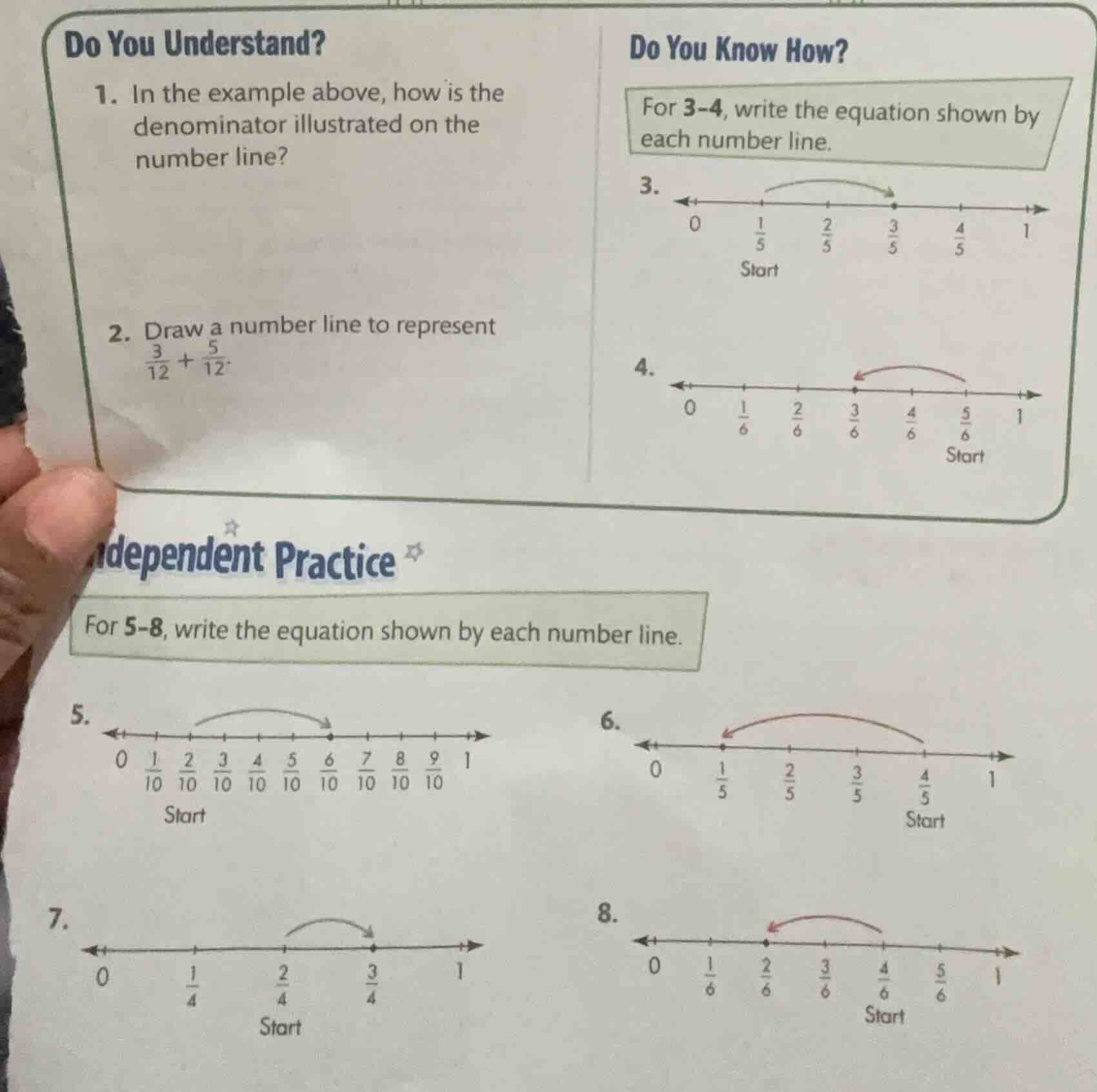
- in the example above, how is the denominator illustrated on the number line?
- draw a number line to represent \\(\frac{3}{12} + \frac{5}{12}\\).
do you know how?
for 3-4, write the equation shown by each number line.
- number line with 0, \\(\frac{1}{5}\\), \\(\frac{2}{5}\\), \\(\frac{3}{5}\\), \\(\frac{4}{5}\\), 1; start at \\(\frac{1}{5}\\), arrow to \\(\frac{3}{5}\\)
- number line with 0, \\(\frac{1}{6}\\), \\(\frac{2}{6}\\), \\(\frac{3}{6}\\), \\(\frac{4}{6}\\), \\(\frac{5}{6}\\), 1; start at \\(\frac{5}{6}\\), arrow to \\(\frac{3}{6}\\)
independent practice
for 5-8, write the equation shown by each number line.
- number line with 0, \\(\frac{1}{10}\\), \\(\frac{2}{10}\\), \\(\frac{3}{10}\\), \\(\frac{4}{10}\\), \\(\frac{5}{10}\\), \\(\frac{6}{10}\\), \\(\frac{7}{10}\\), \\(\frac{8}{10}\\), \\(\frac{9}{10}\\), 1; start at \\(\frac{2}{10}\\), arrow to \\(\frac{6}{10}\\)
- number line with 0, \\(\frac{1}{5}\\), \\(\frac{2}{5}\\), \\(\frac{3}{5}\\), \\(\frac{4}{5}\\), 1; start at \\(\frac{4}{5}\\), arrow to \\(\frac{1}{5}\\)
- number line with 0, \\(\frac{1}{4}\\), \\(\frac{2}{4}\\), \\(\frac{3}{4}\\), 1; start at \\(\frac{2}{4}\\), arrow to \\(\frac{3}{4}\\)
- number line with 0, \\(\frac{1}{6}\\), \\(\frac{2}{6}\\), \\(\frac{3}{6}\\), \\(\frac{4}{6}\\), \\(\frac{5}{6}\\), 1; start at \\(\frac{4}{6}\\), arrow to \\(\frac{2}{6}\\)
Question 3
Step1: Identify start and end points
The start point is $\frac{1}{5}$, and the end point is $\frac{3}{5}$. The number of intervals between them is $2$ (since $\frac{3}{5}-\frac{1}{5}=\frac{2}{5}$, and each interval is $\frac{1}{5}$). So the equation is the start value plus the difference.
Step2: Write the equation
The start is $\frac{1}{5}$, and we add $\frac{2}{5}$ (because $\frac{3}{5}-\frac{1}{5}=\frac{2}{5}$) to get $\frac{3}{5}$. So the equation is $\frac{1}{5}+\frac{2}{5}=\frac{3}{5}$.
Step1: Identify start and end points
The start point is $\frac{5}{6}$, and the end point is $\frac{3}{6}$. The difference is $\frac{5}{6}-\frac{3}{6}=\frac{2}{6}$. So it's a subtraction: start minus the difference.
Step2: Write the equation
The start is $\frac{5}{6}$, and we subtract $\frac{2}{6}$ to get $\frac{3}{6}$. So the equation is $\frac{5}{6}-\frac{2}{6}=\frac{3}{6}$.
Step1: Identify start and end points
The start point is $\frac{2}{10}$, and the end point is $\frac{6}{10}$. The difference is $\frac{6}{10}-\frac{2}{10}=\frac{4}{10}$. So it's addition: start plus the difference.
Step2: Write the equation
The start is $\frac{2}{10}$, add $\frac{4}{10}$ to get $\frac{6}{10}$. So the equation is $\frac{2}{10}+\frac{4}{10}=\frac{6}{10}$.

Snap & solve any problem in the app
Get step-by-step solutions on Sovi AI
Photo-based solutions with guided steps
Explore more problems and detailed explanations
$\frac{1}{5}+\frac{2}{5}=\frac{3}{5}$