QUESTION IMAGE
Question
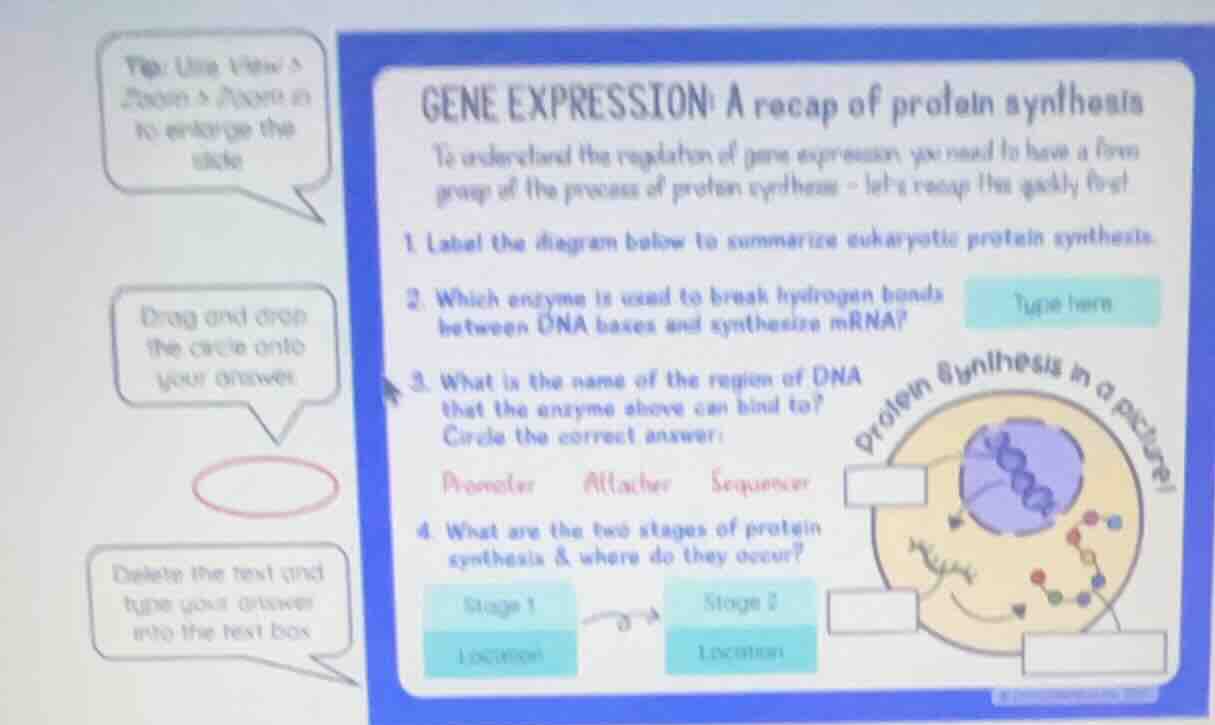
gene expression: a recap of protein synthesis
to understand the regulation of gene expression, you need to have a firm grasp of the process of protein synthesis - lets recap this quickly first!
- label the diagram below to summarize eukaryotic protein synthesis.
- which enzyme is used to break hydrogen bonds between dna bases and synthesize mrna?
type here
- what is the name of the region of dna that the enzyme above can bind to?
circle the correct answer:
promoter attacher sequencer
- what are the two stages of protein synthesis & where do they occur?
stage 1
location
stage 2
location
tip: use view > zoom > zoom in to enlarge the slide
drag and drop the circle onto your answer
delete the text and type your answer into the text box
Brief Explanations
- For the eukaryotic protein synthesis diagram: The top box (nucleus) is Transcription, the middle box (cytoplasm/ribosome area) is Translation, the bottom box is Protein (polypeptide chain).
- The enzyme that breaks DNA hydrogen bonds and synthesizes mRNA is RNA polymerase, as it carries out transcription.
- RNA polymerase binds to the promoter region of DNA, which is the correct regulatory sequence.
- Protein synthesis has two core stages: transcription occurs in the nucleus (eukaryotes), and translation occurs in the cytoplasm at ribosomes.

Snap & solve any problem in the app
Get step-by-step solutions on Sovi AI
Photo-based solutions with guided steps
Explore more problems and detailed explanations
- Diagram labels (top to bottom):
- Top box: Transcription
- Middle box: Translation
- Bottom box: Protein (polypeptide chain)
- RNA polymerase
- Promoter
- Stage 1: Transcription; Location: Nucleus
Stage 2: Translation; Location: Cytoplasm (at ribosomes)