QUESTION IMAGE
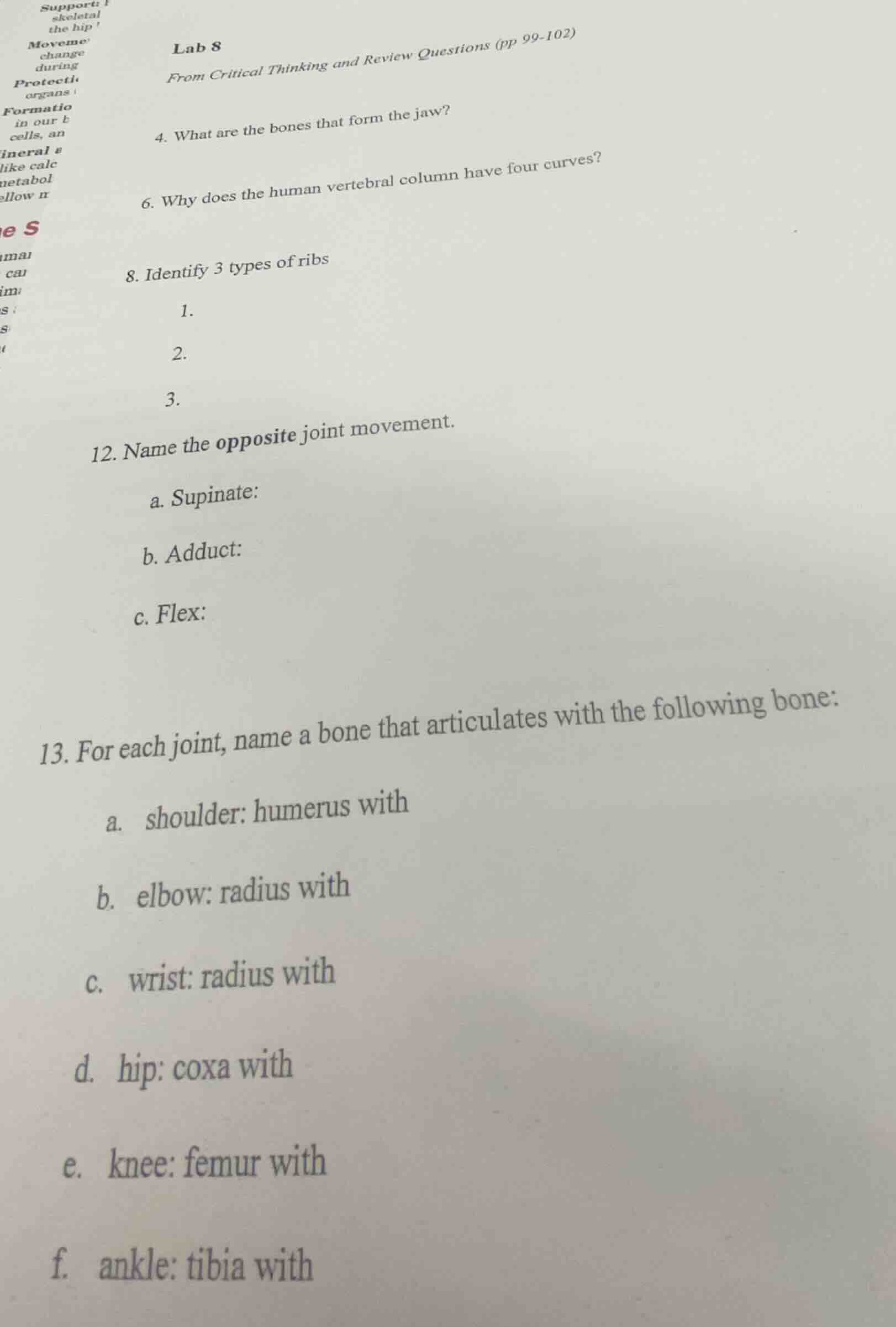
Question
lab 8
from critical thinking and review questions (pp 99-102)
- what are the bones that form the jaw?
- why does the human vertebral column have four curves?
- identify 3 types of ribs
1.
2.
3.
- name the opposite joint movement.
a. supinate:
b. adduct:
c. flex:
- for each joint, name a bone that articulates with the following bone:
a. shoulder: humerus with
b. elbow: radius with
c. wrist: radius with
d. hip: coxa with
e. knee: femur with
f. ankle: tibia with
Brief Explanations
- Question 4: The jaw is formed by two main bones: one fixed bone of the skull and one movable lower bone.
- Question 6: The curves of the vertebral column serve to absorb shock, support the body's weight, and maintain upright posture.
- Question 8: Ribs are classified based on their connection to the sternum.
- Question 12: Joint movements have direct anatomical opposites defined by direction and motion.
- Question 13: Each listed bone articulates with a specific corresponding bone at its named joint, based on human skeletal anatomy.

Snap & solve any problem in the app
Get step-by-step solutions on Sovi AI
Photo-based solutions with guided steps
Explore more problems and detailed explanations
- The mandible (lower jaw) and the maxilla (upper jaw, part of the facial skeleton) form the jaw.
- The four curves of the human vertebral column help absorb shock, distribute the weight of the upper body, and maintain balance for upright posture.
- 1. True (vertebrosternal) ribs
- False (vertebrochondral) ribs
- Floating (vertebral) ribs
- a. Supinate: Pronate
b. Adduct: Abduct
c. Flex: Extend
- a. shoulder: humerus with scapula (or clavicle)
b. elbow: radius with humerus (or ulna)
c. wrist: radius with scaphoid (or lunate)
d. hip: coxa with femur
e. knee: femur with tibia (or patella)
f. ankle: tibia with talus