QUESTION IMAGE
Question
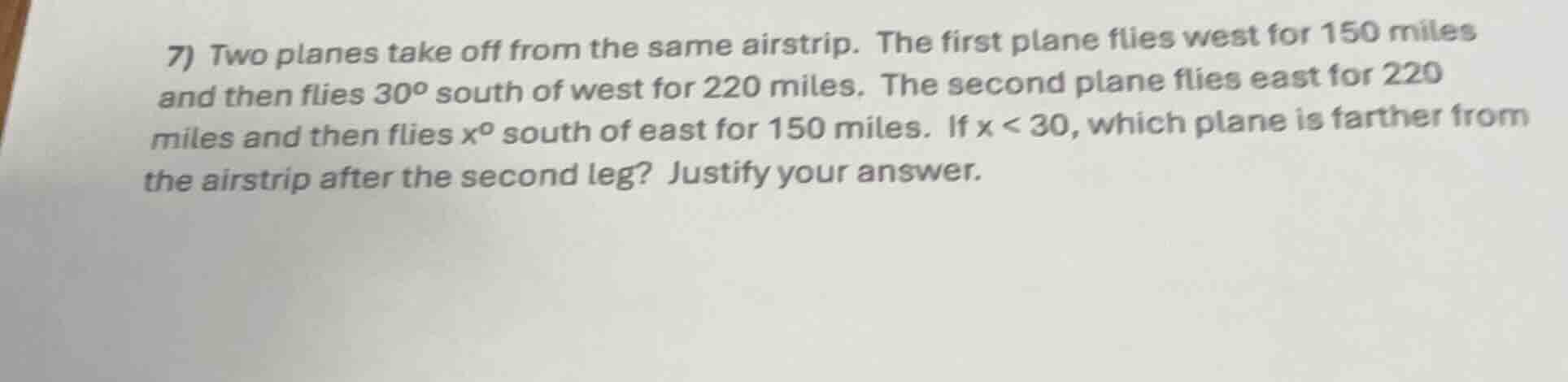
- two planes take off from the same airstrip. the first plane flies west for 150 miles and then flies 30° south of west for 220 miles. the second plane flies east for 220 miles and then flies ( x^circ ) south of east for 150 miles. if ( x < 30 ), which plane is farther from the airstrip after the second leg? justify your answer.
Step1: Define displacement vectors for Plane 1
Let the airstrip be at the origin. West is $-x$ direction, South is $-y$ direction.
First leg: $\vec{v_1} = \langle -150, 0
angle$
Second leg: $220$ miles at $30^\circ$ south of west:
$\vec{v_2} = \langle -220\cos30^\circ, -220\sin30^\circ
angle$
Total displacement $\vec{D_1} = \vec{v_1}+\vec{v_2} = \langle -150 - 220\cos30^\circ, 0 - 220\sin30^\circ
angle$
Step2: Calculate magnitude for Plane 1
Use distance formula $|\vec{D}| = \sqrt{D_x^2 + D_y^2}$:
(Used $\cos^2\theta+\sin^2\theta=1$)
Step3: Define displacement vectors for Plane 2
First leg: $\vec{u_1} = \langle 220, 0
angle$
Second leg: $150$ miles at $x^\circ$ south of east:
$\vec{u_2} = \langle 150\cos x^\circ, -150\sin x^\circ
angle$
Total displacement $\vec{D_2} = \vec{u_1}+\vec{u_2} = \langle 220 + 150\cos x^\circ, 0 - 150\sin x^\circ
angle$
Step4: Calculate magnitude for Plane 2
Step5: Compare the two magnitudes
The only differing term is $\cos30^\circ$ vs $\cos x^\circ$. Since $x<30^\circ$, and $\cos\theta$ decreases as $\theta$ increases in $0^\circ$ to $90^\circ$, so $\cos x^\circ > \cos30^\circ$.
Thus $|\vec{D_2}| > |\vec{D_1}|$.

Snap & solve any problem in the app
Get step-by-step solutions on Sovi AI
Photo-based solutions with guided steps
Explore more problems and detailed explanations
The second plane is farther from the airstrip.