QUESTION IMAGE
Question
- why does the chromatin condense during prophase?
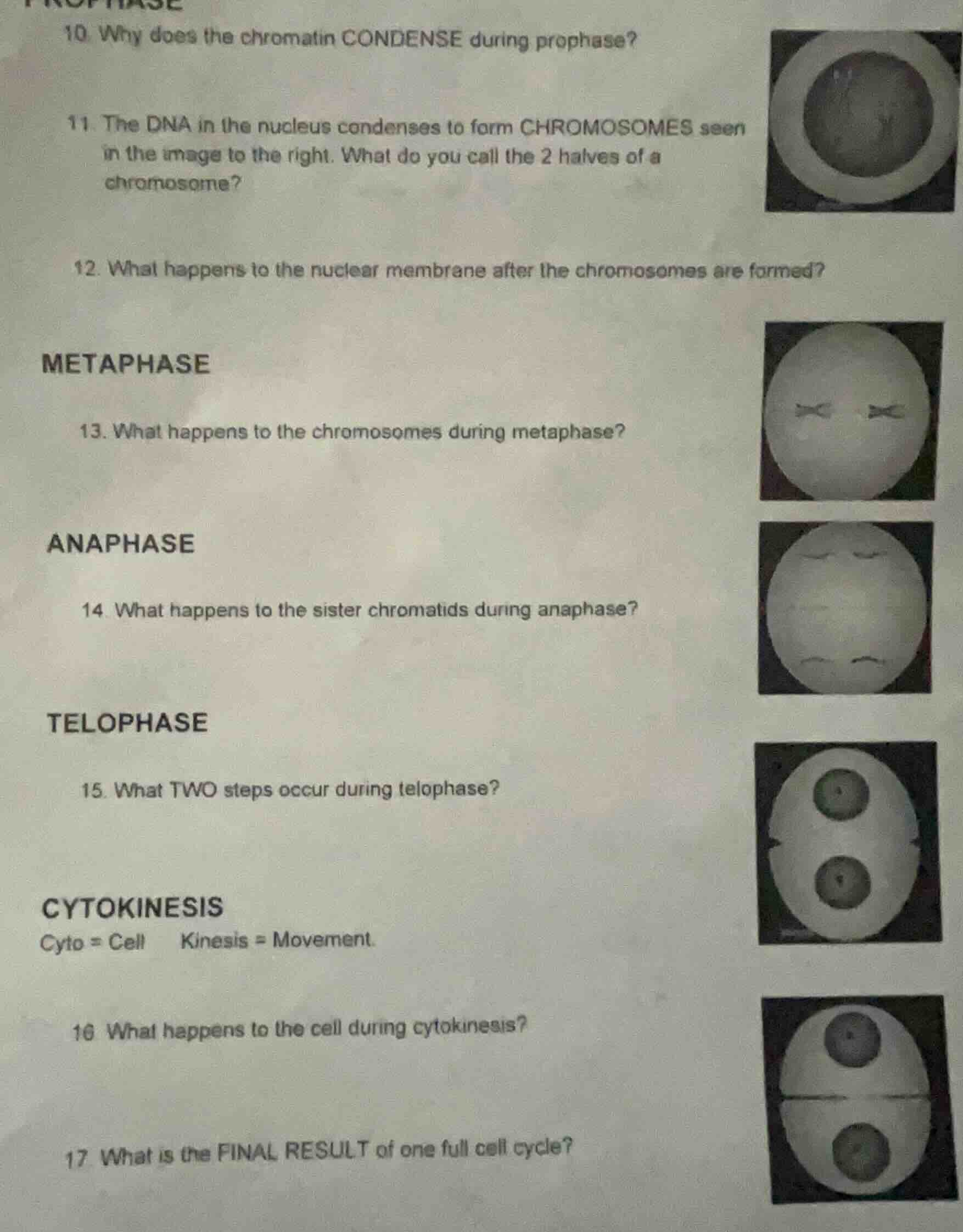
- the dna in the nucleus condenses to form chromosomes seen in the image to the right. what do you call the 2 halves of a chromosome?
- what happens to the nuclear membrane after the chromosomes are formed?
metaphase
- what happens to the chromosomes during metaphase?
anaphase
- what happens to the sister chromatids during anaphase?
telophase
- what two steps occur during telophase?
cytokinesis
cyto = cell kinesis = movement.
16 what happens to the cell during cytokinesis?
- what is the final result of one full cell cycle?
Brief Explanations
- Chromatin condenses to compact DNA into manageable structures, preventing tangling during cell division and enabling proper separation of genetic material.
- The two identical halves of a replicated chromosome are defined as sister chromatids.
- After chromosome formation, the nuclear membrane breaks down to allow spindle fibers access to the chromosomes.
- In metaphase, chromosomes align at the cell's central plane (metaphase plate) to prepare for separation.
- During anaphase, sister chromatids are pulled apart by spindle fibers and move to opposite poles of the cell.
- Telophase involves two key steps: chromosomes decondense back into chromatin, and a new nuclear membrane forms around each set of chromosomes at opposite poles.
- During cytokinesis, the cytoplasm of the parent cell divides, splitting the cell into two distinct daughter cells.
- One full cell cycle produces two genetically identical daughter cells, each with the same number of chromosomes as the original parent cell.

Snap & solve any problem in the app
Get step-by-step solutions on Sovi AI
Photo-based solutions with guided steps
Explore more problems and detailed explanations
- To avoid DNA tangling and enable proper chromosome separation during cell division.
- Sister chromatids
- It breaks down (disassembles).
- They align at the cell's metaphase plate (central equator).
- They are pulled apart and move to opposite cell poles.
- 1. Chromosomes decondense into chromatin; 2. New nuclear membranes form around each chromosome set.
- The cell's cytoplasm divides to form two separate daughter cells.
- Two genetically identical daughter cells (each with the same chromosome number as the parent cell).