QUESTION IMAGE
Question
10th gr q3 documents
president woodrow wilson’s fourteen points
january 8, 1918
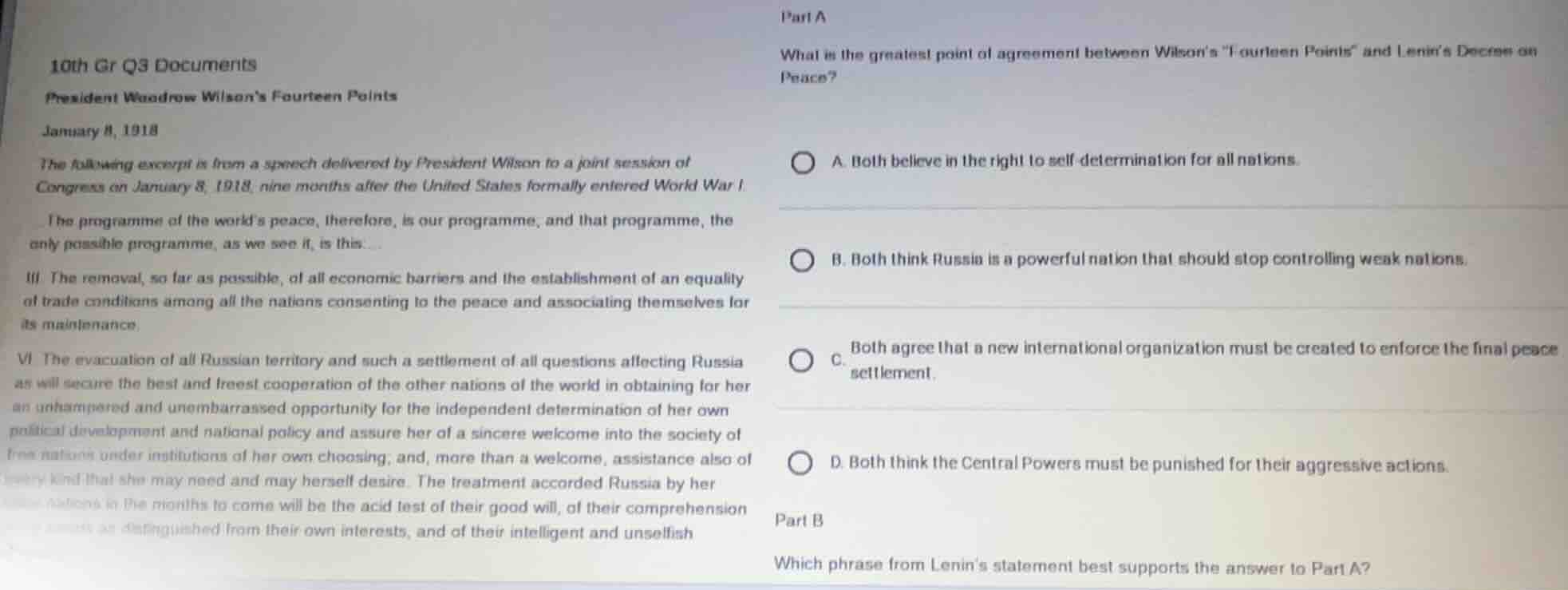
the following excerpt is from a speech delivered by president wilson to a joint session of
congress on january 8, 1918, nine months after the united states formally entered world war i.
the programme of the world’s peace, therefore, is our programme, and that programme, the
only possible programme, as we see it, is this...
iii. the removal, so far as possible, of all economic barriers and the establishment of an equality
of trade conditions among all the nations consenting to the peace and associating themselves for
its maintenance.
vi. the evacuation of all russian territory and such a settlement of all questions affecting russia
as will secure the best and freest cooperation of the other nations of the world in obtaining for her
an unhampered and unembarrassed opportunity for the independent determination of her own
political development and national policy and assure her of a sincere welcome into the society of
free nations under institutions of her own choosing, and, more than a welcome, assistance also of
every kind that she may need and may herself desire. the treatment accorded russia by her
sister nations in the months to come will be the acid test of their good will, of their comprehension
as distinguished from their own interests, and of their intelligent and unselfish
part a
what is the greatest point of agreement between wilson’s “fourteen points” and lenin’s decree on
peace?
a. both believe in the right to self - determination for all nations.
b. both think russia is a powerful nation that should stop controlling weak nations.
c. both agree that a new international organization must be created to enforce the final peace
settlement.
d. both think the central powers must be punished for their aggressive actions.
part b
which phrase from lenin’s statement best supports the answer to part a?
Part A
- Analyze Option A: Wilson's Fourteen Points (especially point VI about Russia's self - determination) and Lenin's Decree on Peace both emphasized the right of nations to self - determination.
- Analyze Option B: There is no indication in Wilson's Fourteen Points or typical understanding of Lenin's Decree on Peace that they focus on Russia controlling weak nations.
- Analyze Option C: Lenin's Decree on Peace did not emphasize creating a new international organization to enforce peace, while Wilson's Fourteen Points led to the League of Nations, but this was not a point of agreement with Lenin.
- Analyze Option D: Lenin's Decree on Peace was more about ending the war and self - determination, not punishing the Central Powers (Wilson's Fourteen Points also had a more conciliatory approach towards the Central Powers in terms of not overly punitive).
To support the answer in Part A (self - determination), we need to find a phrase in Lenin's statement that talks about the right of nations to decide their own political, economic, or social paths (self - determination).

Snap & solve any problem in the app
Get step-by-step solutions on Sovi AI
Photo-based solutions with guided steps
Explore more problems and detailed explanations
A. Both believe in the right to self - determination for all nations.
Part B
(Note: Since the text of Lenin's statement is not fully provided, we can only give a general approach. Assuming Lenin's Decree on Peace has phrases related to national self - determination like "the right of all peoples to self - determination" or similar. For example, if Lenin's statement has a phrase like "the right of every people to self - determination" or "nations' right to determine their own fate", that phrase would support the answer in Part A. But with the given information, we can't provide the exact phrase, but the reasoning is that the phrase should relate to national self - determination to support Part A's answer about self - determination agreement.)