QUESTION IMAGE
Question
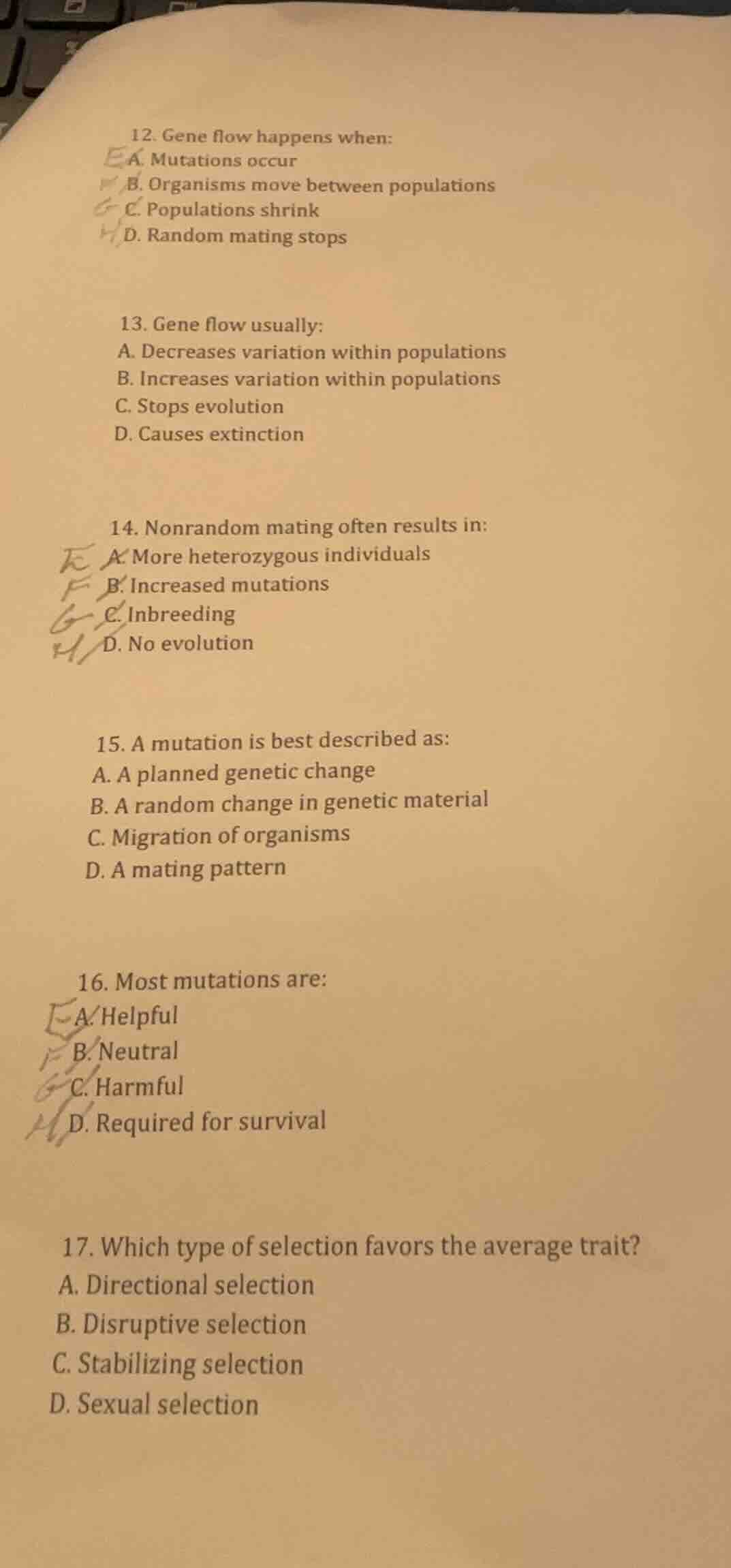
- gene flow happens when:
a. mutations occur
b. organisms move between populations
c. populations shrink
d. random mating stops
- gene flow usually:
a. decreases variation within populations
b. increases variation within populations
c. stops evolution
d. causes extinction
- nonrandom mating often results in:
a. more heterozygous individuals
b. increased mutations
c. inbreeding
d. no evolution
- a mutation is best described as:
a. a planned genetic change
b. a random change in genetic material
c. migration of organisms
d. a mating pattern
- most mutations are:
a. helpful
b. neutral
c. harmful
d. required for survival
- which type of selection favors the average trait?
a. directional selection
b. disruptive selection
c. stabilizing selection
d. sexual selection
Brief Explanations
- Gene flow is defined as the transfer of genetic material between populations, which occurs when organisms move between them.
- By introducing new genetic material from other populations, gene flow adds genetic diversity, increasing variation within a population.
- Nonrandom mating includes mating between closely related individuals, which is inbreeding; it leads to more homozygous, not heterozygous, individuals, does not increase mutations, and can drive evolution.
- Mutations are unplanned, random alterations in an organism's DNA (genetic material), unrelated to migration or mating patterns.
- Most mutations have no significant effect on an organism's fitness, meaning they are neutral; beneficial and harmful mutations are less common.
- Stabilizing selection eliminates extreme trait variations, favoring the average, most common trait in a population.

Snap & solve any problem in the app
Get step-by-step solutions on Sovi AI
Photo-based solutions with guided steps
Explore more problems and detailed explanations
- B. Organisms move between populations
- B. Increases variation within populations
- C. Inbreeding
- B. A random change in genetic material
- B. Neutral
- C. Stabilizing selection