QUESTION IMAGE
Question
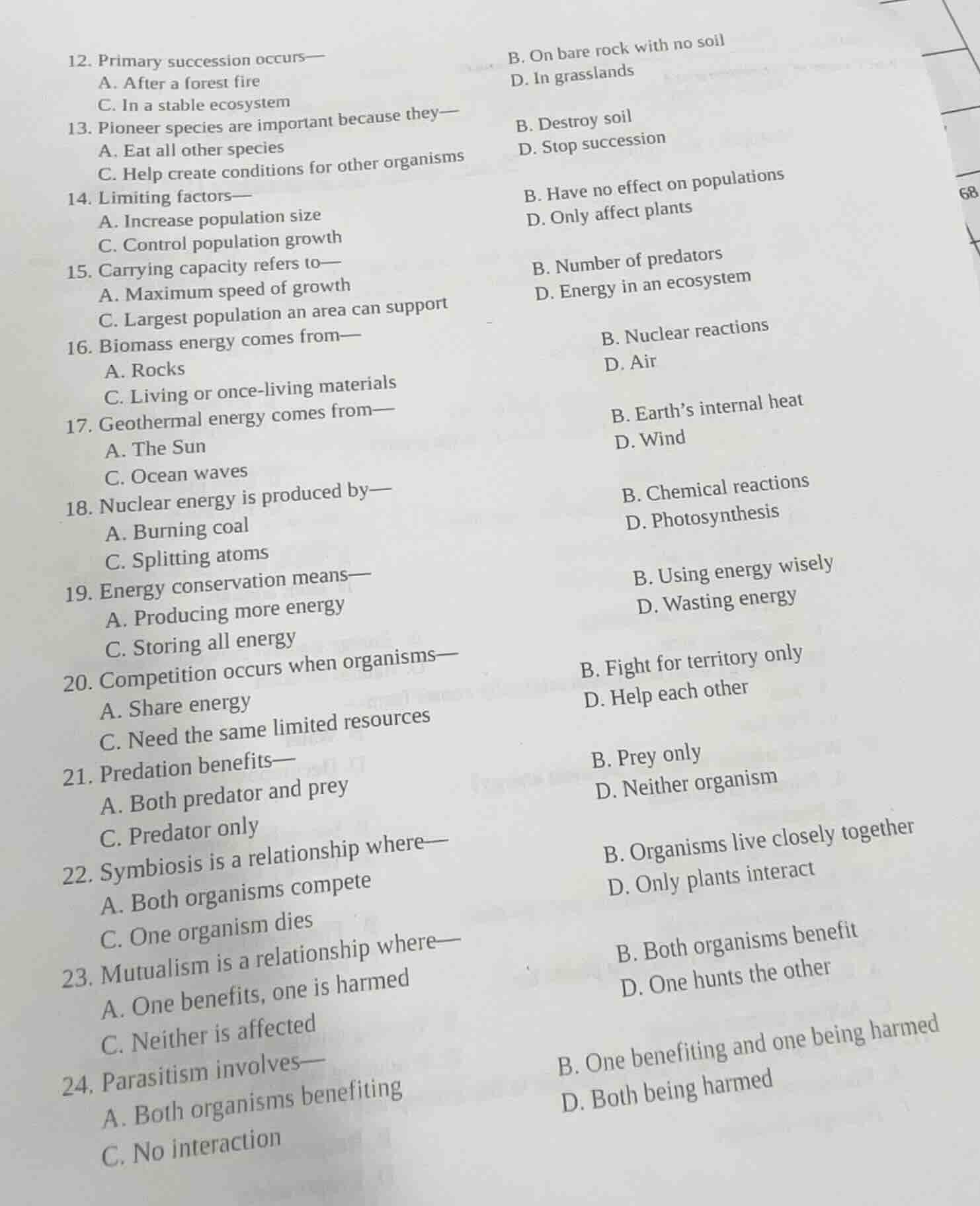
- primary succession occurs—
a. after a forest fire
c. in a stable ecosystem
b. on bare rock with no soil
d. in grasslands
- pioneer species are important because they—
a. eat all other species
c. help create conditions for other organisms
b. destroy soil
d. stop succession
- limiting factors—
a. increase population size
c. control population growth
b. have no effect on populations
d. only affect plants
- carrying capacity refers to—
a. maximum speed of growth
c. largest population an area can support
b. number of predators
d. energy in an ecosystem
- biomass energy comes from—
a. rocks
c. living or once - living materials
b. nuclear reactions
d. air
- geothermal energy comes from—
a. the sun
c. ocean waves
b. earth’s internal heat
d. wind
- nuclear energy is produced by—
a. burning coal
c. splitting atoms
b. chemical reactions
d. photosynthesis
- energy conservation means—
a. producing more energy
c. storing all energy
b. using energy wisely
d. wasting energy
- competition occurs when organisms—
a. share energy
c. need the same limited resources
b. fight for territory only
d. help each other
- predation benefits—
a. both predator and prey
c. predator only
b. prey only
d. neither organism
- symbiosis is a relationship where—
a. both organisms compete
c. one organism dies
b. organisms live closely together
d. only plants interact
- mutualism is a relationship where—
a. one benefits, one is harmed
c. neither is affected
b. both organisms benefit
d. one hunts the other
- parasitism involves—
a. both organisms benefiting
c. no interaction
b. one benefiting and one being harmed
d. both being harmed
Question 12
Primary succession starts on bare rock or other areas with no soil (e.g., after a glacier retreats). A forest fire leads to secondary succession (soil remains). Stable ecosystems have no succession, and grasslands are established ecosystems. So primary succession occurs on bare rock with no soil.
Pioneer species (like lichens) break down rock, add organic matter, and create soil/conditions for other organisms. They don’t eat all species, destroy soil, or stop succession.
Limiting factors (e.g., food, space) control population growth by restricting how large a population can get. They don’t increase population size, have no effect, or only affect plants.

Snap & solve any problem in the app
Get step-by-step solutions on Sovi AI
Photo-based solutions with guided steps
Explore more problems and detailed explanations
B. On bare rock with no soil