QUESTION IMAGE
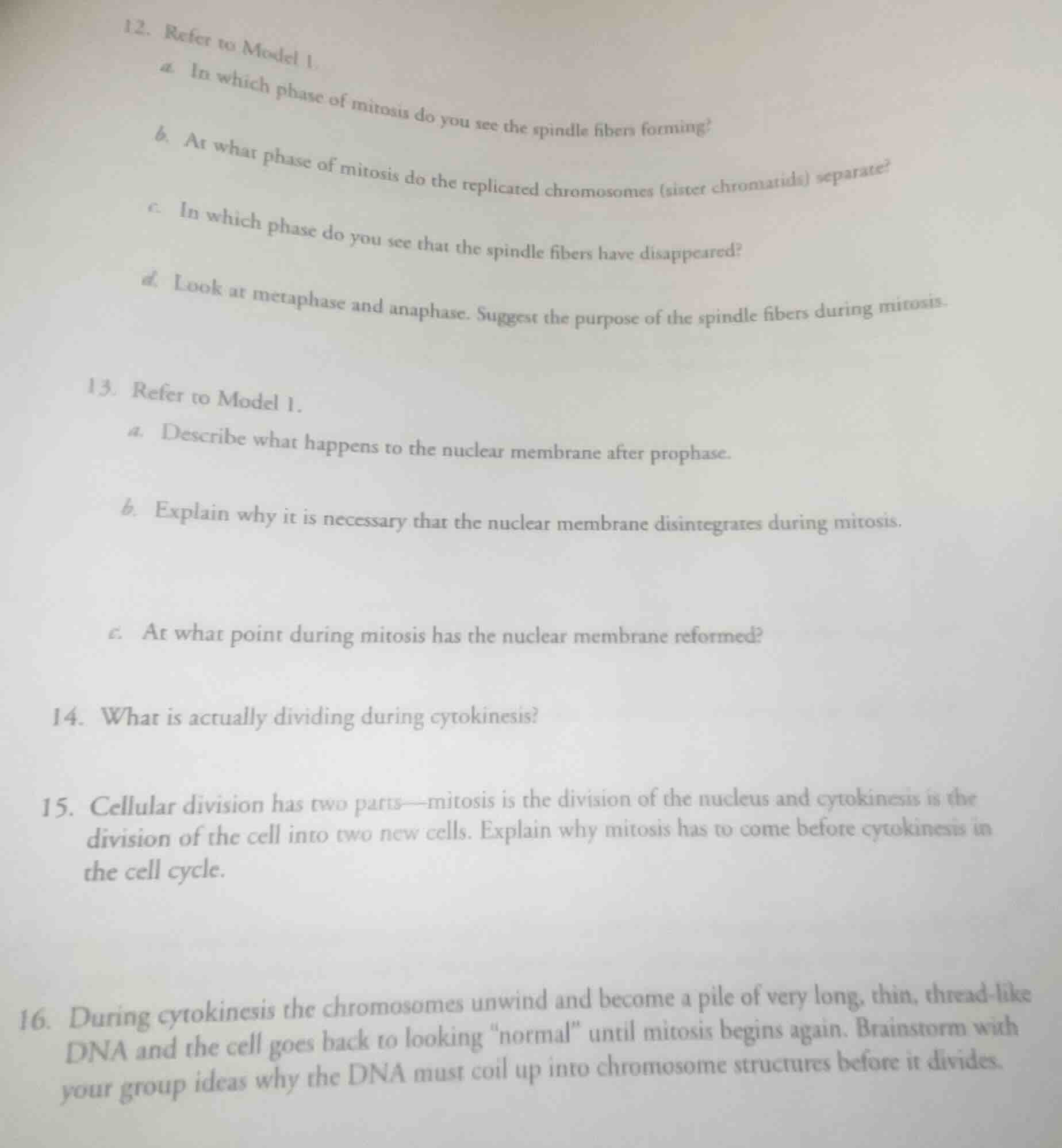
Question
- refer to model 1.
a. in which phase of mitosis do you see the spindle fibers forming?
b. at what phase of mitosis do the replicated chromosomes (sister chromatids) separate?
c. in which phase do you see that the spindle fibers have disappeared?
d. look at metaphase and anaphase. suggest the purpose of the spindle fibers during mitosis.
- refer to model 1.
a. describe what happens to the nuclear membrane after prophase.
b. explain why it is necessary that the nuclear membrane disintegrates during mitosis.
c. at what point during mitosis has the nuclear membrane reformed?
- what is actually dividing during cytokinesis?
- cellular division has two parts—mitosis is the division of the nucleus and cytokinesis is the division of the cell into two new cells. explain why mitosis has to come before cytokinesis in the cell cycle.
- during cytokinesis the chromosomes unwind and become a pile of very long, thin, thread - like dna and the cell goes back to looking
ormal\ until mitosis begins again. brainstorm with your group ideas why the dna must coil up into chromosome structures before it divides.
For Question 12:
a. Spindle fibers form early in mitosis as the cell prepares chromosome movement.
b. Sister chromatids separate when spindle fibers pull them apart.
c. Spindle fibers break down as mitosis concludes and the cell resets.
d. Spindle fibers align chromosomes then pull chromatids apart to ensure even distribution.
For Question 13:
a. The nuclear membrane breaks down after prophase to allow spindle access.
b. Disintegration removes a barrier for spindle-chromosome interaction.
c. The nuclear membrane reforms as new nuclei form around separated chromosomes.
For Question 14:
Cytokinesis splits the cell's cytoplasm and organelles, not the nucleus.
For Question 15:
Mitosis ensures identical genetic material in each new nucleus first, so cytokinesis produces two genetically identical cells.
For Question 16:
Coiled chromosomes prevent tangling, make separation easier, and ensure equal genetic distribution during division.

Snap & solve any problem in the app
Get step-by-step solutions on Sovi AI
Photo-based solutions with guided steps
Explore more problems and detailed explanations
12.
a. Prophase
b. Anaphase
c. Telophase
d. Spindle fibers align chromosomes at the cell's equator during metaphase, then pull sister chromatids apart to opposite poles during anaphase, ensuring each new cell receives an identical set of chromosomes.
13.
a. The nuclear membrane disintegrates (breaks down) after prophase.
b. The disintegration allows spindle fibers to access and attach to the chromosomes, which is necessary for moving the chromosomes during mitosis.
c. Telophase (as the two new daughter nuclei form)
- The cytoplasm (along with the cell's organelles and cell membrane) is actually dividing during cytokinesis.
- Mitosis must come before cytokinesis because mitosis evenly divides the cell's genetic material (chromosomes) into two identical nuclei. If cytokinesis happened first, the genetic material would not be properly distributed, and the resulting cells would not have the correct set of chromosomes.
- DNA coils into chromosomes before division for several reasons:
- It prevents the long, thin DNA strands from tangling, which would make accurate separation impossible.
- The condensed chromosome structure makes it easier for spindle fibers to attach and pull the genetic material apart evenly.
- It ensures that each new cell receives the exact same number and type of genetic segments without breakage or loss of DNA.